
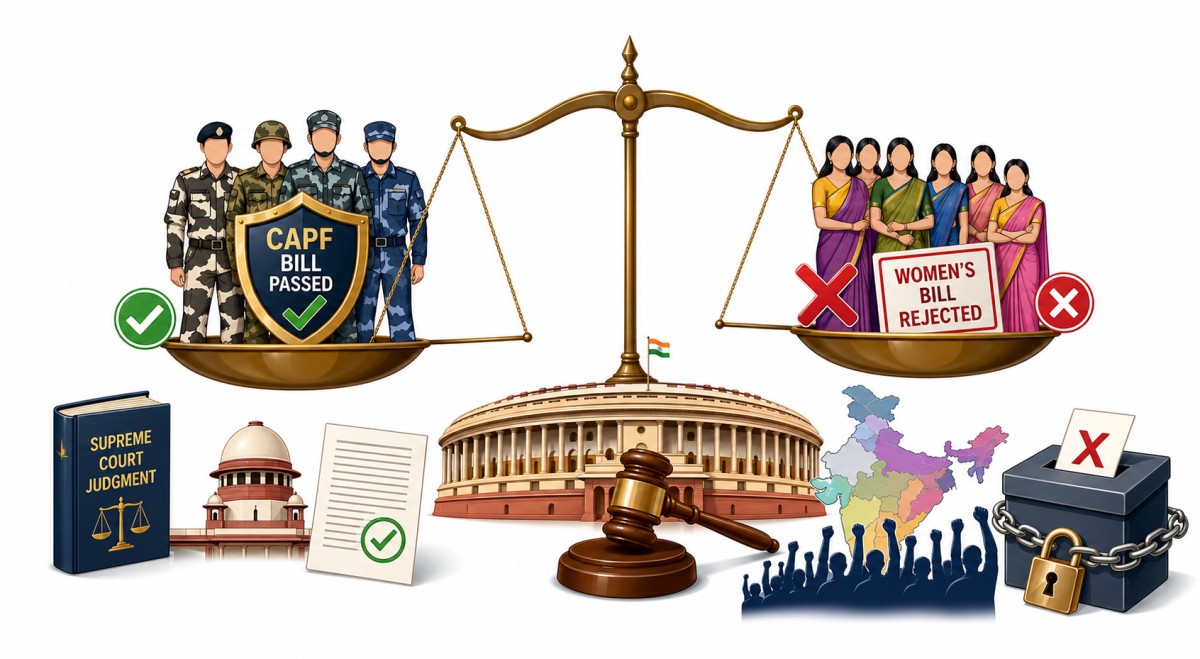
The government’s first legislative defeat in 12 years exposes why some laws pass quietly while others fail loudly.
This is the first time the Modi government has suffered a major legislative defeat since 2014. Yet here’s the puzzle: both bills claimed to advance justice. One protected national security interests. One championed women’s rights. So why did one slide through without actually meaningful opposition, keeping aside party lines , while the other triggered a unified resistance fierce enough to stop a constitutional amendment?
The answer lies not in the bills themselves, but in who had something to lose, and who had the political will to fight back.
The CAPF Bill: When 13,000 Cadre Officers Lost Silently
The government’s stated case: Streamline administrative rules for five Central Armed Police Forces (CRPF, BSF, ITBP, CISF, SSB). Create uniform recruitment and promotion procedures. Strengthen operational clarity.
The constitutional reality: In plain language: Parliament gave the executive power to ignore Supreme Court judgments. This was not administrative housekeeping. This was legislative maneuvering.
The government did not want to give OGAS to CAPF as it has been given to other services. Cornered by the Supreme Court judgement they introduced the CAPF Bill instead of complying.
What the Bill actually does: This codifies what the Supreme Court had ordered be progressively reduced.
Why no one fought: The opposition was fragmented. No major political party actually championed the CAPF Cadre stand as zealously as they should have because of no direct benefits as such. None of the treasury benches took a stand against the bill.
The security establishment-Home Ministry – bureaucracy-defended it, framing the issue through administrative jargon like “recruitment rules” and “deputation quotas,” not moral language.
This misrepresentation buried the real issue: whether Parliament could legislatively nullify judicial mandates.
There were individual very strong speeches but no forced voting, just walkouts . There was no joint strategy.And above all it needed a simple majority.
The consequence: These cadre officers won a Supreme Court battle that took 14 years to reach judgment. Parliament erased that victory in minutes and almost no one noticed.
The Women’s Reservation Bill: When Millions Fought Back
The government’s stated case: Implement the 2023 Women’s Reservation Act, guaranteeing 33% seats in Lok Sabha and state assemblies. Expand Lok Sabha from 543(550) to 850 seats. Use 2011 Census data for delimitation (redrawing constituency boundaries).
The moral appeal was emotional and moreover it needed two- third majority
The hidden machinery: The bills were not presented separately. Women’s reservation was bundled with delimitation using 2011 Census population data. This seemingly technical detail concealed explosive politics.
Without legal safeguards, southern states faced the prospect of permanent electoral disadvantage masked by women’s empowerment rhetoric.
Why people fought: Unlike the CAPF issue, this touched multiple constituencies.
Many recognized that bundling reservation with delimitation would change the proportion of the power of states in parliament that did well in population control.
Southern state governments-Tamil Nadu, Telangana, Karnataka, Andhra Pradesh-united in opposition. These were not abstract constitutional concerns. States feared permanent loss of representation in national decision-making.
The mathematics of defeat: Why? Because enough non-NDA members-particularly from southern and eastern states-voted against the government or stayed absent.
( 298 yes vs 230 no out of 528 MPs-54 votes short of two-thirds (-352 needed). Non-NDA bloc (southern/eastern states) voted no; NDA held but absences hurt.”This was political consensus building.
The CAPF bill saw no such mobilization because CAPF officers lack electoral constituencies.
The consequence: Women remain at 14% Lok Sabha representation. Implementation is deferred until at least 2034. as of now.
Southern states retained their relative parliamentary power. But gender justice was sacrificed at the altar of political maneuvering, why the 2023 Bill should have been linked to delimitation?
Why One Sank, One Sailed:
The Politics of Silence
Both bills violated constitutional norms in different ways. The CAPF Bill legislatively overrode a Supreme Court judgment. The Women’s Reservation Bill weaponized gender justice for electoral gerrymandering.
Yet one passed unopposed amidst walkouts and voice votes.
The other crashed before 528 parliamentarians.
The difference: constituency power.
CAPF officers number 13,000. Professional, institutional, lacking electoral voice.
They won in Courts but they had no political champions. The security establishment-Home Ministry, police bureaucracy, intelligence agencies-defended the bill. Opposing it on streets meant risking a “soft on security” label.
Southern states command electoral influence. When delimitation threatened their power, they mobilized. Regional parties-DMK, AIADMK, TMC, regional Telugu and Kannada parties-united. They said “no” not to women’s reservation, but to the poison pill attached to it.
The CAPF officers could only write articles and file contempt petitions.Southern states could block a constitutional amendment.
This reveals a hard truth about Indian democracy: institutional actors without mass constituencies are vulnerable to legislative reversal, no matter how clear their legal victory. But mass constituencies and federal dynamics can still constrain majoritarian power.
The CAPF Bill represents exactly this usurpation.
Yet it is law now. And the women’s reservation remains delayed.
The tale of these bills is not about justice winning or losing. It is about which groups possess the political weight to make their loss painful for those in power.
