
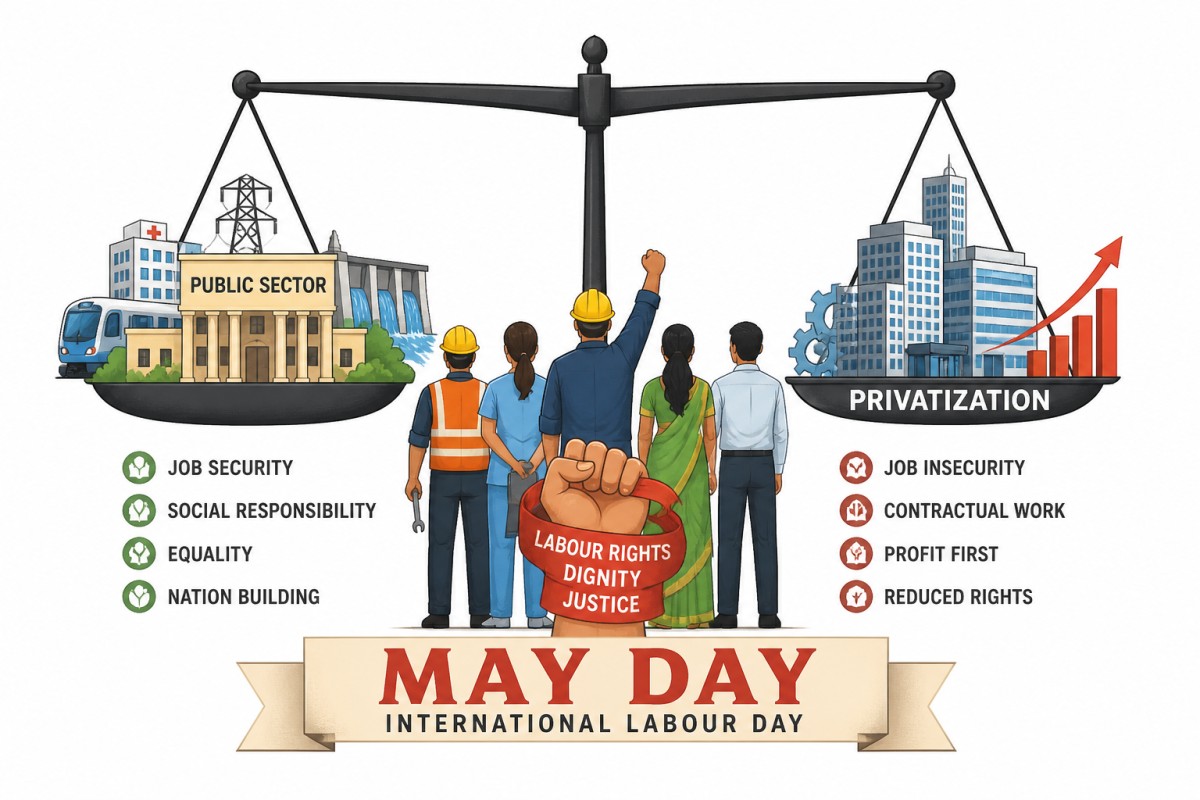
Every year, the first of May arrives not merely as a date on the calendar but as a reminder of struggles that shaped the modern world of work. It commemorates the courage of workers who stood up for dignity, fair wages, and humane working conditions. Yet, in today’s rapidly shifting economic landscape, the meaning of May Day feels increasingly fragile, especially as the debate around privatization and the steady weakening of the public sector gathers pace.
Privatization is often presented as a symbol of efficiency, progress, and economic reform. It is argued that private ownership brings better management, improved services, and reduced financial burden on governments. On paper, this appears logical. But beneath these arguments lies a more complex and uncomfortable reality—one that touches the lives of millions of workers whose voices rarely find space in policy discussions.
For decades, the public sector in India has not just been an economic entity but a social institution. It has provided stable employment, ensured job security, and created a sense of belonging for workers who built their lives around these organizations. Generations of families have relied on public sector jobs not only for income but for identity and dignity. The gradual shift towards privatization threatens to dismantle this foundation in ways that are not always visible in economic data.
One of the most immediate consequences of privatization is the erosion of job security. Where public sector employment once offered long-term stability, privatized environments often introduce contractual work, performance-linked retention, and frequent restructuring. For many workers, this translates into a constant state of uncertainty. The fear of job loss becomes a silent companion, affecting not just livelihoods but mental well-being and family stability.
Labour rights, which were once hard-fought victories, also face subtle dilution in privatized systems. Collective bargaining becomes weaker, unions lose influence, and workers often find themselves negotiating individually against large corporate structures. The balance of power shifts, and with it, the ability of workers to assert their rights. While efficiency may improve in some sectors, it often comes at the cost of the human element that once defined the workplace.
There is also a deeper question of accountability. Public sector enterprises, despite their inefficiencies, operate under a framework of public responsibility. Their mandate extends beyond profit to include social welfare, regional development, and employment generation. Privatized entities, on the other hand, are primarily driven by profitability. This shift in priorities can lead to decisions that, while economically sound, may overlook the broader social impact.
On this May Day, it is worth asking whether the narrative of privatization has been too one-sided. Efficiency and growth are essential, but they cannot be pursued in isolation from the realities of those who sustain the system. Economic reform should not become a synonym for social displacement. The measure of progress must include the well-being of workers, not just balance sheets and market valuations.
The challenge, therefore, is not to reject privatization outright but to approach it with caution and responsibility. There is a need for policies that safeguard labour rights, ensure fair transition for workers, and maintain a balance between efficiency and equity. Social security mechanisms, retraining programs, and stronger labour protections must become integral to any privatization effort.
The spirit of May Day reminds us that the rights enjoyed by workers today were not granted easily. They were earned through struggle, sacrifice, and collective resolve. As the country moves forward on the path of economic transformation, it must not lose sight of this history. Progress that leaves workers behind is not progress at all; it is merely a shift of burden from one set of shoulders to another.
In the end, the true test of any economic policy lies not in how it performs in theory, but in how it affects the everyday lives of people. The quiet anxiety of a worker facing an uncertain future, the fading assurance of stable employment, and the gradual weakening of collective voice—these are realities that demand attention.
May Day is not just a commemoration of the past. It is a call to reflect on the present and shape a more just future. As debates on privatization continue, the voices of workers must not be reduced to an afterthought. They must remain at the center, where they have always belonged.
