
There was a time when India’s neighbourhood policy carried both confidence and clarity. From the Himalayas to the Indian Ocean, New Delhi was seen as the natural anchor of stability in South Asia — not merely because of its size or military strength, but because of its historical, cultural, and civilizational depth. For decades, India occupied a position of quiet authority in the region. It was the first responder in times of crisis, the trusted development partner, and often the balancing force in regional turbulence.
Today, however, an uncomfortable question is beginning to surface in diplomatic circles and public discourse alike: Is India gradually losing strategic control of its own neighbourhood?
This is not a question born out of pessimism.
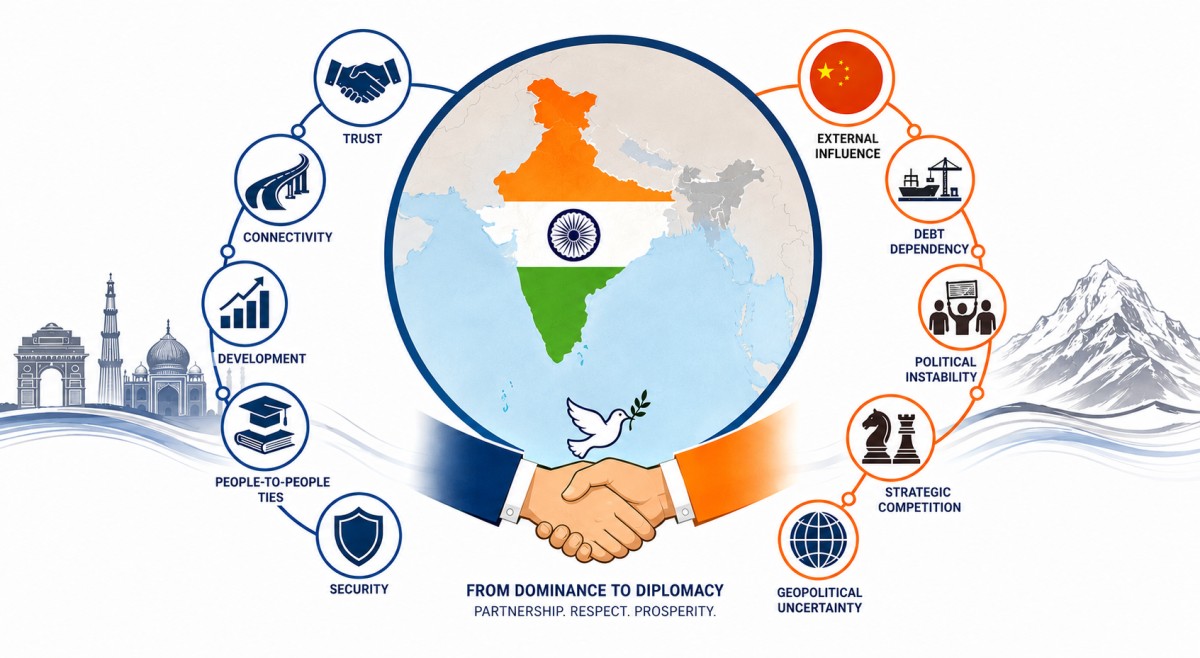
The changing geopolitical currents around India are impossible to ignore. From growing Chinese footprints in Sri Lanka and the Maldives to political volatility in Nepal, uncertain equations in Bangladesh, and external interventions in the Indian Ocean region, the strategic landscape around India is becoming increasingly complex.
Pakistan, too, continues to remain a persistent strategic complication in India’s neighbourhood calculus. While direct diplomatic engagement between New Delhi and Islamabad remains limited and often strained, the broader regional consequences of instability, cross-border tensions, and external alignments involving Pakistan continue to shape South Asia’s security architecture. Any serious assessment of India’s neighbourhood strategy cannot entirely overlook the enduring impact of the India–Pakistan equation on regional cooperation and strategic trust.
Nations once considered comfortably within India’s sphere of influence are diversifying their partnerships, often leaning toward powers whose interests in South Asia are neither organic nor benign.
For a nation aspiring to become a global power, strategic weakness in one’s immediate neighbourhood is not merely an embarrassment; it is a vulnerability.
India’s challenge is not the rise of competition itself. In an interconnected world, smaller nations naturally seek multiple partnerships to maximize their economic and strategic advantage. The concern arises when these relationships begin to dilute India’s long-standing influence to the extent that New Delhi appears reactive rather than decisive.
Take Sri Lanka, for instance. India moved swiftly during Colombo’s economic crisis, extending billions in assistance when few others stepped forward. It was a moment that reaffirmed India’s reliability. Yet even after such substantial support, Chinese strategic and economic presence continues to cast a long shadow over the island nation.
The Maldives presents another lesson. Political transitions there have repeatedly altered the tenor of relations with India. Campaigns framed around “India Out” sentiments have exposed how easily domestic politics in neighbouring countries can be weaponized against Indian interests.
Nepal, despite sharing unmatched cultural and civilizational ties with India, continues to witness recurring strains in bilateral relations, often influenced by perceptions of overreach and unresolved sensitivities.
These examples reveal a difficult truth: goodwill alone is no longer enough.
India’s neighbourhood diplomacy must evolve beyond historical familiarity and emotional assumptions. Shared culture, common heritage, and geographical proximity remain powerful assets, but they cannot substitute for sustained strategic engagement.
Neighbouring nations today seek infrastructure, investment, technological cooperation, climate resilience support, and institutional respect. They are less willing to accept asymmetrical relationships and more inclined to engage with whoever offers faster delivery and fewer political complications.
This is where China has often been effective. Through infrastructure financing, rapid project execution, and aggressive economic diplomacy, Beijing has built influence with remarkable speed across India’s neighbourhood.
To acknowledge this reality is not to glorify China’s model. Many of its projects have left recipient nations burdened with debt and strategic dependency. But perception matters in diplomacy. If India is seen as slow, bureaucratic, or overly cautious while others appear proactive, strategic space inevitably narrows.
India must therefore ask itself some hard questions.
Has its neighbourhood-first policy been adequately backed by execution?
Have development promises translated into visible outcomes?
Has India communicated its intentions with enough sensitivity and consistency?
Too often, Indian diplomacy has relied on the assumption that regional countries will naturally prioritize relations with New Delhi because of geography and history.
Influence in the 21st century is earned daily.
It is built through roads completed on time, digital partnerships that empower local economies, educational exchanges that shape future leadership, and crisis responses that reflect empathy rather than strategic calculation alone.
India has immense strengths to reclaim and reinforce its position.
Its democratic values, developmental experience, cultural reach, technological capabilities, and humanitarian credibility remain unmatched in the region.
Unlike external powers, India’s stakes in South Asia are not transactional. They are existential. Peace and prosperity in the neighbourhood are directly linked to India’s own growth and security.
The way forward lies not in coercion, insecurity, or zero-sum competition. It lies in confidence-driven diplomacy.
India must become a partner that listens more, delivers faster, and respects the sovereign choices of its neighbours while firmly safeguarding its own strategic interests.
Connectivity projects must accelerate. Regional trade frameworks need fresh momentum. Maritime partnerships should deepen. People-to-people diplomacy must be revitalized. Most importantly, India must engage with humility rather than entitlement.
Leadership is not asserted through size; it is earned through trust.
The coming decade will determine whether South Asia evolves as a cooperative regional community led by India’s inclusive vision or becomes an arena for competing external powers.
India cannot afford strategic complacency.
To lose influence in one’s neighbourhood is not merely to lose diplomatic ground; it is to lose the ability to shape the environment essential for national progress.
The answer to the question — Is India losing control of its own neighbourhood?— is neither a definitive yes, nor a reassuring no. It rests in a fragile grey zone, shaped by missed opportunities and emerging challenges. What India does next will determine whether this uncertainty turns into strategic decline—or a renewed assertion of leadership.
But unless India acts with urgency, strategic imagination, and renewed diplomatic energy, this ambiguity may well harden into an uncomfortable reality. For a civilization-state that has shaped this region for centuries, such an outcome would be far more than a policy failure. It would represent a historic missed opportunity.”
