
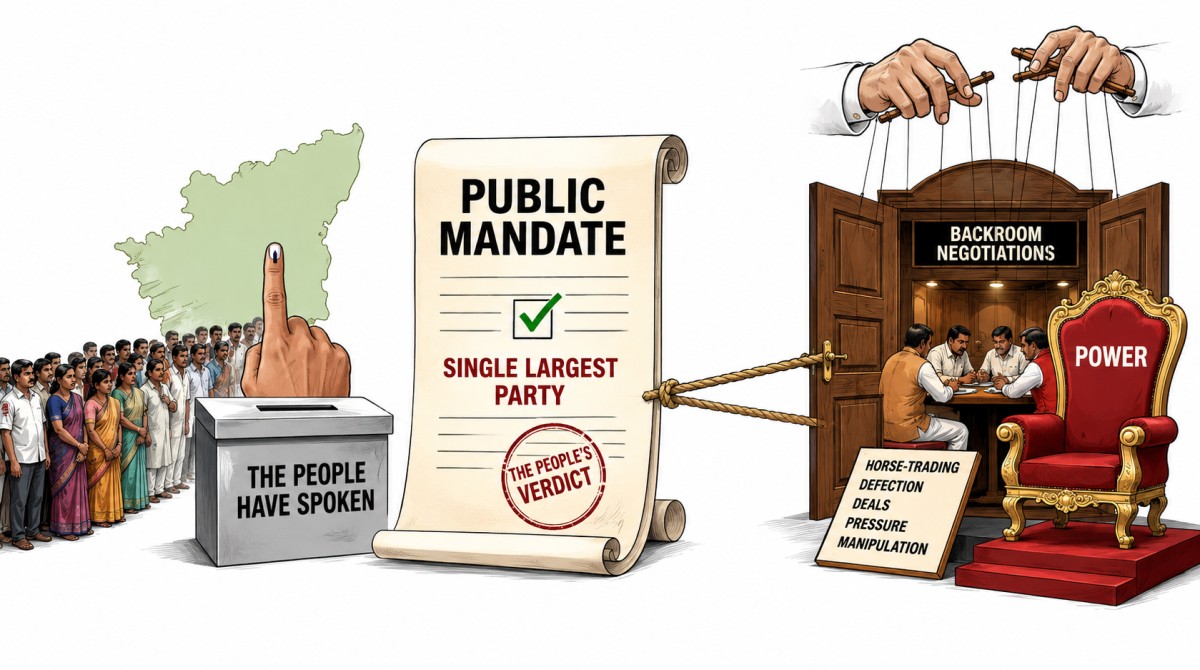
Tamil Nadu today stands at a deeply uncomfortable crossroads where democracy appears to be trapped between constitutional morality and political opportunism. The Assembly election delivered a fractured verdict, yet one message was unmistakably clear: the people rejected the old certainties and elevated a new political force as the single largest party. In every healthy democracy, such a verdict carries moral weight. It may not provide an automatic coronation, but it certainly deserves the first constitutional opportunity to prove majority on the floor of the House.
Instead, what the state is witnessing is a disturbing spectacle of hesitation, backroom calculations, and institutional ambiguity. The delay in inviting the single largest party to form the government has raised serious questions about whether constitutional offices are protecting democratic spirit or merely buying time for political arithmetic to be rearranged behind closed doors.
Actor-politician Vijay led Tamilaga Vettri Kazhagam (TVK) emerged as the single largest party in the Tamil Nadu Assembly elections, yet despite receiving the clearest endorsement from the electorate, the party continues to face political resistance and procedural uncertainty in its attempt to form the government.
The people voted in public. The politicians are negotiating in secrecy.
This is where democracy begins to decay.
The argument being advanced by sections of the political establishment is technical in nature: that numbers alone determine legitimacy. But democratic ethics are not built merely on arithmetic. Elections are not stock exchanges where defeated factions can suddenly combine after rejection and claim moral authority through convenience coalitions. If voters decisively pushed traditional parties backward and elevated a new force to the top position, then denying that party the first opportunity sends a dangerous message — that elections are only preliminary exercises before the real bargaining begins.
Tamil Nadu is not merely facing a constitutional debate; it is confronting a moral crisis.
The Governor’s office, expected to function as a neutral constitutional authority, now finds itself under growing public scrutiny. The longer the uncertainty continues, the stronger the perception becomes that time is being created for “horse-trading,” persuasion, defections, and pressure tactics. Indian politics has unfortunately witnessed such scenes repeatedly.
From Karnataka to Goa and Maharashtra, the country has repeatedly witnessed situations where the spirit of public mandate was weakened through procedural manoeuvring, political engineering, and post-poll power negotiations that appeared to place arithmetic above electoral morality.
The tragedy is not only institutional. It is psychological.
Citizens begin losing faith in voting itself.
When voters see rejected parties attempting to reclaim power through negotiations rather than ballots, democracy slowly transforms into a transactional marketplace. Legislators become commodities. Ideologies become temporary costumes. Alliances become overnight arrangements without moral explanation to the electorate. The voter, meanwhile, is reduced to a spectator watching political traders reinterpret his mandate.
This culture weakens the very foundation of representative democracy.
No constitution can survive merely through legal wording if its democratic conventions are repeatedly violated. Constitutional morality depends upon restraint, fairness, and respect for public perception. The framers of India’s democracy never imagined a republic where electoral verdicts would routinely be subjected to prolonged manipulation in luxury resorts, closed-door meetings, and strategic delays designed to alter political outcomes.
The current situation in Tamil Nadu risks creating precisely that impression.
The irony is impossible to ignore. Political parties that spent months asking people for a decisive mandate are now attempting to manufacture one through post-election bargaining. Leaders rejected by the electorate are suddenly being projected as guardians of “stability.” Parties that fiercely opposed one another during campaigning are now exploring equations solely to keep the electorate’s preferred force away from power.
Such politics may be technically permissible. But it remains ethically hollow.
Democracy is not merely about who can gather numbers after elections. Democracy is also about respecting the emotional and political direction indicated by the people. A constitutional office must rise above partisan suspicion and ensure that the electorate never feels cheated by procedural manipulation.
If the single largest party fails to prove majority on the floor, the House itself can decide its fate. That is how parliamentary democracy is designed to function. But preventing or delaying that opportunity creates a perception far more damaging than political instability itself.
Tamil Nadu deserves clarity, not conspiracy.
At stake today is not merely government formation. What is truly at stake is whether elections in India will continue to reflect public will — or merely become opening rounds in a larger game of negotiation, pressure, and political sale. The people have already spoken. Democracy must now decide whether it still remembers how to listen.
