
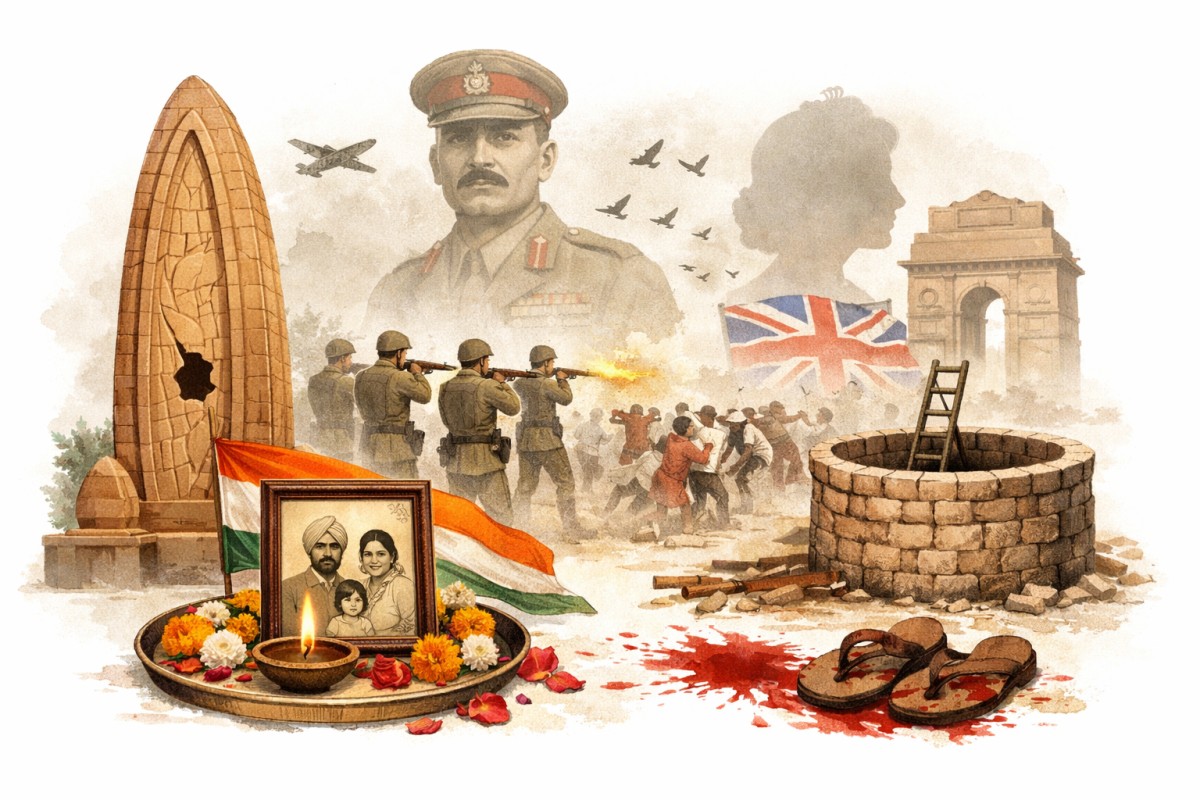
Some events do not end when they are recorded in the pages of history; they continue to live in the collective consciousness of a people. The tragedy of the Jallianwala Bagh massacre on April 13, 1919, remains one such wound—neither faded with time nor fully healed. To dismiss it as an isolated act of excess would be a grave historical oversimplification. It stands, rather, as a stark and enduring symbol of the coercive and often violent nature of colonial rule in India—a blood-stained chapter in a longer history of imperial dominance.
On the day of Baisakhi, Jallianwala Bagh in Amritsar was not a battlefield, yet it was turned into one. Under the command of Reginald Dyer, troops opened fire on a large, unarmed gathering without warning. Among those present were men, women, and children—many unaware of the curfew orders, others assembled peacefully. With exits severely restricted, panic ensued. In desperation, some leapt into the well within the garden in a futile attempt to escape the gunfire—a site that remains a solemn and enduring reminder of that day’s horror, where silence now speaks louder than words ever could.
Importantly, Dyer’s actions were not merely the result of individual excess; they reflected a broader institutional mindset that viewed colonial subjects through a lens of control rather than rights. Across different regions and periods, historians have documented instances of disproportionate force, harsh reprisals, and policies that inflicted deep social and economic distress. From the suppression of uprisings to accounts of extreme punitive actions such as those associated with the Kuka movement, and from the devastating famines in regions such as Bengal and Odisha—widely studied and debated among scholars—there is substantial evidence to suggest that governance often prioritized imperial interests over human welfare. In this context, Jallianwala Bagh emerges not as an anomaly, but as part of a larger historical pattern that shaped the lived realities of millions.
In India, calls for a formal and unconditional apology from Britain have surfaced repeatedly, including within parliamentary discourse. These demands are sometimes countered by arguments pointing to discrepancies in the recorded number of casualties, often used to frame the issue as “emotional” rather than factual. Yet, this reasoning only deepens the injustice. The absence of precise figures itself reflects the limited administrative concern for documenting the loss of Indian lives at the time. At its core, the debate is not about numbers, but about accountability—an acknowledgment of responsibility that remains incomplete.
Even today, many families continue to seek formal recognition of their ancestors who perished that day. This pursuit is not merely about remembrance, but about restoring historical identity and dignity. The incomplete documentation of victims serves as a reminder that this chapter of history remains, in some respects, unfinished—lingering not only in archives, but in memory and identity.
Comparisons between historical tragedies must be approached with care. The atrocities of the The Holocaust and the events at Jallianwala Bagh differ significantly in scale, context, and intent. However, both underscore a troubling reality: the potential for state power to be exercised against defenseless civilians. While Adolf Hitler has come to represent industrialized brutality in global memory, for almost every Indian, Dyer symbolizes the excesses of colonial authority—where power manifested itself through force, with little accountability to those it governed.
In the decades following the Second World War, countries such as Germany undertook sustained efforts to confront their past through acknowledgment, apology, and institutional remembrance. In contrast, Britain has expressed “deep regret” over Jallianwala Bagh—an important gesture, yet one that stops short of a formal apology. The distinction is not merely semantic. Regret conveys sorrow; an apology signifies responsibility. One reflects emotion; the other reflects acceptance.
For Britain, the question of a formal apology today is no longer confined to legal considerations or fears of precedent. It is also about moral clarity and historical responsibility in an increasingly interconnected world. Acknowledging the past does not alter history, but it does shape how it is remembered—and how nations are judged by future generations.
The legacy of Jallianwala Bagh endures because it speaks to universal questions of justice, dignity, and accountability. More than a century later, the call is not driven by a desire for reparation alone, but by the need to affirm the value of truth in historical memory. After 107 years, what remains sought is not simply an expression of regret, but the courage to accept responsibility—so that remembrance is not merely ceremonial, but meaningful.
