
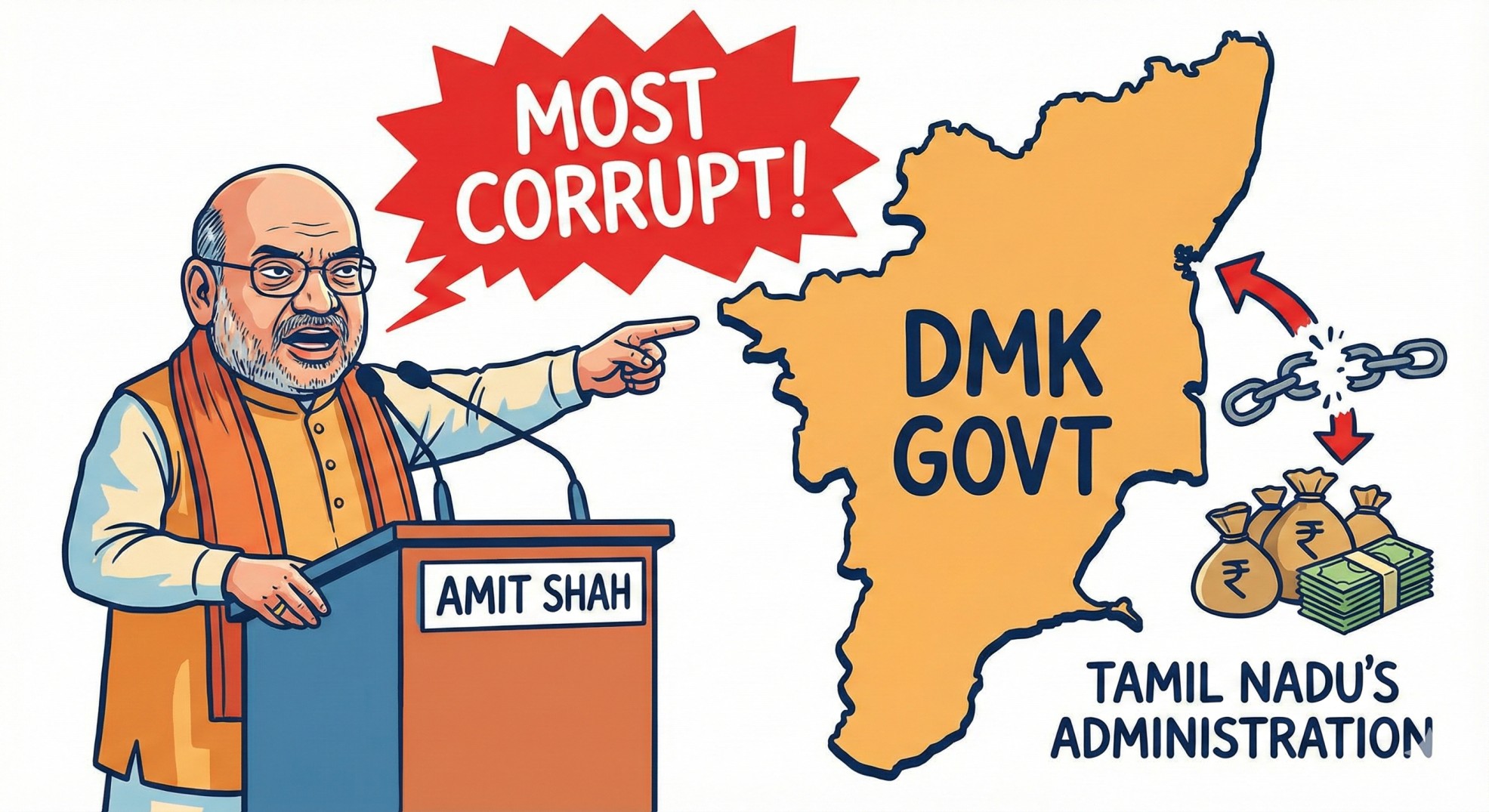
Pudukkottai – Tamilnadu : India’s Home Minister Amit Shah has publicly described the Dravida Munnetra Kazhagam (DMK) government in Tamil Nadu as the most corrupt administration in the country. The remarks, made during a recent political gathering, have ignited a fresh wave of debate across the national and state political spectrum.
Amit Shah’s Statement
Speaking to a crowd of party workers and supporters, Shah asserted that the DMK government “stands out as the most corrupt” among all state administrations. He emphasized that the central government is closely monitoring corruption cases and urged state leaders to uphold transparency and accountability. Shah’s comments were not accompanied by specific allegations or evidence, but they reflected the BJP’s longstanding criticism of the DMK’s governance record.
Political Context and Reactions
The DMK, which leads the Tamil Nadu state government under Chief Minister M.K. Stalin, has repeatedly denied any wrongdoing. Party officials described Shah’s remarks as “politically motivated” and warned that such statements could further polarize public discourse. Opposition parties, including the Congress and the AIADMK, also condemned the comment, calling it an attempt to undermine the state’s development agenda.
In response, the central Ministry of Home Affairs released a brief statement reaffirming its commitment to fighting corruption nationwide, without directly addressing Shah’s specific claim. Meanwhile, civil society groups called for a factual investigation, urging both the central and state governments to focus on evidence-based assessments rather than partisan rhetoric.
Implications for Governance and Public Perception
Shah’s accusation arrives at a time when several high‑profile corruption investigations are underway across India, including probes into procurement irregularities and financial mismanagement in various states. Analysts suggest that the statement could be part of a broader strategy by the BJP to highlight governance issues ahead of upcoming electoral contests.
For Tamil Nadu, the allegation may intensify scrutiny of the DMK’s policies on public welfare schemes, infrastructure projects, and law‑enforcement practices. The state government has pledged to cooperate with any legitimate inquiry and has highlighted its recent achievements in healthcare, education, and social welfare as evidence of effective administration.
As the debate unfolds, observers will watch closely how the allegations affect inter‑governmental relations, voter confidence, and the broader narrative on corruption in Indian politics.
