
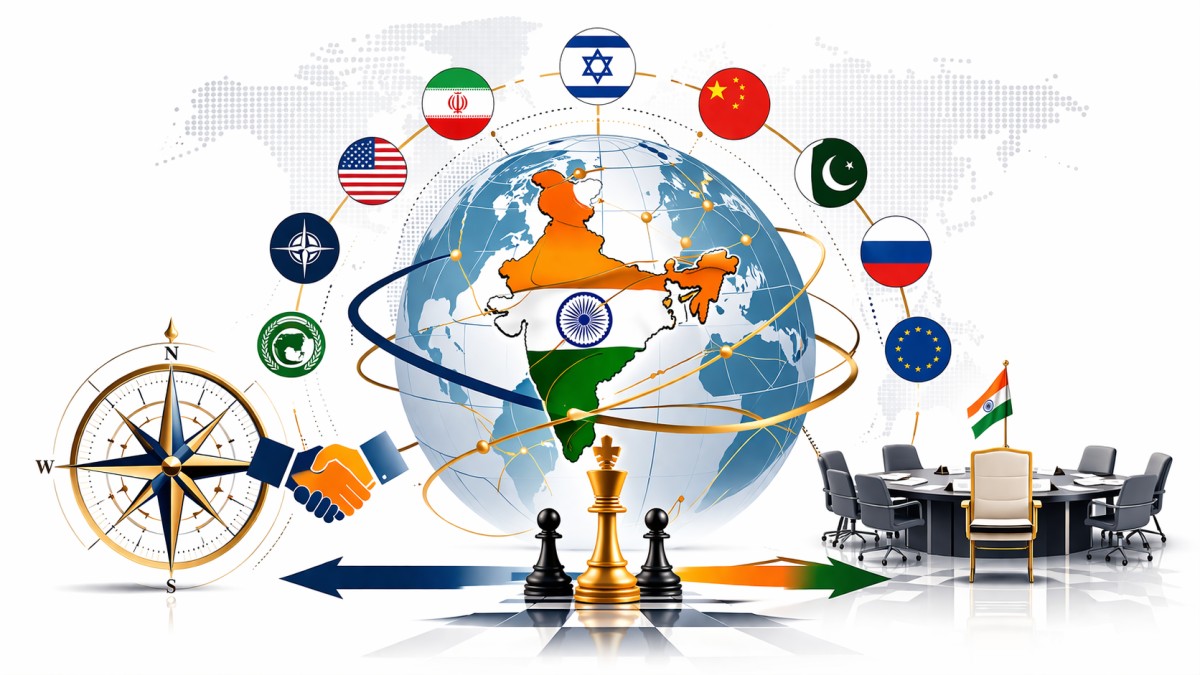
In moments of global upheaval, foreign policy is not judged by speeches, symbolism, or optics—it is tested by outcomes. The unfolding tensions involving Iran, Israel, and the United States have once again placed India in a difficult position: present, vocal, but not decisive. The crisis has exposed not just the limits of India’s influence, but also the contradictions within its much-claimed strategic autonomy.
For decades, India took pride in its legacy of Non-Aligned Movement—a doctrine that promised independence from power blocs and an ability to engage all sides without being bound by any. That posture, however, appears increasingly strained in today’s polarized geopolitical landscape.
The discomfort is not merely theoretical. It has roots in recent diplomatic signalling. When Narendra Modi addressed the Israeli Parliament and referred to Israel in deeply civilizational and emotional terms, many saw it as a departure from India’s carefully balanced West Asia policy. While such gestures may strengthen bilateral ties, they also carry costs—especially in a region where perception shapes alignment.
Today, India finds itself in an uneasy middle. It maintains strategic ties with Israel, continues energy and connectivity interests with Iran, and deepens defence and technological cooperation with the United States. Yet, when crisis erupts among these very actors, India’s ability to influence outcomes appears limited. Neutrality, in such situations, risks being interpreted not as strength, but as absence.
The larger concern, however, lies closer home. In the event of a future confrontation—whether along the western frontier with Pakistan or the northern border with China—a troubling question emerges: who stands openly with India?
Israel, often perceived as India’s closest strategic partner in defence cooperation, may offer quiet support, particularly in intelligence or technology. But even here, its actions would likely be shaped by its own dependencies, especially on the United States. Open alignment in a South Asian conflict cannot be taken for granted.
Meanwhile, Pakistan has demonstrated a different kind of diplomatic agility. By positioning itself as a mediator or facilitator in sensitive geopolitical moments, it has managed to remain relevant to both Washington and Beijing. Its long-standing strategic ties with China, combined with periodic engagement with the United States, create a dual-anchor framework that India does not currently possess. Reports and perceptions—whether fully verified or not—of Chinese assistance to Iran in military or strategic domains further reinforce the idea of a tightening axis that could, in time, extend toward Pakistan in ways adverse to India’s interests.
India’s outreach toward Europe and its engagement with Western institutions such as NATO reflect an attempt to diversify partnerships. Yet Europe’s strategic capacity remains constrained without strong American leadership. Any expectation of rapid, decisive European backing in an Asian conflict may be optimistic, at least in the near term.
Similarly, Russia—India’s long-time defence partner—has evolved into a more transactional actor. Its priorities are increasingly shaped by economic survival and geopolitical balancing. Arms sales and energy exports will continue, but the likelihood of overt political or military support in a high-stakes India–China conflict remains uncertain.
The Arab world presents another layer of complexity. Several countries in the region have strengthened economic ties with India, yet their strategic calculus is deeply influenced by regional identity and internal stability. In a hypothetical India–Pakistan conflict, expecting military backing from these nations would overlook the sensitivities of religious and regional affiliations.
Even beyond state actors, emerging alignments—such as the deepening military cooperation between Turkey, Saudi Arabia, and Pakistan—add to India’s strategic anxieties.
Against this backdrop, it is fair to ask: what has India gained from a decade of high-visibility diplomacy? Prime ministerial visits, diaspora engagements, and global summits have elevated India’s profile, no doubt. The country is more visible, more heard, and more courted than before. But visibility is not the same as influence. Recognition is not the same as leverage.
There is also a troubling shift in domestic discourse, where strategic thinking is increasingly shaped by spectacle rather than substance. Popular culture has, over time, promoted a cinematic and simplified view of conflict, where—almost every year—narratives of decisive victories over Pakistan are repeatedly showcased. Worryingly, elements of political and diplomatic language at times seem to echo this tone, leaning on punchlines and dramatic assertions rather than measured statecraft. The result is a blurred line between perception and policy, leaving sections of the public in an illusion, unable to clearly distinguish between cinematic portrayal and strategic reality.
The risk, therefore, is not merely diplomatic isolation, but strategic miscalculation born out of overconfidence. In international relations, narratives do not deter adversaries—capabilities, alliances, and credibility do.
While India’s foreign policy has achieved gains in certain areas, the current geopolitical churn exposes critical gaps that demand urgent and honest introspection.
India’s challenge is to move beyond the comfort of being “well-regarded” to becoming “indispensable.” That requires deeper, more structured alliances, clearer red lines, and a willingness to make difficult choices in an increasingly binary world.
Strategic autonomy was never meant to be passive neutrality. It was meant to be active, calibrated engagement—backed by the ability to shape outcomes. The present moment, shaped by the Iran–Israel–US tensions, is a reminder that in geopolitics, intent must be matched by influence.
And influence, ultimately, is measured not by how many doors a nation can knock on—but by how many will open when it matters most.
