
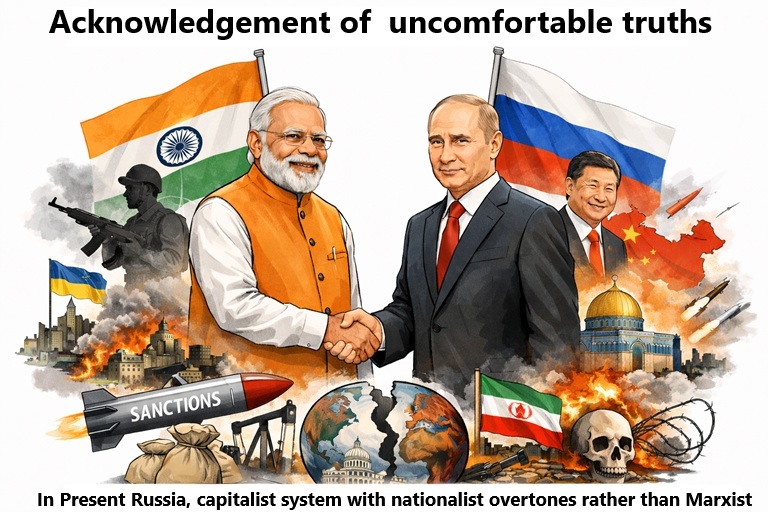
India’s claim to moral leadership as the world’s largest democracy sits uneasily with its perceived accommodation of Vladimir Putin. In recent years, a clear dissonance has emerged in its political narrative: even as New Delhi positions itself as a voice of principle for the Global South, sections of its leadership—particularly those aligned with the current establishment under Narendra Modi—have appeared consistently receptive to Moscow’s strategic concerns. This posture has endured despite Russia’s invasion of Ukraine, its deepening engagement with Xi Jinping, and mounting strain on its own economy.
At a moment when global fault lines are hardening—from the Iran–Israel tensions to the strategic calculus of the United States—India’s studied caution risks being perceived as strategic under-assertiveness. While New Delhi proceeds with restraint, Pakistan has moved with greater opportunism, leveraging its position to extract diplomatic visibility and economic advantage. Simultaneously engaging Washington and Beijing, deepening defence ties with China, and drawing financial and strategic support from Saudi Arabia and Turkey, Islamabad has sought to position itself as a more agile and transactional actor—highlighting the potential costs of excessive caution in a rapidly shifting geopolitical order.
India’s official stance is one of “strategic neutrality.” Yet neutrality, when consistently tilted in tone and symbolism, begins to resemble selective alignment in perception if not in intent. Abstentions at key United Nations votes on Ukraine and carefully calibrated diplomatic messaging suggest not just balance, but a deliberate effort to preserve longstanding partnerships alongside evolving global pressures.
To understand this posture, one must acknowledge the historical depth of India–Russia ties—defence cooperation, energy interdependence, and Cold War alignments that fostered enduring trust. These factors continue to shape India’s policy choices, particularly in areas where immediate alternatives remain limited.
For many Indian left-leaning thinkers, the very word “Russia” still carries the emotional weight of the old Soviet Union—a time when Karl Marx’s ideas seemed to find state expression, when solidarity with developing nations was articulated in ideological terms, and when Moscow symbolized an alternative to Western capitalism. That memory, shaped by history, literature, and political upbringing, continues to evoke familiarity and even admiration.
But present-day Russia under Vladimir Putin rests on a very different foundation. It is not guided by Marxist ideals or socialist internationalism; instead, it operates through centralized power, nationalist assertion, and a form of state capitalism in which oligarchic interests and strategic control dominate. The ideological core that once defined the Soviet experiment has given way to pragmatic geopolitics.
In effect, Russia’s political narrative has shifted from class struggle to national pride. Yet in India, it is still often seen through its earlier ideological lens, even as left parties fail to derive any clear inspiration from the Russia of today.
Modern Russia is post-ideological—selectively invoking its Soviet past for symbolism while functioning as a centralized, state-capitalist system with nationalist overtones. To conflate today’s Russia with the Soviet Union is not just nostalgic; it obscures a profound transformation in both purpose and character.
Russia today is navigating sanctions, demographic strain, and growing economic dependence on China. In seeking to preserve an old partnership, India risks appearing insufficiently responsive to a shifting geopolitical equation.
The more contentious issue is not engagement with Russia—realpolitik demands dialogue—but the tendency to frame Putin’s leadership model in selectively positive terms within sections of public discourse. Commentary, amplified by parts of the political class and sympathetic observers, often presents him as a symbol of strength, decisiveness, and national pride. This narrative can understate the accompanying concerns: democratic constraints within Russia, the curtailment of dissent, and the human toll of the Ukraine conflict. Strategic autonomy should not be seen as a euphemism for inconsistent normative positioning.
Equally concerning is Russia’s proximity to China, India’s principal strategic competitor. While New Delhi invests heavily in countering Beijing’s influence—from border preparedness to Indo-Pacific partnerships—Moscow has steadily deepened its alignment with Beijing, both economically and diplomatically. A partner increasingly intertwined with a primary rival raises legitimate questions about long-term strategic reliability.
Moreover, Russia’s capacity to shape global outcomes appears more constrained than in previous decades. Its limited role in on-going tensions involving Iran, the United States, and Israel reflects a narrowing strategic bandwidth. Once a formidable geopolitical balancer, Russia today appears less central to crisis mediation in certain theatres.
Yet within India’s political discourse, these shifts are often underplayed. There is a tendency to emphasize continuity—to present the relationship as unshakeable, almost immune to global flux. This is where the critique of the central government sharpens: not for engaging Russia, but for not fully articulating a recalibrated narrative with transparency and strategic clarity.
India’s strength has always lain in its ability to adapt, to pursue autonomy without illusion. True strategic autonomy is not about clinging to legacy partnerships; it is about reassessing them in light of evolving realities. Respect for Russia need not translate into reverence for its current leadership, nor into silence on its actions.
A mature foreign policy demands nuance, but also conviction—the willingness to call aggression by its name, to confront uncomfortable truths, and to align rhetoric with principle. In an increasingly multipolar world, India’s voice carries weight. That voice must not appear inconsistent to the point of affecting credibility.
Engagement with Russia may be inevitable—but strategic clarity must take precedence over historical sentiment. A rising power cannot afford to confuse nostalgia with strategy.
