
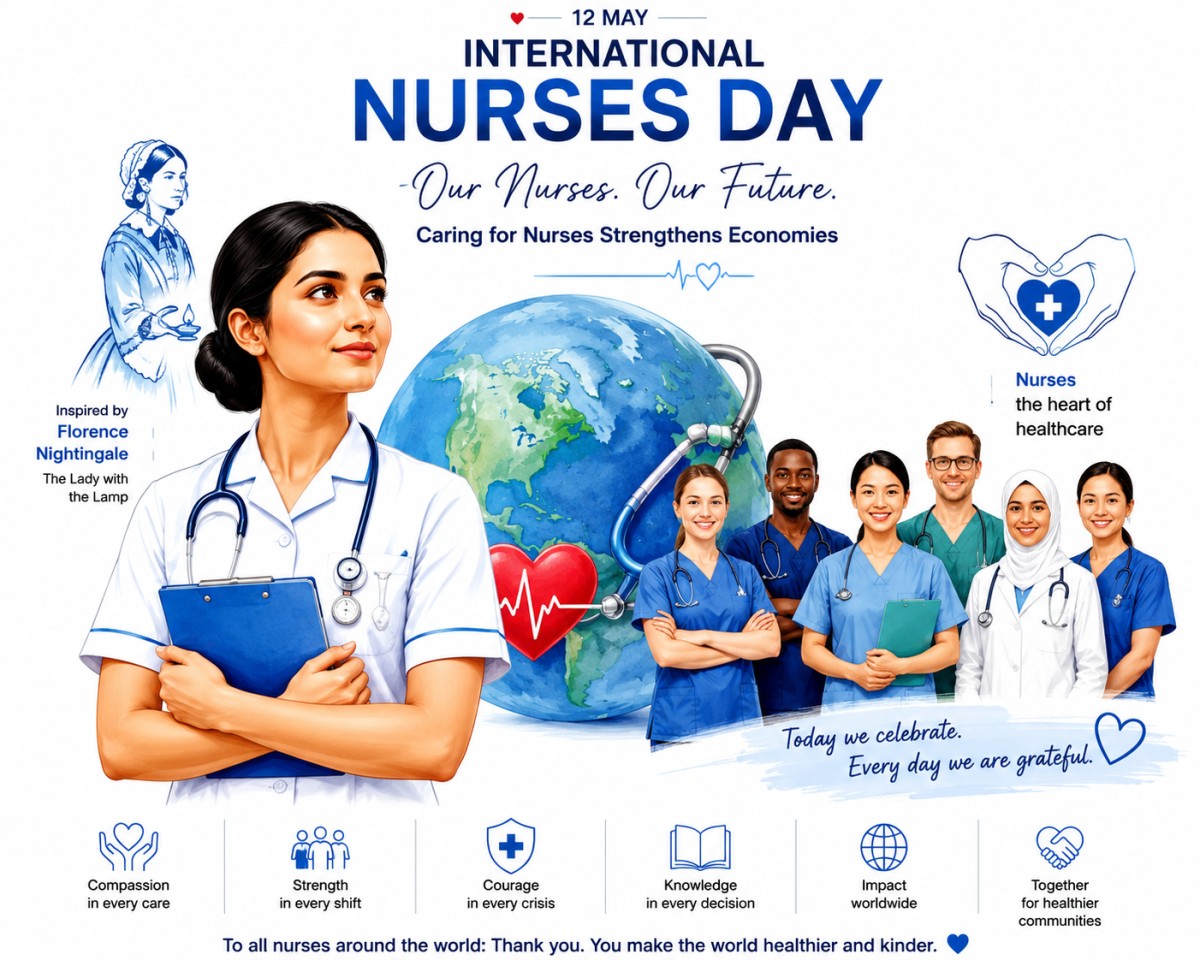
Every year on May 12, the world observes International Nurses Day, a day dedicated to honouring the unwavering commitment, compassion, sacrifice, and resilience of nurses across the globe. The date is not accidental. It marks the birth anniversary of Florence Nightingale, the legendary British social reformer widely regarded as the founder of modern nursing. Her tireless service during the Crimean War transformed nursing from an unrecognised duty into a respected and disciplined profession. Carrying a lamp through dimly lit hospital corridors while tending to wounded soldiers, Nightingale became a symbol of care, courage, and humanity. More than a century later, that lamp still burns in the hands of millions of nurses working in hospitals, clinics, war zones, disaster-hit regions, remote villages, rehabilitation centres, old-age homes, and crowded emergency wards around the world.
International Nurses Day was first celebrated by the International Council of Nurses in 1965 and was officially fixed on May 12 in 1974 to commemorate Florence Nightingale’s legacy. Over the years, the observance has evolved into a global acknowledgement of the indispensable role nurses play in sustaining healthcare systems and protecting human life. The 2026 theme, “Our Nurses. Our Future. Empowered Nurses Save Lives,” carries a profound message for governments, institutions, and societies. It reminds the world that no healthcare system can survive without adequately trained, respected, protected, and empowered nurses.
The nursing profession is often described as the backbone of healthcare, yet the reality is that nurses are much more than caregivers. They are counsellors, emergency responders, emotional anchors, teachers, healers, administrators, researchers, and often the first human face a patient encounters during moments of fear and vulnerability. A doctor may prescribe treatment, but it is the nurse who remains beside the patient throughout the journey of recovery, pain, uncertainty, and hope. From administering medicines and monitoring vital signs to comforting anxious families and supporting terminally ill patients in their final moments, nurses carry an emotional and physical burden that few professions experience.
Modern healthcare has become increasingly sophisticated with advanced technology, robotic surgeries, artificial intelligence, telemedicine, and precision diagnostics. Yet despite all scientific progress, healthcare ultimately remains a deeply human service. Machines can detect disease, but they cannot wipe tears, calm frightened children, encourage exhausted patients, or provide dignity to those nearing death. Nurses bridge this crucial gap between medical science and human compassion. In intensive care units, neonatal wards, oncology centres, trauma facilities, and mental health institutions, nurses often spend long hours under immense psychological pressure while maintaining composure and empathy.
The COVID-19 pandemic exposed to the world what nurses have silently endured for decades. During the darkest phases of the global health crisis, when fear gripped entire nations and hospitals overflowed with critically ill patients, nurses stood on the front lines risking their own lives to save strangers. Many worked without adequate protective equipment in the early months of the outbreak. Thousands remained isolated from their own families to avoid transmitting infection. Many nurses succumbed to the virus while serving humanity. Across continents, images of exhausted nurses with bruised faces caused by protective masks became symbols of sacrifice and courage. Yet beyond the applause, social media tributes, and ceremonial appreciation, the pandemic also revealed severe shortages of nursing staff, burnout, emotional trauma, and poor working conditions faced by healthcare workers worldwide.
In many countries, nurses continue to struggle with inadequate salaries, excessive working hours, staff shortages, workplace violence, and limited opportunities for leadership. Despite carrying immense responsibilities, many remain under-recognised and underrepresented in policy-making decisions. The migration of skilled nurses from developing countries to wealthier nations has created another global imbalance. Nations in Asia, Africa, and parts of Latin America invest heavily in nursing education, only to witness their trained workforce migrate abroad seeking better pay and dignity. This healthcare diaspora has become both an economic opportunity and a social challenge.
Indian nurses, for example, have established a remarkable global reputation for professionalism, discipline, clinical competence, and compassionate care. From the Gulf nations to the United Kingdom, the United States, Canada, Australia, Ireland, and several European countries, Indian nurses form a critical component of healthcare infrastructure. Kerala, in particular, has long been recognised as a major contributor to the international nursing workforce. Thousands of Indian nurses working overseas send remittances back home, support families, and contribute significantly to local economies while also enhancing India’s image internationally through their dedication and service.
The nursing diaspora represents not merely migration but the global movement of care itself. Nurses often leave behind parents, spouses, and children to work in unfamiliar environments, adapting to different languages, cultures, climates, and healthcare systems. Many endure loneliness, homesickness, discrimination, and emotional stress while continuing to care for patients with professionalism and compassion. During crises such as pandemics, earthquakes, conflicts, and humanitarian emergencies, these migrant nurses become lifelines for societies far from their own homeland.
The importance of nurses extends beyond hospitals. In rural healthcare systems, community health centres, vaccination campaigns, maternal care programmes, school health services, and public health missions, nurses serve as the first and sometimes only accessible healthcare providers. In developing countries especially, nurses play a decisive role in reducing infant mortality, promoting hygiene awareness, controlling infectious diseases, supporting mental health, and ensuring maternal safety. Their contribution becomes even more critical in remote regions where medical infrastructure remains weak.
Nursing is also one of the few professions where technical expertise and emotional intelligence must coexist every single day. A nurse must possess scientific knowledge, clinical precision, patience, communication skills, emotional stability, and extraordinary endurance. The profession demands sleepless nights, continuous learning, and emotional resilience. Nurses witness pain, grief, trauma, and death more frequently than most people can imagine. Yet they continue to report for duty with dignity and commitment.
International Nurses Day is therefore not merely a ceremonial observance. It is a reminder to society that gratitude alone is insufficient. Real respect for nurses must be reflected through better working conditions, fair compensation, mental health support, career growth opportunities, workplace safety, and stronger healthcare investment. Governments and healthcare institutions must recognise that strengthening nursing systems directly strengthens public health. A nation that neglects its nurses ultimately weakens its healthcare foundation.
Florence Nightingale once said, “I attribute my success to this: I never gave or took any excuse.” Her words continue to resonate in the nursing profession today. Nurses rarely seek attention or recognition. Their work is often invisible to the outside world, hidden behind hospital walls and emergency curtains. Yet in every recovery story, every newborn’s first cry, every patient saved from critical illness, and every peaceful final goodbye, the silent presence of a nurse remains deeply woven.
As the world marks International Nurses Day today, humanity must pause to acknowledge those who continue to heal not only bodies but also spirits. In a world increasingly divided by conflict, inequality, loneliness, and uncertainty, nurses represent one of the purest forms of service still alive. Their profession is not merely a career; it is an act of continuous humanity. Behind every functioning healthcare system stands an army of nurses whose sacrifices often go unnoticed, but whose contribution remains immeasurable.
International Nurses Day is ultimately a celebration of compassion in action. It is a tribute to those who choose service over comfort, patience over frustration, and humanity over exhaustion. The world may move forward with new medicines, advanced machines, and modern hospitals, but the healing touch of a nurse will always remain irreplaceable.
