
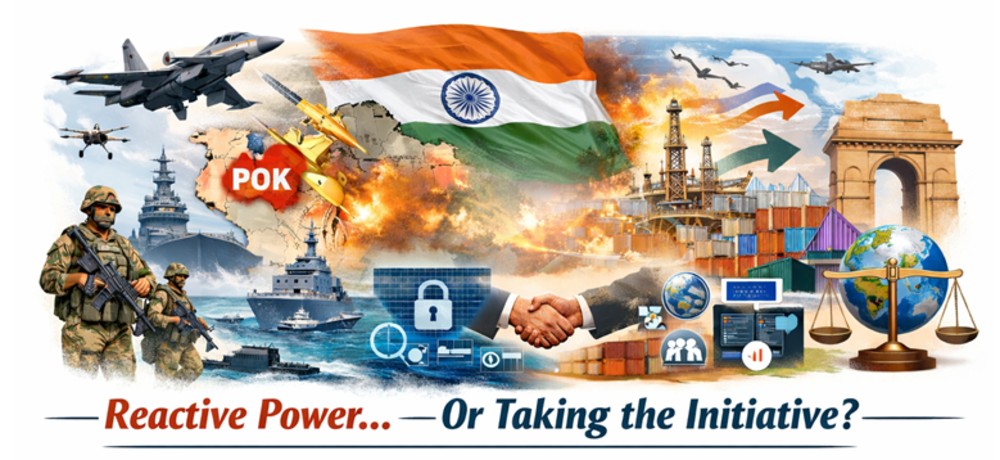
May 7, 2025 emerged as more than a date on the calendar; it entered national memory as a moment when India’s security doctrine appeared to acquire a sharper edge a defining moment in India’s strategic history marked the beginning of what has been described as ‘Operation Sindur.’ This was not just a response to the terror attack in Pahalgam on April 22, 2025, but also a clear signal of a major shift in India’s military strategy. During this operation, Indian forces reportedly targeted terror-linked infrastructure, while several observers suggested that the strategic messaging extended beyond conventional limits of response. For many observers, the operation represented not merely retaliation, but the articulation of a doctrine that increasingly values initiative over restraint.
Although the operation was paused on May 10, 2025, the message was clear,this was not an end, but a strategic pause. Now, in 2026, that pause continues to invite strategic speculation. The silence after such operations often carries as much meaning as the strike itself, because in strategic affairs, pauses are frequently periods of recalibration rather than withdrawal.
During recent public remarks on global uncertainty, the Prime Minister emphasized preparedness and national resilience, a message that some observers interpreted in wider strategic terms beyond immediate economic concerns. However, in strategic circles, it is also seen as a sign of broader national readiness. Such language carries layered meaning in a country where public memory of national disruption remains vivid and immediate. It is important to note that this readiness is not about creating fear, but about ensuring a resilient infrastructure that can withstand global shocks and internal disruptions. Ongoing mock drills, security reviews, and strong statements from the Defense Ministry suggest that India’s approach is no longer limited to waiting. The key question is: will India continue to react, or is it preparing to act on its own terms? Behind these developments lies a larger shift: preparedness is no longer military alone, it is civil, economic, digital, and psychological.
Recent conflicts in Ukraine and the Middle East have shown that long wars come with heavy economic costs. That is why any future strategy must focus not just on winning, but on achieving fast, precise, and decisive results. At the same time, maintaining economic strength and protecting supply chains will be equally important. In the modern era, a nation that preserves market confidence while sustaining strategic pressure often gains more durable advantage than one that simply dominates the battlefield.
Today, warfare is not limited to the battlefield alone. It also includes internal stability, digital security, and public awareness. Signals of public preparedness are not only about safety they are also about mental and technical preparedness. In modern conflicts, cyber space and information warfare play a major role. The success of any operation will depend on how well a country can protect its systems from cyber attacks, misinformation, and disruption. In the end, the strength of citizens and the stability of essential services become the foundation of victory. The confidence of ordinary citizens, uninterrupted communications, and trust in institutions now form an invisible front line that can decide how long a nation can sustain pressure.
Lessons from 1971 show that direct confrontation is not always the only path. Weakening an opponent by targeting their economic and strategic lifelines can be equally effective. This is why maritime routes and trade corridors are becoming more important. The growing role of the Navy highlights that sea power is now a key tool not just for defense, but for strategic pressure. At the same time, technologies like drone swarms and AI-based surveillance powered by India’s push for indigenous ‘Atmanirbhar’ defense tech are giving the nation a new kind of advantage. What was once considered support capability is now moving to the center of operational thinking, where indigenous systems may define both speed and strategic autonomy.
In this context, if regional strategic equations around PoK evolve further, it could go beyond territorial considerations and expand strategic reach toward Central Asia and Russia, potentially influencing future trade, energy, and connectivity discussions. However, any such development would also invite complex diplomatic scrutiny. In strategic discourse, such possibilities are often examined through doctrines such as pre-emptive self-defense, a concept frequently debated in international security and legal scholarship when states justify anticipatory action under perceived threat conditions. At the same time, managing China’s Belt and Road framework and uncertainty in Afghanistan would remain important strategic challenges. Every tactical development on the ground would therefore require equally careful diplomatic articulation before the international community.
Any future strategy must be judged not just by immediate gains, but by its long-term geopolitical impact. If a conflict arises, its effects will go far beyond the borders, influencing the economy, energy systems, and international relations. The true measure of success will lie in whether strategic assertiveness can coexist with economic confidence and diplomatic credibility.
“Operation Sindur 2.0” may not be an official reality today but it has become a question for the future: a phrase that increasingly reflects the national debate on whether India’s next major security decision will be reactive or transformational.
Will India remain a reactive power…
Or will this be remembered as the moment it chose to take the initiative? The answer may shape not only India’s military posture, but also the larger balance of power across the region in the years ahead.
