
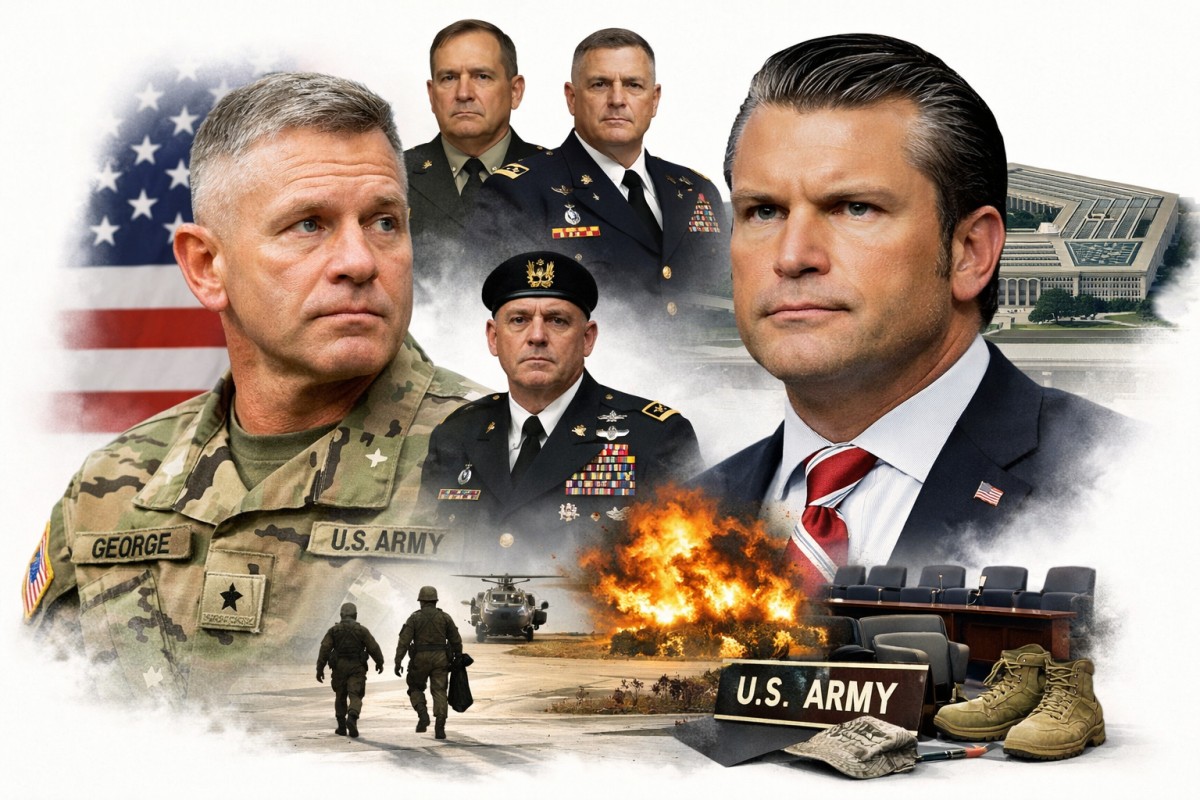
Washington, April 2, 2026: In a move that has sent ripples through the United States defence establishment, U.S. Defense Secretary Pete Hegseth has forced the early retirement of Army Chief of Staff Randy George, marking one of the most abrupt leadership shake-ups in recent military history.
General George, who had been expected to serve until 2027 as part of the traditional four-year tenure, was asked to step down immediately without any formal public explanation. His departure comes at a particularly sensitive time, as U.S. forces remain actively engaged in escalating military tensions linked to Iran.
The decision was not isolated. Alongside George, two other senior Army officers—Gen. David Hodne and Maj. Gen. William Green Jr.—were also removed, reinforcing the perception of a broader restructuring effort within the Pentagon.
Officials have indicated that Gen. Christopher LaNeve, currently serving as vice chief of staff, is likely to step in as acting Army chief. His proximity to the current leadership and alignment with the administration’s strategic outlook has fueled speculation that loyalty and ideological compatibility may be influencing key decisions.
Hegseth’s tenure has increasingly been defined by assertive interventions in military hierarchy. Since assuming office, he has overseen the removal or sidelining of several high-ranking officers across branches, often without detailed justification. Critics argue that such a pattern risks undermining institutional stability, especially during periods of geopolitical strain, when continuity of command is crucial.
At the heart of the tension lies a deeper ideological divide. Hegseth has been openly critical of sections of senior military leadership he perceives as aligned with past policy frameworks or supportive of internal reform initiatives. His recent actions appear aimed at reshaping the armed forces in line with a more traditional and centralised strategic doctrine.
The abrupt nature of General George’s removal has raised concerns within defence circles about morale and command cohesion. Military observers note that such high-level dismissals during a time of heightened global tensions are rare and potentially disruptive, particularly when operational readiness remains paramount.
While the Pentagon has formally acknowledged George’s decades of service, the absence of a clear rationale continues to fuel speculation. For many observers, the episode underscores a growing consolidation of authority within civilian defence leadership—one that may redefine the balance between political oversight and military autonomy in the years ahead.
