
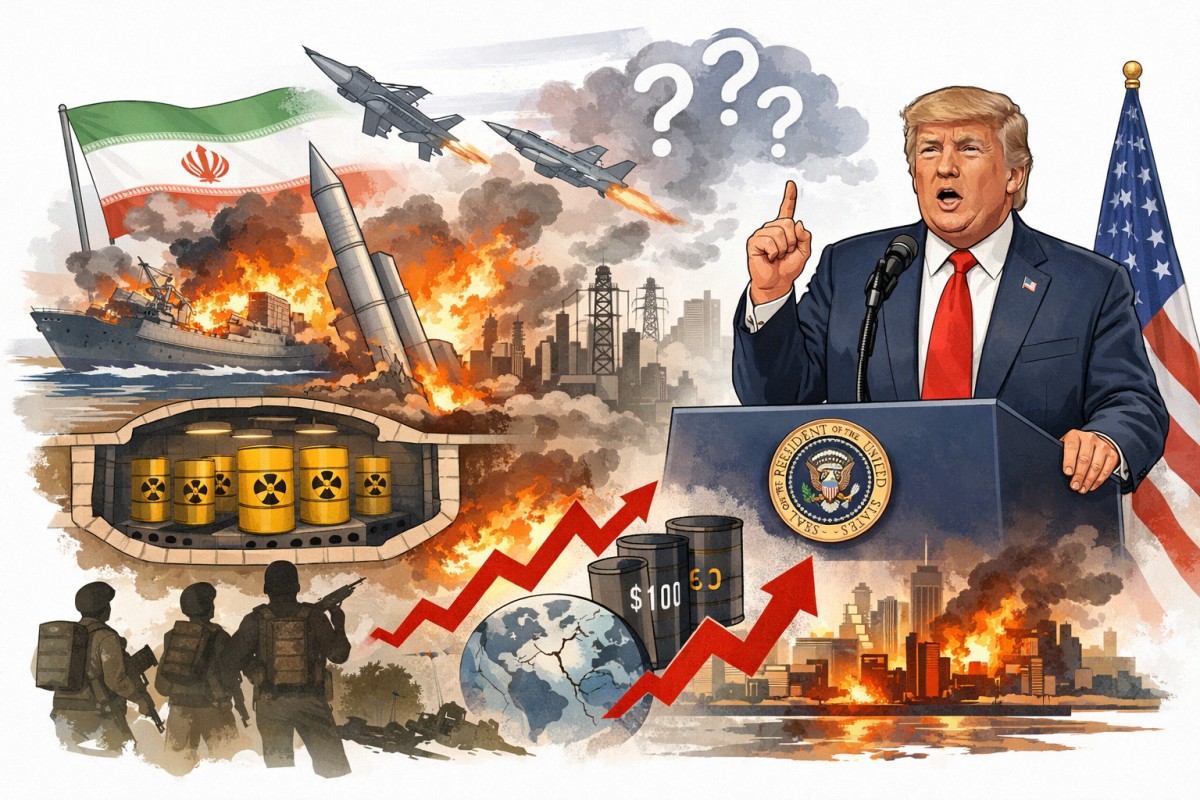
In a carefully staged national address, Donald Trump presented the ongoing conflict with Iran as a campaign nearing success, projecting confidence in military achievements while simultaneously hinting at further escalation. The tone was firm, even assured—but beneath the rhetoric, critical questions remained unanswered, leaving allies, markets, and observers navigating a fog of uncertainty.
Trump claimed that American forces had significantly weakened Iran’s military infrastructure, pointing to the destruction of key naval, air, and missile capabilities. The narrative was clear: the United States had acted decisively to neutralize a perceived nuclear and strategic threat. Preventing Iran from acquiring nuclear weapons remained the central justification—a position reiterated with urgency and conviction.
Yet, even as he spoke of progress, Trump acknowledged that Iran still retains enriched uranium stockpiles buried deep underground, a detail that subtly undercuts the assertion of near-complete success. The contradiction was difficult to ignore: if the threat persists, can the mission truly be considered close to finished?
More striking was the absence of a clearly defined endgame. While Trump suggested that operations could conclude within weeks, he stopped short of committing to any firm timeline, arguing that revealing specifics would benefit adversaries. This ambiguity, however, has done little to reassure a global audience already wary of prolonged conflict. Analysts and allies alike have expressed concern that the strategy appears fluid, if not improvised.
Compounding these concerns was Trump’s warning that the United States could intensify its offensive, including potential strikes on Iran’s oil and power infrastructure. Such statements, intended to signal strength, also raise the specter of broader regional destabilization—particularly in a region already strained by months of conflict.
The economic ripple effects were immediate. Oil prices surged sharply, and global markets reacted with visible anxiety, reflecting fears of prolonged disruption in energy supply chains. The strategically vital Strait of Hormuz—through which a significant portion of the world’s oil flows—remains a focal point of concern. Yet, notably, Trump stopped short of committing the United States to securing it, instead urging other nations to step in.
At a political level, the speech appeared aimed as much at domestic audiences as at international ones. With public skepticism growing and pressure mounting, the address sought to frame the war as both necessary and nearly won. However, the repetition of familiar arguments, without new clarity or direction, left many unconvinced.
To be clear, few dispute that Iran’s actions—particularly its nuclear ambitions and regional posture—have long been a source of global tension. But strength in intent does not automatically translate into clarity in execution. A strategy that oscillates between declarations of victory and threats of escalation risks creating more questions than answers.
In the end, the speech succeeded in projecting power, but not certainty. It reinforced the United States’ willingness to act, yet left unresolved the fundamental issue of how—and when—this conflict will truly end.
