
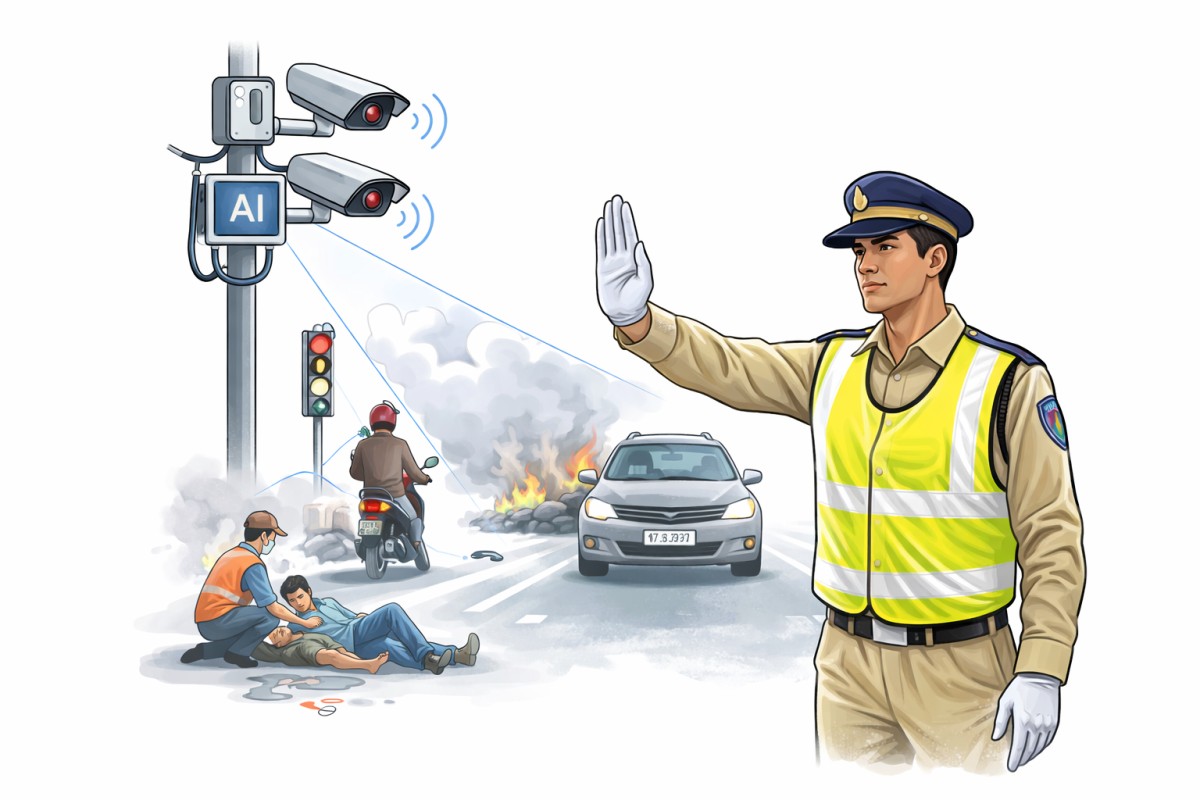
Every day, our roads tell stories—some of discipline, many of neglect, and far too many of tragedy. In recent years, the rise of AI-powered surveillance systems has introduced what many call an “invisible police”—a network of cameras silently recording violations, issuing fines, and attempting to enforce order without human intervention. It is a remarkable advancement, no doubt. Yet, to believe that technology alone can ensure road safety is to misunderstand the complexity of human behavior.
Cameras are efficient observers. They capture red-light violations, speeding incidents, and riders without helmets with impartial precision. They do not tire, they do not overlook, and they do not negotiate. But what they lack is presence—the very element that often prevents a violation before it even occurs. A driver approaching a junction behaves differently when a uniformed officer is visibly standing there. That psychological check, rooted in accountability and immediacy, cannot be replicated by a device mounted on a pole.
More importantly, roads are dynamic environments. Accidents, sudden congestion, reckless behavior, or medical emergencies require instant judgment and human response. A camera can record a collision, but it cannot manage the chaos that follows. It cannot direct traffic, assist the injured, or make real-time decisions that demand empathy and situational awareness. This is where the role of trained traffic personnel becomes indispensable.
The conversation, therefore, should not be framed as technology versus manpower. It must evolve into a collaborative approach where both complement each other. AI can strengthen enforcement by ensuring that violations do not go unnoticed, while on-ground police presence can ensure that rules are respected proactively and crises are handled effectively.
However, enforcement alone is not the ultimate solution. Road safety is as much a cultural issue as it is a regulatory one. Awareness campaigns must continuously remind citizens that rules are not obstacles but safeguards. Stricter penalties for habitual offenders can act as deterrents, but long-term change will only come when responsible driving becomes a shared social value rather than a forced obligation.
Public cooperation remains the cornerstone of this transformation. No system—no matter how advanced—can compensate for widespread disregard of basic norms. Wearing helmets, following signals, respecting lanes, and exercising patience are simple acts, yet they collectively define the safety of millions.
In the end, safer roads will not emerge from technology alone, nor from policing alone, but from a balanced integration of both, supported by a conscious and responsible society. Cameras may watch, and officers may guide—but it is ultimately the driver who decides whether a journey ends safely or becomes another statistic.
