
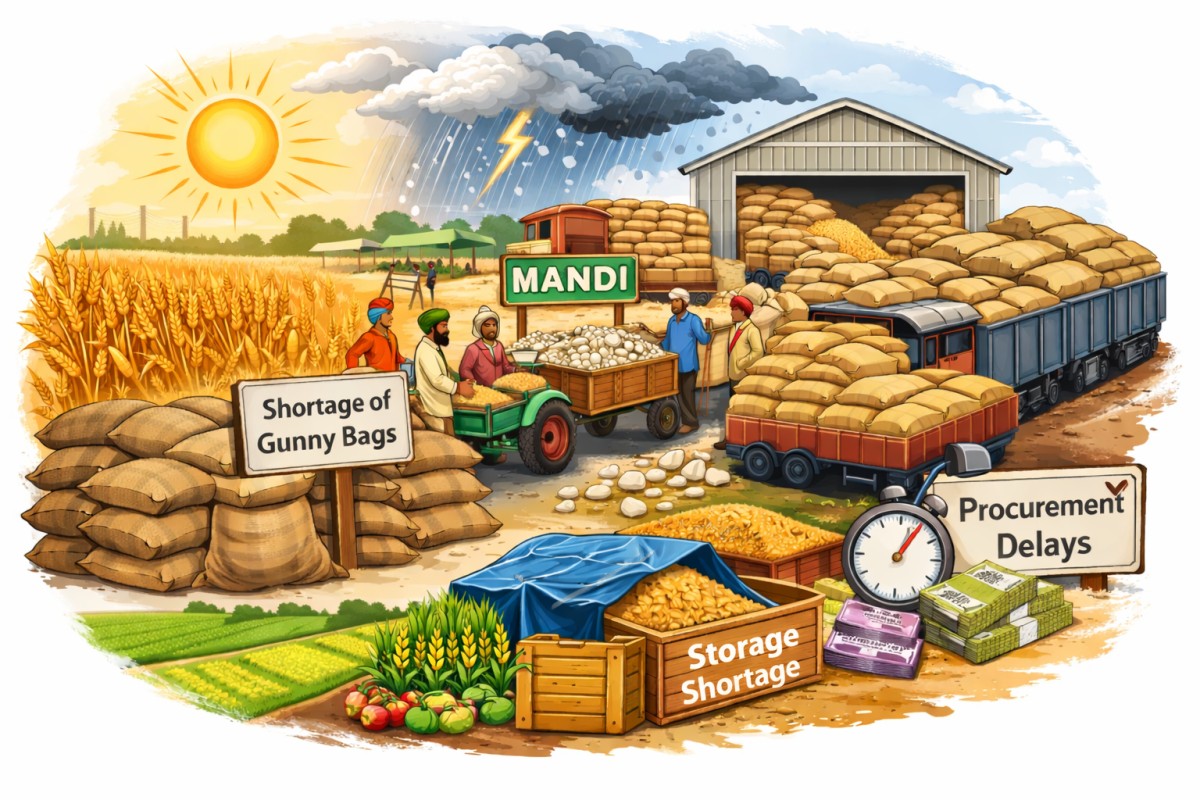
Punjab stands on the cusp of yet another abundant wheat season, with projections suggesting a harvest touching nearly 140 lakh metric tonnes—an achievement that should ordinarily inspire confidence, even quiet pride. Yet, beneath this promise of plenty lies a familiar unease, where systemic inefficiencies threaten to dilute the very gains that farmers have worked tirelessly to secure. For a state that has long carried the burden of feeding the nation, such moments ought to mark administrative readiness and institutional confidence; instead, they repeatedly expose the fragility of procurement preparedness precisely when efficiency is needed most.
The wheat fields may be ready, but the ecosystem meant to receive their yield appears far from prepared. As the harvest window unfolds through March and April, and mandi arrivals are expected to peak around Baisakhi, the state finds itself grappling not with scarcity, but with management. This paradox—of abundance coexisting with anxiety—has become an annual ritual, but in 2026, its contours appear sharper. The concern is no longer confined to isolated procedural delays; it now reflects a recurring pattern where every successful crop season is shadowed by doubt over whether the system can absorb what farmers produce.
One of the most pressing concerns is the glaring mismatch between production and storage capacity. With expected arrivals hovering around 125 lakh metric tonnes and storage availability lagging at roughly 100 lakh metric tonnes, a substantial gap looms large. Warehouses remain clogged with previous stock that has yet to be lifted, effectively choking the system before it even begins to absorb the new crop. This recurring congestion is more than a seasonal inconvenience—it reveals how inadequate evacuation planning continues to undermine procurement efficiency, despite years of warning and repeated experience.
Equally troubling is the anticipated shortage of nearly 5 crore gunny bags, a basic yet indispensable component of procurement. Without adequate packaging, even the most efficient procurement mechanisms risk grinding to a halt. The consequence is not merely logistical inconvenience; it translates into mandi congestion, delayed lifting, and ultimately, financial strain on farmers who depend on timely procurement for liquidity. For thousands of cultivators, every additional day that produce remains stranded in mandis means greater exposure to uncertainty, weather risk, and delayed cash flow—at a time when immediate liquidity is critical for clearing dues and preparing for the next crop cycle.
Overlaying these structural challenges are environmental uncertainties. A late-February heat spike had already raised concerns over grain quality, and unseasonal rains and hailstorms in March in parts of Punjab have compounded the risk. While these weather events may not significantly dent overall output, they have the potential to affect grain quality and complicate harvesting timelines, adding yet another layer of unpredictability. Even limited weather disturbances at this stage can influence moisture content, grain shine, and market acceptance—factors that often determine whether procurement remains smooth or slips into disputes over quality standards.
To its credit, the state has not remained passive. Requests have been made to expedite the movement of old grain stocks, and plans are underway to deploy special trains to transport wheat directly from mandis. Temporary storage solutions such as CAP structures and the use of vacant rice mill space are being explored. Even alternative packaging options like plastic and wooden crates are being considered to bridge the gunny bag deficit. These interventions demonstrate urgency, yet they also underline how frequently emergency arrangements have become part of routine procurement management rather than exceptional responses.
Yet, these measures, while necessary, feel largely reactive—short-term responses to a recurring structural problem. The deeper issue lies in the persistent misalignment between production capacity and procurement infrastructure. Punjab continues to produce at a scale that its storage, logistics, and policy frameworks struggle to sustain year after year. The contradiction is striking: agricultural productivity has advanced steadily, but institutional adaptation has not kept pace with the scale, speed, and complexity procurement now demands.
There is also a broader question that quietly lingers in the background: sustainability. The wheat-paddy cycle, long the backbone of Punjab’s agricultural economy, is increasingly being scrutinized for its environmental and logistical strain. Diversification into less resource-intensive crops is often suggested, but the transition remains slow, constrained by market assurances and policy inertia. Farmers remain understandably hesitant to move away from wheat and paddy when procurement certainty, minimum support pricing, and market confidence remain far stronger for established crops than for alternatives.
What emerges, therefore, is not a story of failure, but one of imbalance. Farmers have upheld their end of the equation with resilience and consistency, ensuring that the nation’s food security remains intact. The challenge now lies with institutions—to match that effort with systems that are equally robust, responsive, and forward-looking. The burden of adjustment cannot continue to fall disproportionately on cultivators who have already absorbed climatic, financial, and operational risks with remarkable resilience.
A bumper harvest should symbolize stability and strength. But unless the bottlenecks that accompany it are addressed with structural clarity and long-term intent, abundance will continue to arrive with a shadow of uncertainty—an irony that Punjab, and indeed the country, can ill afford to ignore. For if every season of agricultural success is met with avoidable logistical distress, the achievement itself begins to lose part of its meaning, and the celebration of plenty quickly turns into a test of institutional capacity.
