
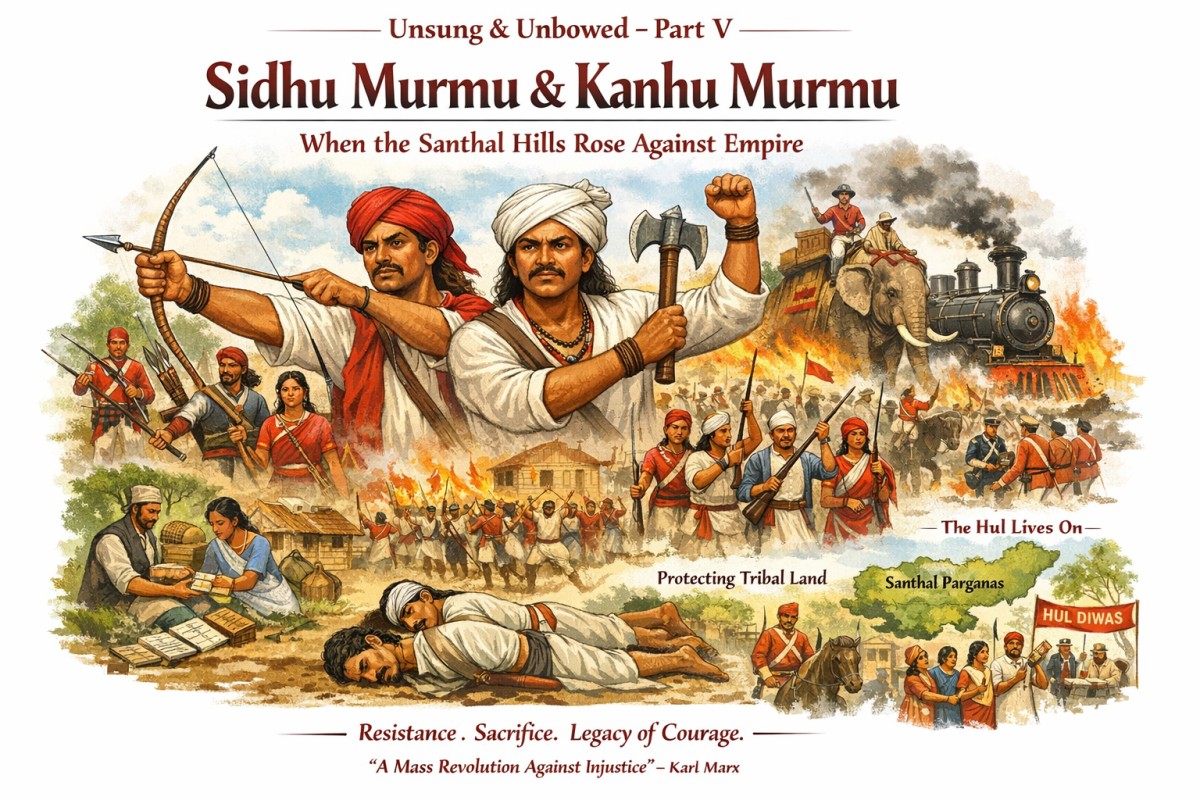
WHEN THE SANTHAL HILLS ROSE AGAINST EMPIRE
There are hours in history when the earth itself seems to listen—when wounded people, long denied justice, rise like a gathering storm and their collective cry travels farther than the commands of those who rule over them. The Santhal Rebellion (1855–1856), or the Hul, emerged from such an hour, when silence in the hills had become heavier than fear and endurance itself had begun to feel like surrender. It was the moral eruption of a people who had watched their dignity repeatedly pushed to the margins of their own land.
By the middle of the nineteenth century, the tribal world of the Santhals had begun to feel the weight of a changing order. A new system of revenue, policing, and legal control had entered everyday life, bringing with it unfamiliar structures that rarely understood local customs but quickly enforced authority. Alongside colonial administration came the dikus—outsiders comprising traders, moneylenders (mahajans), and revenue intermediaries whose influence grew rapidly under official protection. What had once been a social order rooted in land, community, and inherited rhythm began to bend under pressure from written contracts and usurious interest rates often exceeding 500%.
For many Santhal families, exploitation did not arrive dramatically; it entered gradually through everyday transactions. A small loan taken during hardship became a lifetime of bonded labor under systems like Kamioti and Harwahi. Land passed out of tribal hands through agreements that many never fully understood. Even when the land had been cleared and cultivated through years of labor, ownership no longer felt secure. Humiliation became part of ordinary life, reinforced by petty officials who exercised power without accountability.
The Divine Mandate and the Gathering Storm
It was in this atmosphere that Sidhu and Kanhu Murmu emerged as voices of unusual clarity. They did not speak as mere rebels; they spoke as messengers. Hailing from the village of Bhognadih, they claimed a divine mandate from Thakur Jiu (the Supreme Being), who they said had commanded them to rid the land of the “white man” and the “usurer.”
Along with their brothers Chand and Bhairav, and their sisters Phulo and Jhano—who led an army of women into the heart of the conflict—they began to gather people across villages. On June 30, 1855, nearly 10,000 Santhals assembled under the open sky. What was declared there was simple yet profound: oppression had crossed its limit. This was no longer just a protest; it was the declaration of a Santhal Raj.
The Fire of the Hul
The rebellion that followed did not arise from military academies. It drew strength from memory, terrain, and solidarity. Armed with bows, arrows, and battle-axes, the Santhal warriors—numbering nearly 60,000 at the height of the movement—targeted the institutions of their exploitation. They struck at police stations, railway construction sites, and the estates of oppressive landlords.
The colonial administration was unsettled not only by the violence but by the speed of mobilization. They had underestimated how deeply resentment had spread beneath apparent quietness. The British responded with overwhelming force, proclaiming martial law in November 1855. In a final, tragic irony of technology versus courage, Santhal warriors stood firm against war elephants and modern muskets. It is estimated that 15,000 to 20,000 Santhals were killed in the suppression.
A Legacy Written in Law
Sidhu Murmu was eventually betrayed and killed in 1855, and Kanhu was captured and executed in early 1856. Their deaths were intended to end the movement, but the deeper effect could not be extinguished.
The Hul forced the British to concede what they had long denied: that governing without justice is unsustainable. In the immediate aftermath, the colonial government carved out a separate administrative unit known as the Santhal Parganas. Most importantly, the rebellion eventually led to the Santhal Pargana Tenancy Act, which prohibited the transfer of tribal land to non-tribals—a legal shield that protects the community’s identity to this day.
Why the Santhal Rebellion Matters
The significance of the uprising lies in its scale and what it revealed about early resistance. Long before nationalism acquired organized language in later decades, tribal communities recognized that freedom begins when dignity refuses to accept systematic humiliation. Karl Marx famously noted the Santhal Rebellion as a “mass revolution,” recognizing it as one of the most significant anti-colonial struggles of its time.
Sidhu and Kanhu did not leave behind polished speeches. What remains instead is a stronger inheritance: the image of a community that stood upright before overwhelming power. Today, every June 30th, India observes Hul Diwas to remember that history is often carried forward by those whose names were never meant to endure, yet refused to disappear.
