
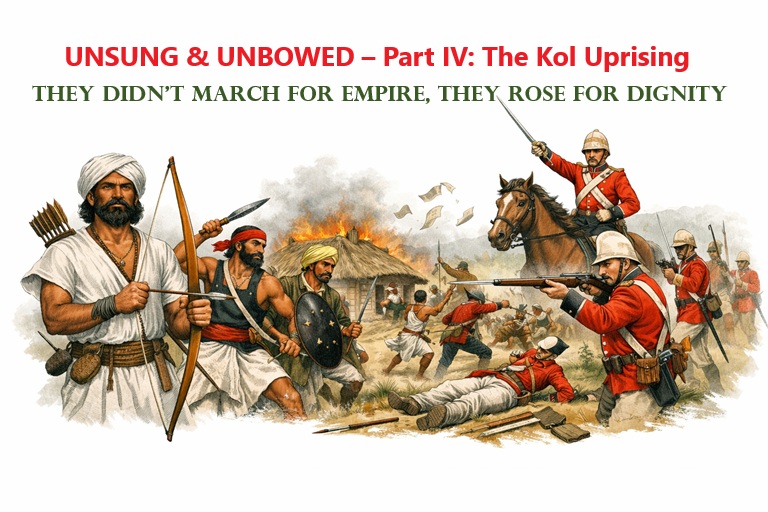
Long before nationalism acquired slogans, flags, and organised political vocabulary, resistance in India had already taken root in forests, hills, and remote settlements where survival itself became a political act. In 1831, across the Chotanagpur plateau of present-day Jharkhand, a powerful tribal rebellion erupted against a system that had begun to strip local communities of land, dignity, and authority. Known as the Kol Uprising, this was one of the earliest large-scale tribal assertions against colonial disruption in eastern India.
The uprising did not emerge suddenly. It had been gathering silently for years in villages where forests were shrinking under administrative maps and customary rights were being weakened by legal instruments no tribal elder had designed. For the Munda, Ho, Oraon and related communities grouped by colonial officials under the broad label “Kol,” land was never merely an economic asset. It was inheritance, ancestry, food, and faith tied together.
When East India Company rule extended deeper into Chotanagpur, the British introduced a revenue structure that altered local power relations dramatically. Traditional chiefs found themselves bypassed by new revenue agents, while outsiders—moneylenders, traders, leaseholders and landlords—entered the region with legal backing. These outsiders came to be known locally as “dikus,” a word that gradually carried the weight of distrust and resentment.
The British administration viewed land through records, taxation, and settlement rights. Tribal communities viewed it through collective belonging. This clash produced consequences that reached every household. Many cultivators lost control over ancestral land through debt agreements they scarcely understood. Revenue demands increased pressure on already fragile village economies. Court systems favoured those who knew procedure and language, leaving tribal communities exposed to manipulation.
What made the anger deeper was that colonial authority often appeared not in the form of distant British officers but through local intermediaries. The face of oppression was frequently a landlord collecting rent, a moneylender enforcing debt, or a court-backed outsider claiming ownership over fields cultivated for generations. This is why the uprising was directed both against British administrative structures and against those Indians seen as collaborators within that machinery.
Among the remembered names of this rebellion, Budhu Bhagat occupies a central place. He did not belong to elite political circles, nor did he lead through formal office. His authority emerged from trust among ordinary villagers who believed that silence had already become too costly. Budhu Bhagat became one of the strongest symbols of resistance in Chotanagpur because he represented a form of leadership rooted in community rather than hierarchy.
Alongside him, figures such as Joa Bhagat and several local chiefs contributed to mobilising resistance across scattered regions. Leadership in the Kol Uprising was not concentrated in one command centre. It moved from village to village, often shaped by local grievances but united by a common feeling that an entire social order was being pushed aside.
By late 1831, this resentment turned into organised action. Police stations, revenue centres, moneylenders’ establishments and settlements associated with exploitative authority came under attack. The rebellion spread across parts of Chotanagpur with speed that unsettled British officials. Forest terrain worked in favour of local fighters who understood routes, hills, and movement better than outside troops.
British records of the period reveal anxiety about the rebellion’s intensity. The concern was not simply about violence; it was about the possibility that tribal resistance could destabilise newly established authority in a region where administration remained fragile. Troops were sent to suppress the uprising, and military operations intensified across affected areas.
The repression was severe. Villages were searched, suspected rebels arrested, and local resistance networks broken through force. Budhu Bhagat himself became one of the most remembered martyrs of this phase when he was killed during British action against rebel groups. His death entered local memory not as defeat, but as testimony that tribal resistance had already announced itself long before later national struggles took shape.
What makes the Kol Uprising historically significant is that it exposed a central truth of colonial rule: power rarely arrived alone. It travelled with intermediaries, legal structures, and economic actors who benefited from disruption. For tribal communities, therefore, resistance naturally confronted both imperial authority and those who profited under its shelter.
This uprising also belongs to a larger sequence of early Indian resistances that emerged before 1857. Like the Paika Rebellion, the Khasi Rebellion, and the courage associated with Rani Chennamma, the Kol movement reflected a simple but profound instinct: communities may endure hardship, but they resist when authority begins to erase dignity.
There is something deeply emotional in remembering this history today. These were not armies marching for empire or ideology. They were villagers defending a moral geography—fields inherited from ancestors, forests tied to worship, and social systems threatened by distant decisions taken without consent.
The Kol fighters may not have left behind grand declarations, but they left a political lesson of lasting relevance: whenever governance forgets the language of justice, resistance eventually learns the language of courage.
And in 1831, courage spoke from the forests of Chotanagpur.
