
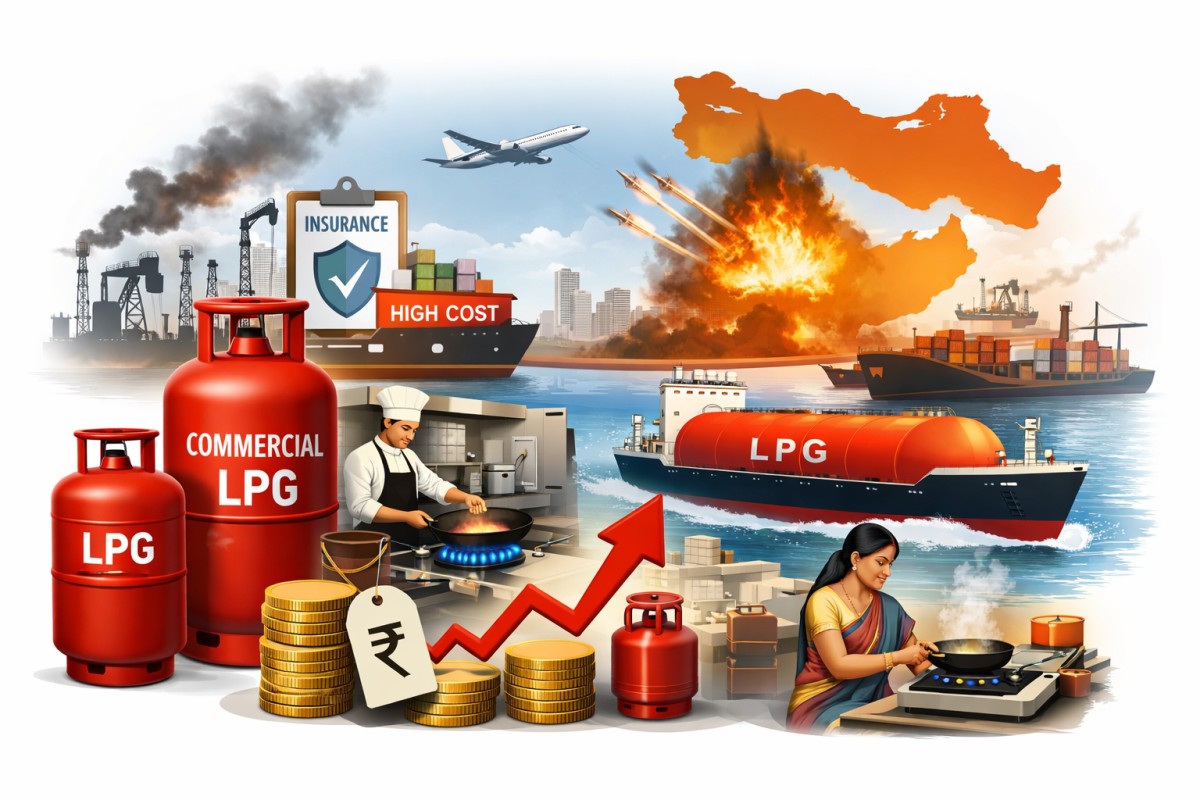
The above image is an illustrative representation, created with AI and does not depict actual individuals or events.
March 7, 2026, New Delhi : The ripple effects of the deepening military crisis in West Asia have reached Indian kitchens this weekend as oil marketing companies announced a significant hike in the prices of Liquefied Petroleum Gas. Effective from Saturday, the cost of a standard 14.2 kg domestic cylinder has been raised by 60 rupees, while the 19 kg commercial cylinder used by businesses and restaurants has seen a steeper jump of approximately 115 rupees. This marks the first major price revision for household consumers in nearly a year, ending a period of relative stability that had lasted since April 2025.
The price adjustment is a direct response to the volatile energy landscape in the Middle East, where recent military strikes and threats to maritime security have sent global crude and gas benchmarks soaring. In the national capital, a non-subsidized domestic cylinder now costs 913 rupees, up from the previous rate of 853 rupees. Similar increases have been implemented in other major metros, with prices in Mumbai reaching 912.50 rupees and Kolkata seeing a rise to 939 rupees.
Commercial entities are feeling a more immediate squeeze as the price for a 19 kg cylinder in Delhi climbed to 1,883 rupees. This follows a smaller increase earlier in the month, bringing the total cumulative rise for commercial gas to over 300 rupees since the start of the year. Industry experts suggest that the surge is largely driven by logistical bottlenecks and heightened insurance costs for tankers navigating the Strait of Hormuz, a critical waterway through which a significant portion of India’s energy imports must pass.
Despite the upward pressure on prices, government officials have moved to reassure the public regarding the country’s fuel security. While acknowledging the strain caused by the geopolitical situation, authorities stated that India maintains robust energy reserves and has successfully diversified its import sources to mitigate the risk of a physical shortage. Support remains in place for lower-income households under the Ujjwala scheme, where subsidies continue to provide a necessary cushion against the rising cost of living.
