
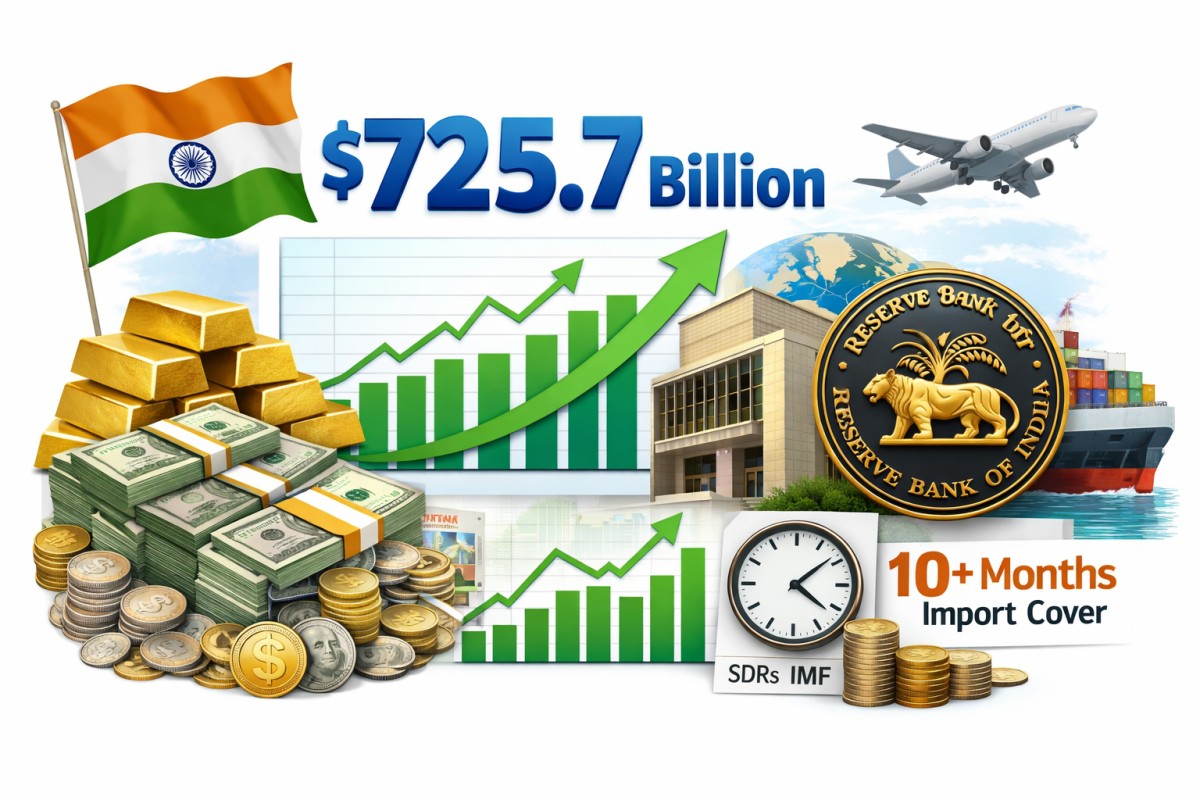
Mumbai, February 21, 2026: India’s foreign exchange reserves climbed sharply in the week ending February 13, reflecting strengthening external financial buffers and sustained investor confidence. According to the latest data released by the Reserve Bank of India, the country’s total forex kitty rose to approximately 725.7 billion US dollars during the reporting week, registering an increase of about 8.66 billion dollars compared to the previous week. The latest figure has approached the previous all-time high of around 723.8 billion US dollars recorded in late January, underscoring the sustained strength of the country’s external position.
Foreign currency assets, which constitute the largest component of the reserves, were the primary driver of the increase. These assets account for the bulk of the overall holdings and are influenced by changes in global currency valuations. Alongside this, India’s gold reserves also witnessed a moderate rise, while Special Drawing Rights and the reserve position with the International Monetary Fund remained broadly stable.
The rise in reserves provides India with a comfortable import cover of more than ten months, strengthening the country’s ability to manage external obligations and cushion against global volatility. At the current level of 725.7 billion US dollars, the reserves are estimated to be sufficient to finance approximately 10-11 months of merchandise imports, reinforcing India’s capacity to withstand external shocks. Higher reserves also enhance the central bank’s ability to intervene in currency markets to prevent excessive fluctuations in the rupee.
Economists attribute the surge to a combination of valuation gains in foreign assets, stable capital inflows, and resilient remittance flows from overseas Indians. The steady accumulation reflects prudent reserve management amid shifting global interest rate expectations and geopolitical uncertainties.
With the forex kitty standing near its historical peak in the week ending February 13, policymakers view the development as a positive signal for macroeconomic stability and external sector resilience in the months ahead.
