
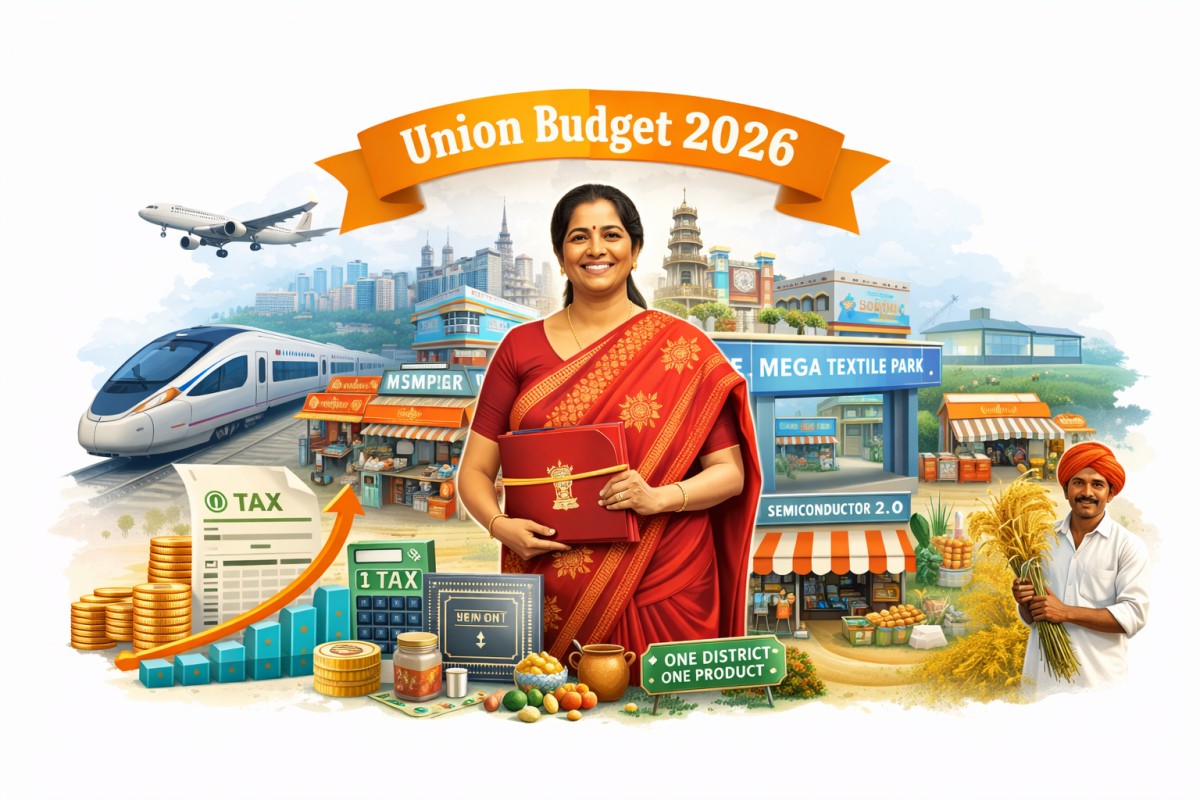
New Delhi, February 1, 2026 :The Union Budget 2026 was presented in Parliament with a wide ranging development blueprint focused on faster economic growth, middle class relief, infrastructure expansion and a stronger push toward a self reliant India. Described by the government as a policy framework built around 3 core objectives, the budget aims to boost economic momentum, meet public aspirations and advance inclusive development across sectors and regions.
Capital expenditure remains the backbone of the growth plan, with proposed public spending of about 12 lakh crore rupees for 2026–27. Infrastructure development has been given priority with the announcement of seven high speed rail corridors, expansion of rail and logistics capacity, and development of 20 new national waterways over the next five years. The budget also provides for revival of around 200 industrial corridors and clusters to rejuvenate manufacturing ecosystems. New aircraft repair and maintenance centres are planned in Patna and Varanasi, while smaller pilgrimage cities are set to receive targeted infrastructure and tourism support.
Technology and strategic manufacturing feature prominently in the policy direction. The Semiconductor 2.0 Mission proposed to launch to deepen domestic chip production and position India more strongly in the global electronics value chain. In the advanced health manufacturing space, a Biopharma Shakti programme with an allocation of 10000 crore rupees has been introduced to strengthen biotechnology and pharmaceutical innovation and production capacity.
Micro, small and medium enterprises are a central pillar of the budget’s industrial strategy. A Champion MSME Atam Nirbhar Bharat top up fund of 2000 crore rupees has been announced along with expanded credit and modernization support. Policy measures encourage MSME development aligned with new market trends, digital adoption and creative economy opportunities.
The textile and traditional sectors receive dedicated attention through the establishment of Mega Textile Parks and expanded coverage under the Mahatma Gandhi Handloom Yojna. The Mahatma Gandhi Swaraj Yojna has been introduced to strengthen village and community based industries. Priority has also been indicated for environmentally responsible textile production under a Tex Eco approach. The One District One Product programme will continue to be scaled up to promote region specific goods, crafts and export potential.
Agriculture and rural development measures include new initiatives to improve productivity, credit access and crop diversification, alongside continued digitisation of welfare delivery systems to improve transparency and targeting. Skill development, vocational training and sports infrastructure have received higher allocations to align youth capabilities with emerging industry needs.
On the macroeconomic front, the government reiterated its commitment to fiscal discipline while sustaining growth oriented spending. A review of foreign exchange arrangements and trade facilitation mechanisms has been proposed to strengthen resilience amid shifting global financial conditions. Tax administration reforms and compliance simplification measures are set to continue to provide greater predictability for businesses and individuals.
Taken together, the Budget 2026 combines tax relief, infrastructure scale up, sector specific missions and MSME empowerment with social and rural support measures, presenting a comprehensive roadmap for sustained and broad based economic expansion.
