
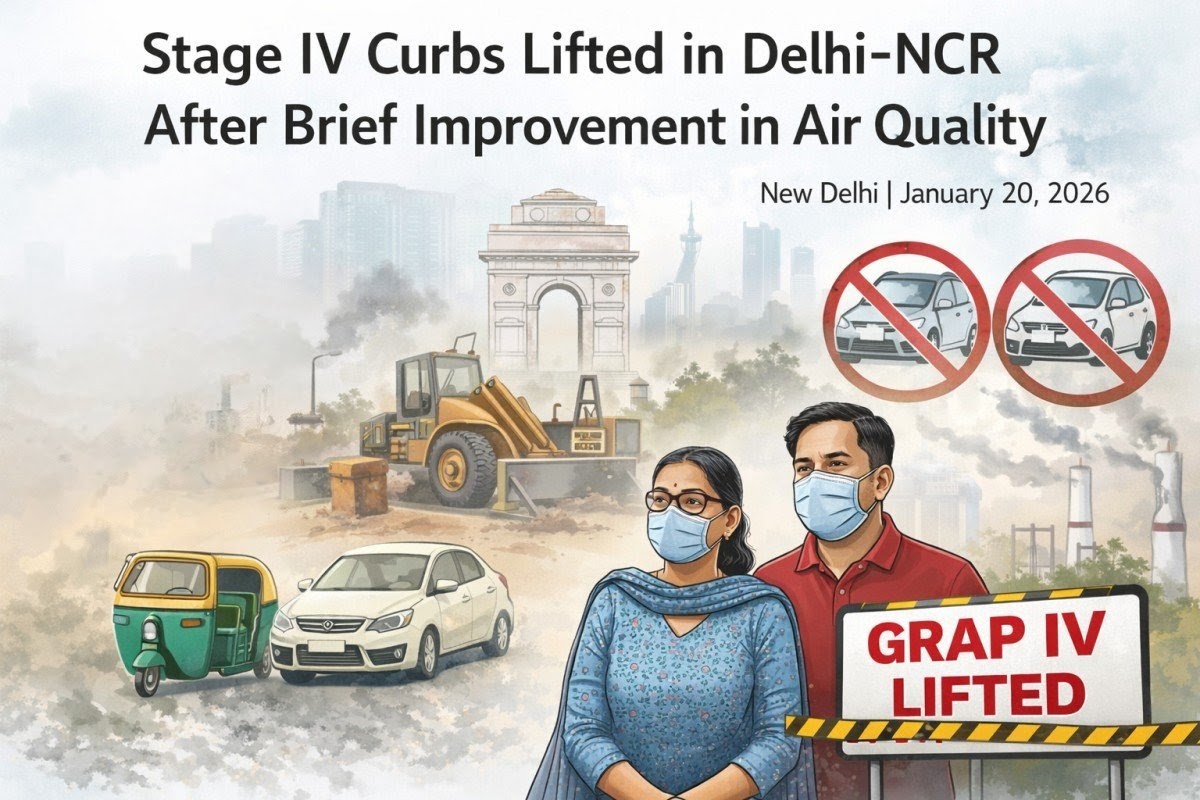
New Delhi, January 20, 2026 : The Commission for Air Quality Management (CAQM) on Tuesday revoked Stage IV restrictions under the Graded Response Action Plan (GRAP) in Delhi-NCR, citing a marginal but consistent improvement in air quality levels across the region. The decision comes barely three days after the stringent measures were reimposed following a sharp deterioration that pushed the Air Quality Index (AQI) into the ‘severe’ category.
According to the official order, while GRAP Stage IV has been withdrawn with immediate effect, preventive measures prescribed under Stages I, II and III will continue to remain in force. The commission underlined that the partial relaxation should not be interpreted as a complete rollback of pollution control efforts, particularly given the prevailing winter conditions that are known to hinder atmospheric dispersion.
CAQM noted that recent meteorological factors, including improved wind speed and slight changes in weather patterns, have contributed to better air quality readings. However, it cautioned that the situation remains fragile and could deteriorate rapidly if precautionary measures are not strictly followed by both authorities and citizens.
In its advisory, the commission urged residents to adhere to the citizen charter outlined under GRAP Stages I to III to prevent a resurgence of severe pollution levels. It stressed that vehicular emissions, dust from construction activities and industrial pollution continue to pose significant risks during the winter months.
Under Stage IV of GRAP, private vehicles are not subject to a blanket ban, but restrictions are imposed based on emission norms and fuel type. Specifically, BS-III petrol and BS-IV diesel vehicles are barred from operating in Delhi-NCR during this stage, except those engaged in essential services. With the revocation of Stage IV, these prohibitions have been eased, though older and more polluting vehicles remain under scrutiny as per the lower stages of GRAP.
The commission also acknowledged that the Delhi-NCR region has been grappling with elevated pollution levels for several months, marked by frequent fluctuations between ‘very poor’ and ‘severe’ AQI categories. It warned that any laxity in enforcement or public compliance could necessitate the reintroduction of stricter curbs at short notice.
Officials reiterated that GRAP-IV is activated when the AQI crosses the 450 mark, signalling ‘severe plus’ conditions. They added that continuous monitoring is underway and further action will be taken if air quality indicators show signs of deterioration in the coming days.
The decision reflects a cautious approach by the authorities, balancing short-term relief for residents with the need for sustained vigilance during one of the most pollution-prone periods of the year.
