
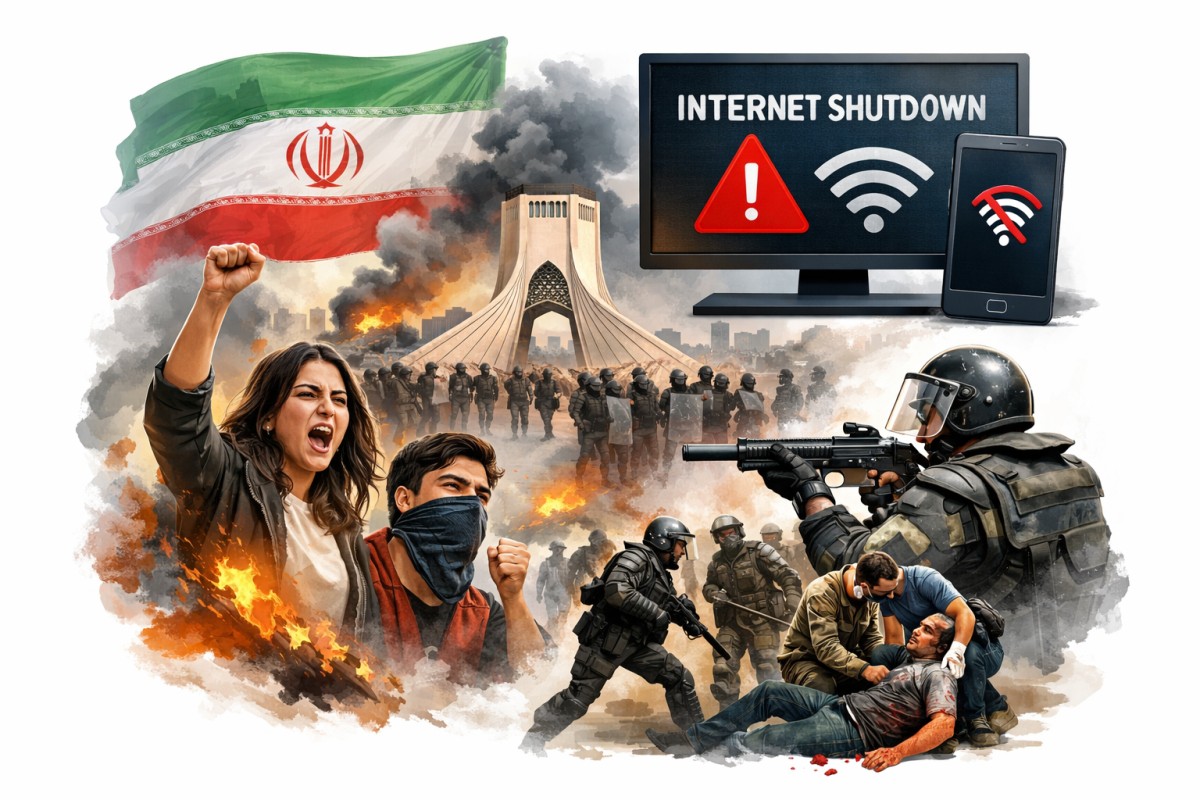
Iranian authorities have imposed sweeping restrictions on internet and communication services across the country amid a renewed surge of anti-government protests, as reports from rights groups indicate that dozens of people have been killed since unrest escalated earlier this month.
According to multiple monitoring organizations and regional media outlets, mobile data services, broadband access, and popular messaging platforms were disrupted or suspended in large parts of the country from early Tuesday morning. The shutdown has affected major urban centres as well as several provincial areas, significantly limiting the flow of real-time information from inside Iran.
Government officials have justified the move as a measure aimed at maintaining public order and national security. However, critics argue that internet restrictions have historically been used to curb mobilisation, restrict independent reporting, and obscure the scale of security operations during periods of unrest.
Clashes reported in Tehran and multiple provinces
Fresh confrontations between demonstrators and security forces were reported in parts of Tehran, including central districts and surrounding neighbourhoods, according to eyewitness accounts and medical volunteers quoted by rights groups. Protesters, many of them young people and students, were seen chanting slogans critical of senior leadership and demanding broader political and social reforms.
Unrest has also been reported in several provinces, including Khuzestan, Isfahan, and Kurdistan, where local sources described mass arrests, damage to public property, and the deployment of additional security personnel. Human-rights organisations have alleged that live ammunition and crowd-control weapons were used in some locations, though authorities have not released detailed casualty figures.
Death toll disputed amid information blackout
Independent verification remains difficult due to the communications blackout. However, human-rights monitors estimate that at least 45 people may have been killed since protests reignited in early October, with hundreds more injured or detained. Official figures have not been publicly confirmed, and past incidents suggest that casualty numbers often emerge gradually after restrictions are lifted.
Groups such as Amnesty International and Human Rights Watch have called on Iranian authorities to halt the use of lethal force, release arbitrarily detained protesters, and restore full access to the internet and communication services.
International concern grows
The unfolding situation has drawn international attention, with several governments and multilateral bodies expressing concern over the use of force and the suppression of digital communications. The United Nations Office of the High Commissioner for Human Rights urged Iranian authorities to respect the right to peaceful assembly and ensure the protection of civilians.
Officials in the United States and the European Union have warned that continued violence and restrictions could lead to additional diplomatic measures, including targeted sanctions. Analysts note that prolonged internet shutdowns may further isolate Iran internationally and complicate humanitarian and medical coordination efforts.
Situation remains fluid
As of now, security forces continue to maintain a strong presence in protest-prone areas, while internet access remains severely restricted in much of the country. Observers warn that without de-escalation and transparent communication, the risk of further casualties and wider instability remains high.
At a Glance
- Internet and messaging services restricted nationwide
- Protests reported in Tehran and multiple provinces
- Rights groups estimate at least 45 deaths, figures unverified
- Allegations of live fire and mass arrests
- International calls for restraint and accountability
