
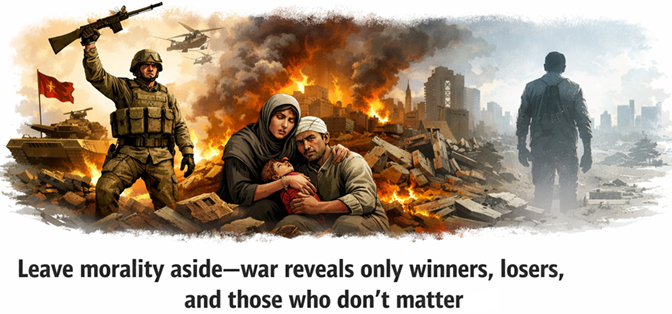
“When empires indulge their follies, it is nations that pay the price.” In West Asia today, that price is not abstract—it is cities reduced to rubble, economies pushed to the brink, and ordinary lives permanently altered.
The on-going confrontation involving Iran on one side and the combined force projection of United States and Israel on the other is being shaped less by facts and more by narratives. Across media platforms and political circles, the conflict is increasingly framed as a symbolic standoff—of resistance versus dominance, ideology versus power. But war, stripped of sentiment, speaks in harder terms: the scale of destruction, the number of lives lost, the economic damage inflicted, and the years required to rebuild. By that measure, the balance is far from equal.
The side that absorbs greater structural damage, whose civilians face direct and prolonged suffering, and whose economy is set back by decades is the side that is losing—regardless of how loudly it claims otherwise. Iran today finds itself in that position. Its infrastructure is under strain, its economic lifelines are choked by both conflict and sanctions, and its population bears the cumulative burden of instability. Retaliation may create moments of tactical visibility, but it does not rebuild destroyed cities or restore lost livelihoods.
By contrast, the United States and Israel operate with a decisive structural advantage. Their wars are externalized. Their cities remain largely insulated, their economies continue to function without existential disruption, and their military capabilities are replenished with relative ease. Losses, where they occur, are contained and do not translate into national regression. This asymmetry is often ignored in public discourse, replaced instead by selective narratives that confuse momentary resistance with strategic parity.
History has already written this script. Iraq stands as a stark reminder of what prolonged confrontation with United States military power can lead to. Once a nation with functioning institutions, infrastructure, and a defined economic framework, it descended into years of instability following invasion and conflict. Decades later, it continues to grapple with political fragility, economic strain, and social disruption. Compared to where it stood thirty years ago, the regression is unmistakable. War did not elevate it; it hollowed it out.
What is unfolding now carries echoes of that past. When leadership leans into rigid ideology, when religious chauvinism and national pride override pragmatic decision-making, the cost is borne not by those in power but by the nation itself. A country does not merely lose a war—it loses time. Years of development vanish, institutions weaken, and an entire generation inherits uncertainty instead of opportunity. This is how nations are pushed twenty years back, not by defeat alone, but by stubbornness disguised as strength.
Equally dangerous is the ecosystem of misinformation surrounding the conflict. Claims that the United States is “losing” or “suffering” are not grounded in the realities of modern warfare. A nation whose economic engine continues uninterrupted, whose civilian infrastructure remains intact, and whose global influence is undiminished is not losing in any conventional or strategic sense. These narratives, often amplified by partisan media and geopolitical sympathies, obscure the actual cost being paid on the ground.
Amid this, several countries have revealed their diminishing relevance. India, despite its ambitions of being a decisive global player, has struggled to assert a clear and consistent position. The absence of firm red lines or meaningful diplomatic intervention reflects a broader hesitation. This is not merely a question of foreign policy optics; it has tangible consequences. Energy dependencies, disrupted trade routes, and regional instability directly impact India’s economic interests. In trying to balance all sides, it risks being consequential to none.
At the same time, there are countries quietly gaining from the conflict. Arms-exporting nations benefit from increased demand. Energy-rich states leverage price volatility to their advantage. Strategic intermediaries elevate their diplomatic standing by positioning themselves as negotiators or logistical hubs. In every prolonged conflict, influence shifts—not always to those who fight, but often to those who remain just outside the battlefield, calculating their gains.
This war is not a moral contest. It is a ledger of loss and resilience. The nation that sees its infrastructure shattered, its people displaced, and its future compromised is losing—regardless of how it frames its resistance. The nation that sustains its economic strength, protects its homeland, and continues to shape global dynamics is winning—regardless of criticism.
In the end, the harsh truth remains: wars are not decided by narratives, but by what is left standing when they are over.
