
Writing this article is unusually difficult. The narratives are changing every minute. What appears definitive at one hour is revised the next. There is no certainty that this assessment will remain fully relevant by the time it reaches readers. In a conflict shaped by live statements, counter-claims, and rapid military developments, even language struggles to keep pace.
Iran’s Supreme Leader’s death has ruptured the nation’s political core. Authority once concentrated in a single figure is now contested among clerics, security institutions, and elected bodies. For citizens, though, the crisis is measured not in survival — the price of bread, the value of the rial, the grip of sanctions. Meanwhile, global capitals weigh exposure: oil flows, shipping corridors, and financial risk. In global capitalism, caution moves faster than compassion.
History shows that in moments like this, the emotional weight felt by citizens rarely matches the tone of international diplomacy.
Power Realignment and Competing Futures
Iran’s system places sweeping authority in the hands of the Supreme Leader — spanning the military, judiciary, and foreign policy. His death has unsettled the internal balance between religious leadership, security institutions, and elected bodies. The struggle ahead is not just about succession, but about who ultimately shapes the state’s direction.
For ordinary Iranians, however, the crisis is immediate. It is about whether the rial falls further, whether inflation tightens its grip, whether sanctions deepen isolation. In homes and markets, survival matters more than ideology.
Meanwhile, external voices are attempting to define the moment. Reza Pahlavi’s proposed “Prosperity Project” frames the rupture as an opportunity for democratic transition and economic reintegration. Whether that vision finds traction inside Iran remains uncertain.
Beyond its borders, though, the dominant concern is not reform but risk — oil flows, regional stability, and strategic alignment. While Iranians debate their future, much of the world is calculating exposure.
Markets React Before Mourning Ends
Energy markets moved almost instantly. Iran’s position near the Strait of Hormuz makes instability there a global economic concern. Even countries that do not directly import Iranian crude are vulnerable to price shocks.
Insurance premiums have fluctuated. Freight costs are under review. Shipping corridors are being reassessed. For energy-importing economies including India and several East Asian nations, even a modest surge in oil prices can ripple into inflation, currency pressure, and political strain.
Multinational corporations are equally alert. Businesses exposed to U.S. financial systems understand that escalation could revive sanctions regimes or secondary penalties. Access to American markets and dollar-denominated transactions often outweighs moral positioning.
Washington’s Shadow — and the Pattern of New Americanism
Under President Trump, U.S. foreign policy has increasingly reflected what critics describe as a new form of assertive Americanism — transactional, unilateral, and willing to employ military and economic leverage with limited multilateral consultation.
From Ukraine and Russia to Venezuela; from Israel-Palestine to tensions involving Greenland; from the India–Pakistan dynamic to conflicts in Africa such as Rwanda–DRC; from Armenia–Azerbaijan to the Nile dispute between Egypt and Ethiopia; and now to Iran’s crisis — Washington’s imprint is visible, whether through sanctions, mediation attempts, arms transfers, coercive diplomacy, or decisive military action.
The Iran strikes sit squarely within this broader pattern.
Yet one of the most revealing aspects of the global reaction is this: few countries have openly condemned the U.S.–Israeli attack on Iran. Beyond Russia, China, and nations like North Korea, public denunciations have been limited. Many Western and allied governments instead issued neutral statements urging restraint or simply condemned Iran’s retaliatory missiles — without challenging the legality or morality of the original strikes themselves.
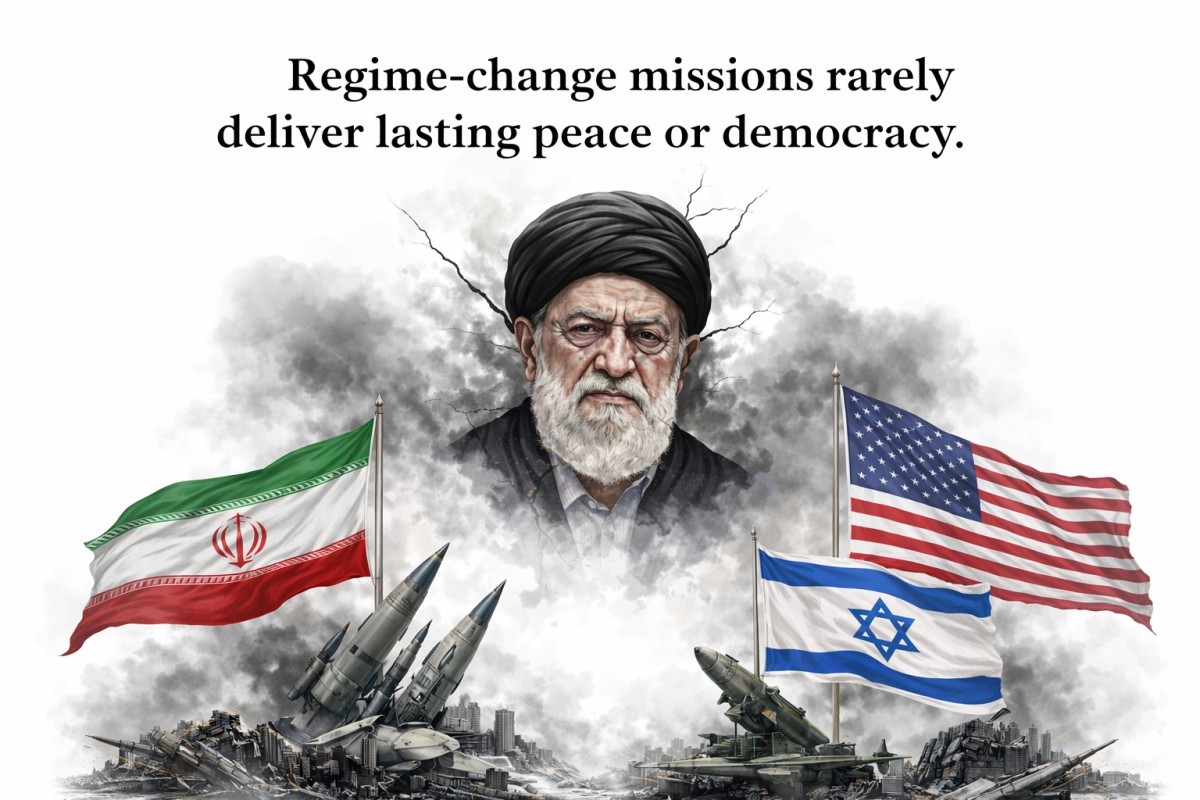
Within the United States itself, major newspapers and opinion pages have noted a troubling historical pattern: whenever American administrations have attempted to instigate regime change abroad, the outcomes have most often been destabilising or disastrous. Examples cited repeatedly include Libya’s fragmentation after NATO-led intervention, the long aftermath of U.S. withdrawal from Afghanistan, and earlier episodes where intervention did not lead to stable governance. These assessments caution that regime-change missions tend to fail to deliver the peace and democracy they promise, instead leaving power vacuums and humanitarian crises in their wake.
The concern echoed in these domestic debates is whether history is repeating itself.
The Human Element, Faint but Real
Inside Iran, grief, anger, fear, and uncertainty coexist. Some citizens mourn leadership figures. Others confront economic and social anxiety. Younger generations, already navigating hardship, wonder whether this will be a turning point toward reform — or the beginning of a more protracted struggle.
International organisations have issued statements urging restraint and humanitarian continuity. Yet global headlines remain dominated by oil benchmarks, casualty claims, and sanction scenarios rather than the lived experience of Tehran’s city workers, university students in Isfahan, or families in Shiraz already burdened by inflation and hard currency shortages.
Strategic Silence and Calculated Distance
Regional actors — Gulf states, the European Union, and major countries such as India — are observing developments primarily through security lenses. European governments, wary of escalation, have called for de-escalation while avoiding direct confrontation with Washington. Strategic alignment remains central to their calculations.
Publicly, leaders speak of stability. Privately, discussions focus on exposure — financial, military, and diplomatic.
The uncomfortable reality is this: while Iran navigates shock and uncertainty, much of the international community is focused on safeguarding its own strategic and economic interests.
Conscience or Convenience?
Transitions of power are always fragile. In Iran’s case, that fragility has been intensified by military escalation and stark casualty claims that have shaken the region. While initiatives like the “Prosperity Project” speak of renewal and reinvention, others fear the country could slip into deeper uncertainty.
What stands out is not only Iran’s internal struggle, but the tone of the global response. Reactions appear driven less by principle and more by alignment, leverage, and national interest.
The world is watching — but it is watching from a careful distance.
When this chapter is written into history, the question may not be limited to how Iran endured it. It may also ask whether the international community chose conscience — or convenience — and whether once again regime change was mistaken for resolution.
