
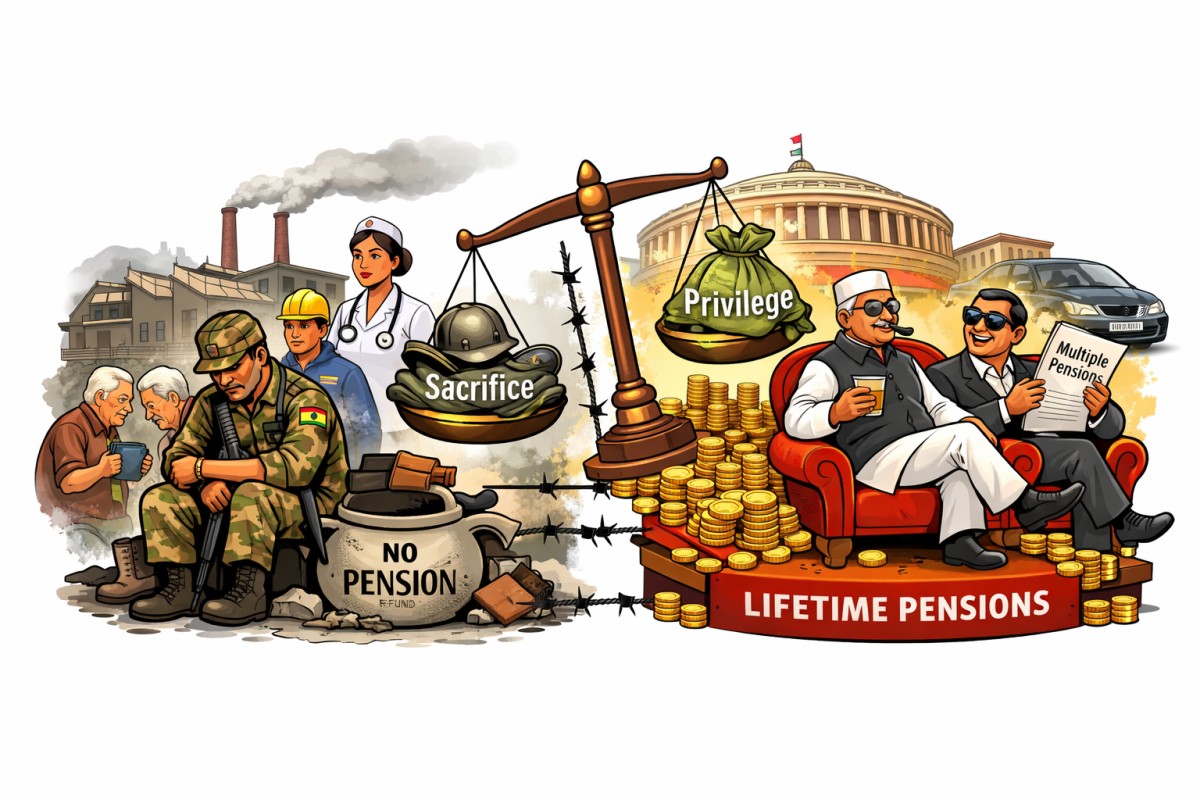
“The politician who makes his own life comfortable at the expense of the people is not a servant, but a burden.”
In the world’s largest democracy, a devastating rift has formed—not of ideology, but of destiny.
On one side stands the Indian citizen—the soldier, the teacher, the nurse, and the factory worker—whose retirement is increasingly defined by market risks and contractual limits. On the other stands the political class, shielded by a golden parachute that remains untouched by the economic gravity they impose on everyone else.
This is no longer a matter of mere budgetary math; it is a profound moral crisis.
The Architecture of Entitlement
While the average Indian is told that the era of guaranteed pensions is a fiscal impossibility, the legislative framework tells a different story for its authors. Under existing laws, a single term in office secures a lifetime of support. But the real friction point lies in what many critics describe as the multi-dipping phenomenon.
The Pension Stack: A politician who serves in a state assembly and later moves to Parliament can draw separate, cumulative pensions from both institutions.
The Executive Bonus: Ministerial roles often bring additional layers of benefits, creating a stream of income that continues long after their tenure in office.
The Inflation Shield: While private-sector laborers watch their savings erode with rising prices, political pensions are often indexed, protecting the elite from the very inflation that policy failures can produce.
Sacrifice vs. Privilege: The Agniveer Contrast
The inequity becomes especially stark when viewed through the lens of the Agnipath Scheme. Young Indians are asked to dedicate their most energetic years to the defense of the nation, yet for a large majority of them the journey ends after four years with a one-time Seva Nidhi package and no pension.
These young men and women serve in uniform and face real risks, yet they do not receive the lifelong security associated with traditional military service. The symbolism is stark: the soldier’s sacrifice is rewarded with uncertainty; the politician’s tenure, with permanence. The Vanishing Social Contract
The erosion of long-term security is not limited to the armed forces. It is spreading across both public and private sectors through several structural shifts.
The Contractual Trap: From government hospitals employing outsourced nurses to academic institutions hiring contractual staff, the concept of the permanent job is gradually disappearing. Workers who sustain public services are increasingly treated as temporary manpower rather than citizens entitled to stability.
The Industrial Struggle: In factories and mills, laborers spend decades in difficult and often hazardous conditions, only to retire into financial uncertainty with modest provident funds or none at all.
The Pension Rollback: Many public institutions and universities are being pushed toward contributory systems such as the National Pension System or provident funds, shifting the burden of retirement security from the state to the individual.
Two Realities, One Nation
The divide between the governing and the governed becomes most visible in the contrasting realities of their later years.
For the citizen, retirement is shaped by contributory survival, where personal savings determine dignity in old age. These workers are repeatedly asked to tighten their belts in the name of fiscal responsibility.
For the politician, however, retirement often carries institutional permanence. A single term in office can unlock benefits that an ordinary person might struggle to accumulate in forty years of work. While austerity is preached to the masses, the architects of these policies remain insulated from their consequences.
Beyond the Marble Halls
For the common citizen, fiscal discipline increasingly means the withdrawal of the state’s protective hand. Yet that discipline often disappears when it reaches the corridors of power.
It is difficult for taxpayers to accept that a nation cannot afford stronger social security for its workers while continuing to fund cumulative pensions for individuals who have served in multiple legislative offices.
The Mirage of Impossibility
Public debate often frames a guaranteed social safety net as financially unrealistic. Yet policy experiments challenge this assumption. The “One MLA, One Pension” reform introduced in Punjab demonstrated that significant savings could be achieved by limiting cumulative legislative pensions.
If governments can justify limiting military careers or restructuring civilian retirement benefits to save public funds, then multiple pensions for political officeholders appear less like a necessity and more like a policy choice.
Restoring the Social Contract
The health of a democracy is ultimately measured by how it treats those who serve it. Soldiers guard its borders, nurses preserve its health, teachers shape its future, and laborers sustain its industries.
When their security becomes uncertain while political privilege remains guaranteed, the social contract begins to erode.
True reform is not merely about balancing budgets. It is about restoring faith that public service is guided by responsibility rather than entitlement. A democracy flourishes when its leaders share the same economic realities as its citizens.
In a nation built on the promise of equality, no servant should stand above the people they claim to represent.
A nation’s promise fades when its guardians retire in shadows while its rulers rest in light; democracy endures only when dignity in old age belongs to all, not just the powerful.
