
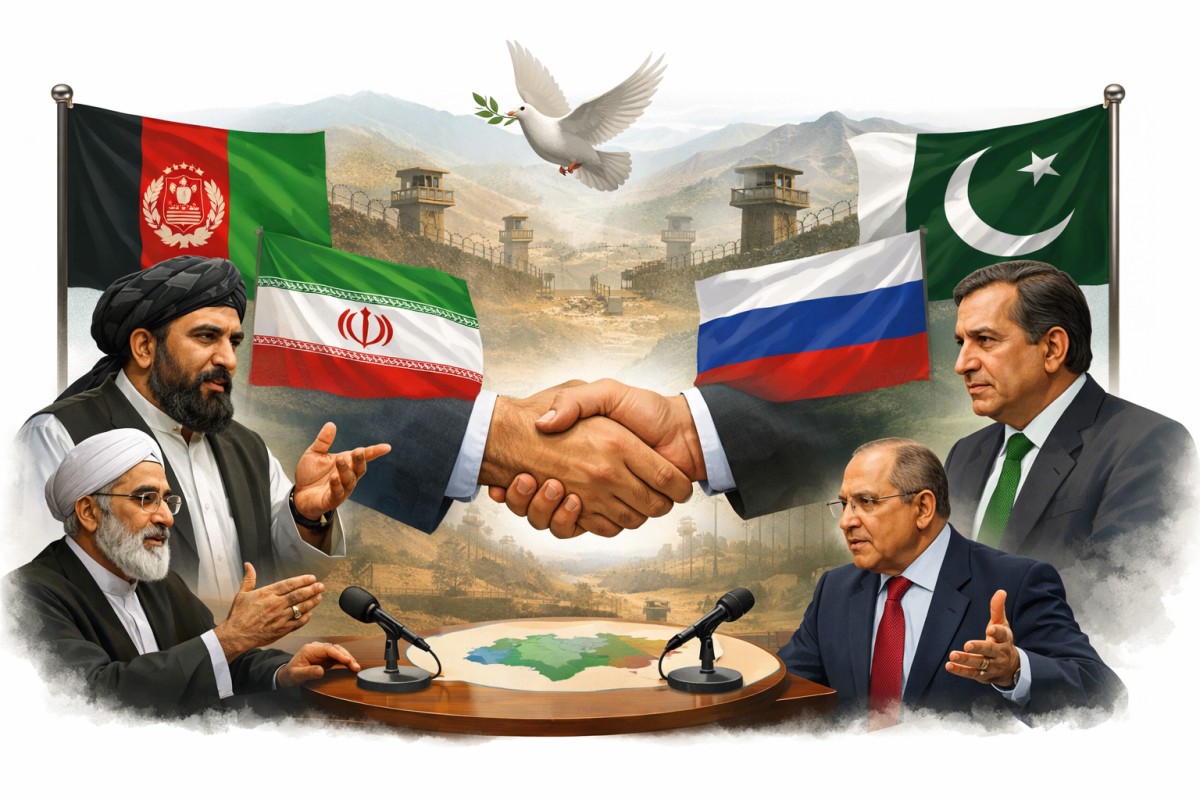
The above image is an illustrative representation, created with AI and does not depict actual individuals or events.
Kabul, February 27, 2026 — The Afghan government has formally expressed its commitment to resolving intensifying military friction with Pakistan through diplomatic channels, following a series of heavy cross-border exchanges that have raised alarm across the region.
Officials in Kabul stated on Friday that the administration remains steadfast in its preference for peaceful solutions, emphasizing that direct talks are the most constructive way to address grievances rather than continued armed engagement. The announcement comes at a time of heightened tension, with reports of significant military activity along frontier areas.
Regional Reactions
The escalation has prompted swift responses from neighboring powers and international actors concerned about regional stability.
- Iran: The Iranian Foreign Ministry underscored the importance of restraint during the holy month of Ramadan, offering to act as a facilitator for dialogue. Tehran expressed readiness to host or assist in negotiations, stressing that regional security is best preserved through cooperation among neighboring states.
- Russia: Moscow voiced deep concern over the reported use of heavy weaponry, including regular air and ground forces, in recent clashes. The Russian Foreign Ministry urged both sides to step back from the brink of a broader confrontation and return immediately to the negotiating table. Senior diplomats warned that unchecked escalation could destabilize the wider region.
- China and the United Nations: Both joined calls for de-escalation, highlighting the humanitarian risks for civilian populations living near the border. They emphasized the need for a ceasefire and encouraged mediated discussions to prevent further deterioration.
Outlook
While the military situation on the ground remains fluid, the international community’s focus has shifted toward creating space for Kabul and Islamabad to engage in dialogue. Afghan officials reiterated their openness to third-party mediation if it contributes to a peaceful resolution.
The coming days will determine whether diplomatic overtures can halt the cycle of confrontation and pave the way for negotiations, or whether the conflict risks deepening into a prolonged crisis with wider regional implications.
