
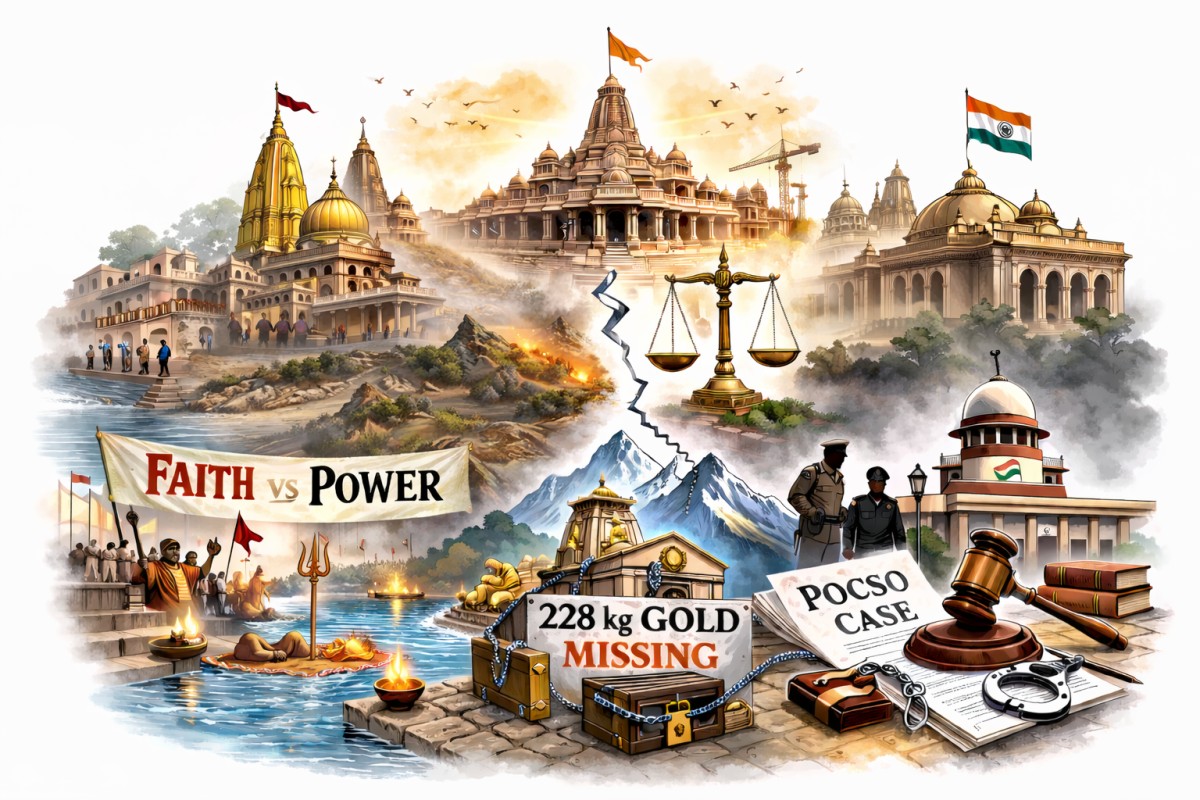
The above image is an illustrative representation, created with AI and does not depict actual individuals or events
A simmering disagreement between Swami Avimukteshwaranand Saraswati and the Uttar Pradesh government has expanded into a complex confrontation involving religious authority, political optics, and serious legal allegations. This dispute highlights a rare and public fracture between the state’s highest levels of temporal and spiritual authority, evolving from a theological debate into a high-stakes administrative standoff that has captured national attention.
The monk, who was appointed Shankaracharya of Jyotish Peeth in Uttarakhand in September 2022 following the death of his guru Swami Swaroopanand Saraswati, traces his lineage to the Dashanami tradition established by Adi Shankaracharya. Jyotish Peeth, also known as Jyotirmath, is regarded as one of the four principal maths founded to promote Advaita Vedanta. However, the Uttar Pradesh government and local authorities have increasingly questioned the legitimacy of this religious title, citing a 2022 Supreme Court matter where his coronation was stayed due to a lack of endorsement from other Peeths.
Public friction intensified in January 2024 during the consecration ceremony of the Ram temple in Ayodhya. Swami Avimukteshwaranand declined the invitation to attend, stating that inaugurating an incomplete structure was contrary to established Hindu scriptural norms. He maintained that religious procedures should follow tradition rather than political timelines, especially in a year when general elections were approaching. His refusal was widely read as a direct challenge to the state and central governments, placing him at odds with Chief Minister Yogi Adityanath.
The dispute has since moved beyond Ayodhya to involve multiple layers of temple administration and alleged corruption. The Swami has been a vocal critic of the Kashi Vishwanath Corridor project in Varanasi, mourning the demolition of ancient heritage temples for redevelopment. Furthermore, in 2024, he alleged that 228 kilograms of gold had gone missing from the Kedarnath temple in Uttarakhand and criticized the construction of a temple replica in Delhi, arguing that a shrine’s sanctity is tied to its Himalayan location. He even questioned whether a renunciant should hold a salaried constitutional post, a remark seen as a pointed jab at the Chief Minister.
Administrative tensions peaked during the January 2026 Magh Mela in Prayagraj. The Swami alleged that authorities prevented him from taking a holy dip at the Triveni Sangam, leading to an 11-day sit-in protest. In response, Chief Minister Yogi Adityanath remarked that not everyone can assume the title of Shankaracharya at will and cautioned people against being misled by individuals likened to “Kalanemi,” a demon from the Ramayana who disguised himself as a saint to trick Lord Hanuman.
The conflict has now entered a darker legal phase. A First Information Report (FIR) was registered in Prayagraj against Swami Avimukteshwaranand and his disciple under the Protection of Children from Sexual Offences (POCSO) Act. The complaint, lodged by a former associate, alleges the abuse of two minors over an extended period. The Swami has categorically denied these allegations, calling them a fabricated attempt at character assassination orchestrated by individuals with criminal histories. He maintains that the boys mentioned were never students at his gurukul and that the entire “system” is being used to pressure him into withdrawing from his religious campaigns.
What began as a disagreement over temple rituals has evolved into a layered battle involving spiritual legitimacy, state authority, and criminal investigation. As the Swami moves the High Court for anticipatory bail and the Supreme Court eventually weighs in on the Shankaracharya title, the episode continues to serve as a significant example of the uneasy intersection between traditional monastic authority and a politically powerful state government.
