
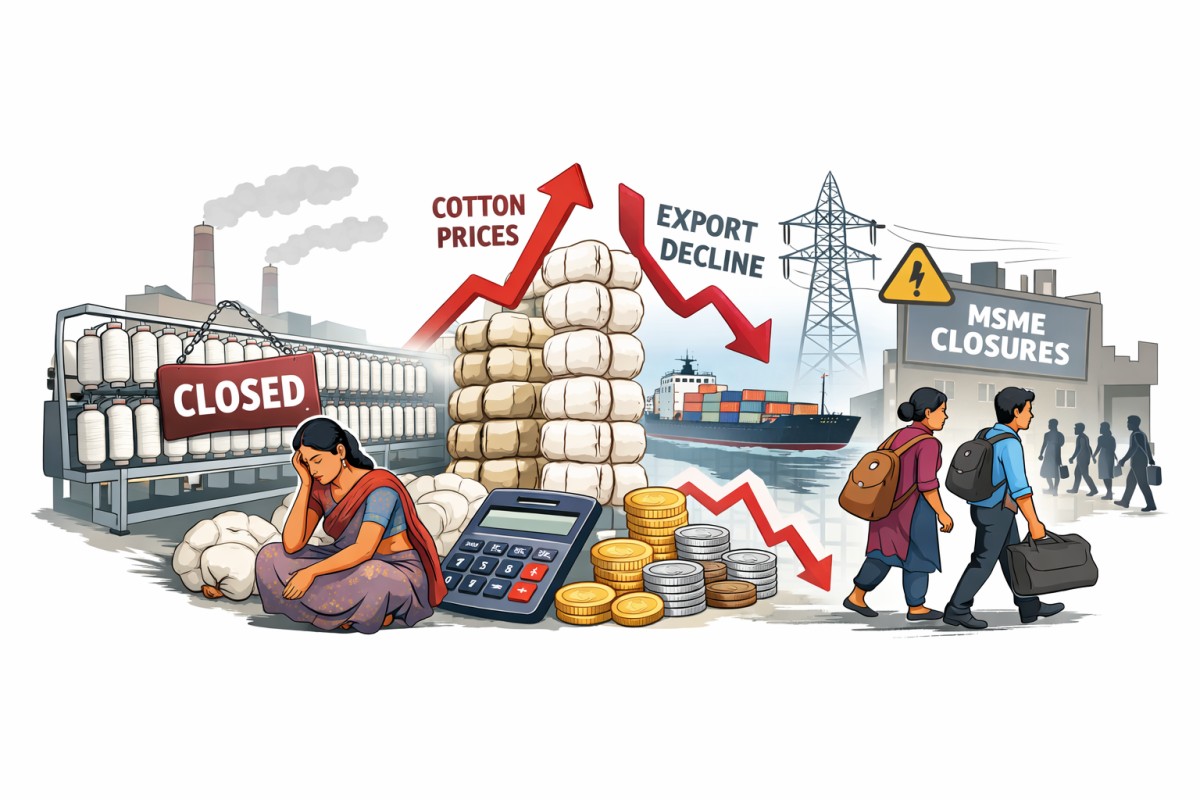
The hum of mills fades as costs climb, leaving workers adrift and exports weakened.
The steady shutdown of textile mills in Tamil Nadu over the past few years has cast a long shadow over one of India’s most labour-intensive and export-driven industries. From spinning units in Coimbatore and Tirupur to composite mills in Erode and Dindigul, production lines have slowed or fallen silent, leaving thousands of workers uncertain about their future.
Tamil Nadu has long been regarded as the textile capital of India, accounting for nearly half of the country’s spinning capacity. The state houses close to 45–47 percent of India’s total spinning capacity, with over 1,650 spinning mills operating at various scales. Industry representatives estimate that more than 250–300 spinning mills in Tamil Nadu have either shut down temporarily or ceased operations between 2020 and 2025, largely due to sustained financial stress. Larger composite units have also scaled back shifts or reduced output in response to mounting losses.
Mill owners cite a combination of factors behind the closures. The sharp rise in cotton prices during 2021 and 2022 disrupted cost structures, squeezing margins in an industry already operating on thin profits. Cotton prices surged from around Rs. 45,000 per candy in 2020 to nearly Rs. 1,00,000 per candy in 2022, sharply increasing input costs for spinning mills. Volatility in global demand, particularly after the pandemic-driven slowdown, further compounded the strain. Export orders from key markets in Europe and the United States weakened amid inflationary pressures and shifting retail trends.
Energy costs have emerged as another major challenge. Tamil Nadu’s power-intensive spinning sector relies heavily on uninterrupted electricity. Power tariffs for industrial consumers in the state have risen by an estimated 15–25 percent in recent years, while diesel prices crossed Rs. 90 per litre during peak periods, inflating transportation and captive power costs. At the same time, competition from countries such as Bangladesh and Vietnam, where labour and energy costs are comparatively lower, has intensified pressure on Indian exporters. Official data shows that Tamil Nadu recorded 4,900 MSME closures in the 2024–25 fiscal year, part of 39,446 small businesses that shut down nationwide. Tamil Nadu’s closures were second only to Maharashtra, which reported 9,702 units, underscoring the wider stress on manufacturing.
Across India, the textile sector reflects similar stress. Industry estimates suggest that within this sector alone, over 400–500 small and medium textile units have either closed or become financially distressed since 2020. Capacity utilisation in several spinning segments reportedly dropped to 60–70 percent during peak crisis periods. Delays in payments from buyers and tighter lending norms have made recovery difficult for many units.
The human impact is visible in mill towns where generations have depended on textile employment. Workers, many of them women and migrant labourers, have faced reduced wages, layoffs, or forced migration back to their native districts. The textile and apparel sector in India employs over 45 million people directly, with Tamil Nadu accounting for several lakh workers in spinning and garmenting units alone. Industry representatives indicate that tens of thousands of workers in the state have faced job disruptions in the past five years. Trade unions have repeatedly called for targeted relief, including subsidised power tariffs, easier working capital loans, and measures to stabilise raw material prices.
Government initiatives such as production-linked incentive schemes and efforts to modernise infrastructure have offered some relief, particularly to larger players investing in man-made fibre and technical textiles. The central government’s Production Linked Incentive scheme for textiles has an outlay of Rs. 10,683 crore, aimed at boosting large-scale investments in man-made fibre apparel, fabrics and technical textiles. However, smaller spinning and weaving units argue that they require immediate liquidity support and policy stability to survive.
Economists warn that prolonged closures could weaken India’s global competitiveness in textiles, a sector that contributes substantially to export earnings and rural employment. India’s textile and apparel exports stood at approximately 34–36 billion US dollars annually in recent years, making it one of the country’s top export segments. While there are signs of gradual recovery in global demand, industry leaders maintain that sustained policy intervention and structural reforms will be essential to revive confidence.
For now, in Tamil Nadu’s industrial belts, the whirring sound of spinning machines has grown noticeably quieter. Whether the looms will regain their former rhythm depends on how swiftly the industry can adapt to changing market realities and how effectively support mechanisms reach those most at risk.
