
The Punjab government has intensified its push to strengthen the state’s education system, with Chief Minister Bhagwant Mann and Education Minister Harjot Singh Bains leading extensive ground-level reviews of government schools across districts. Their mission has been presented as unprecedented, with the minister claiming to have visited more than two thousand schools. Yet, education experts and teacher unions point out that such visits, while commendable, are part of the minister’s basic duty and should perhaps be viewed as part of routine administrative responsibility rather than exceptional milestones. The real measure of success, they argue, lies not in counting visits but in ensuring lasting improvements in classrooms, teaching conditions, and student outcomes.
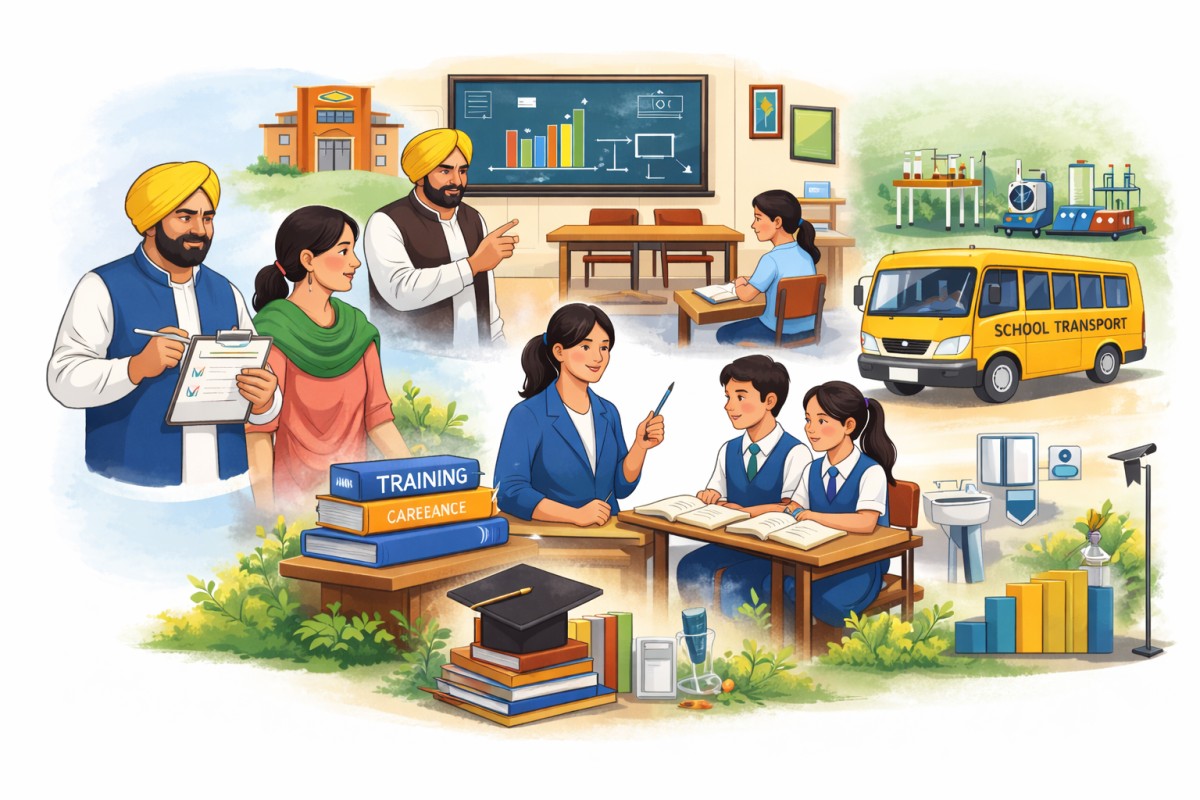
Over the past several months, the Education Minister has toured schools across Punjab, engaging directly with principals, teachers, parents, and children. These visits have focused on classroom conditions, digital learning facilities, laboratory equipment, sanitation infrastructure, and curriculum reforms. Flagship initiatives such as Samarth are being monitored to strengthen foundational literacy and numeracy, while the Schools of Eminence model is upgrading select institutions with modern labs, digital boards, and free transport services. A new focus on digital transparency is also being introduced, with on-screen marking systems planned for upcoming board examinations to ensure fairness and speedier result declarations.
Parents across districts have welcomed visible improvements such as upgraded classrooms, boundary walls, better sanitation facilities, and the availability of textbooks at the start of the academic session. Students have expressed optimism about enhanced extracurricular opportunities, career guidance sessions, and exposure to competitive exam preparation being introduced in select schools.
Teachers, however, continue to voice concerns that reforms must go beyond infrastructure. Associations have reiterated demands for filling vacant posts to reduce workload, upgrading staff rooms, ensuring timely promotions, and addressing issues related to contractual employment. Teacher unions have further highlighted the need for allowances linked to newly mandated dress codes, improved security arrangements in rural schools, and the resolution of promotion backlogs. Many educators argue that while modern buildings and digital boards are welcome, reforms will remain incomplete unless the teaching community is empowered with dignity, stability, and professional support.
The Education Minister has acknowledged these concerns during interactions, assuring that strengthening the teaching community remains central to sustainable reform the government has stated that recruitment drives are underway to fill pending vacancies, and infrastructure upgrades will include improved working spaces for staff. Health profiling of students, with digital records to address medical concerns, is also being piloted to ensure holistic development.
Education experts note that consistent monitoring and community engagement are crucial to translating policy into lasting change. They argue that while infrastructure investments are important, empowering teachers through professional support and stable employment conditions is equally vital for raising learning standards. Teachers, they emphasize, are not just facilitators of policy but the backbone of the system — without their well-being, no reform can truly succeed.
Observers point to examples from other states where education ministers have emphasized systemic improvements rather than publicity. In several regions, ministers have been credited with prioritizing teacher training, curriculum innovation, and infrastructure upgrades, focusing on measurable outcomes instead of projecting routine inspections as headline achievements. Such models highlight that genuine reform is best judged by improved learning levels, empowered teachers, and restored public trust — not by the number of schools visited. As Punjab seeks to rebuild confidence in its public education system, the government’s direct outreach to schools signals a hands-on approach. Chief Minister Bhagwant Mann has emphasized that quality education is a cornerstone of the state’s development agenda, while Education Minister Harjot Singh Bains continues to lead grassroots engagement. Whether these efforts lead to measurable improvements in academic outcomes will depend on continued investment, administrative follow-through, and meaningful dialogue with the teaching workforce. For Punjab’s classrooms to thrive, reforms must not only modernize infrastructure but also uplift the teachers who carry the responsibility of shaping the next generation.
