
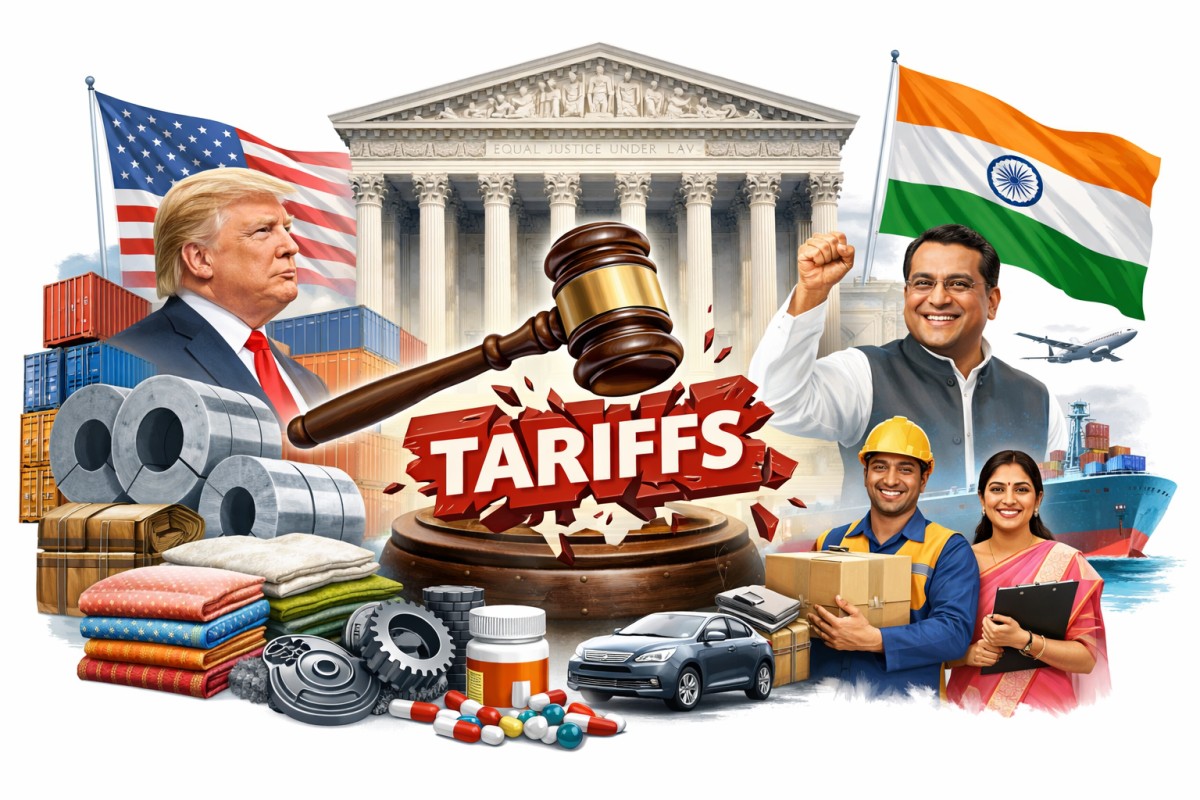
Washington, February 20, 2026 — In a landmark 6–3 decision, the United States Supreme Court struck down a significant portion of President Donald Trump’s sweeping tariff regime, ruling that the executive branch had exceeded its constitutional authority.
The case centered on the International Emergency Economic Powers Act (IEEPA), which the administration had invoked to impose broad import duties without explicit congressional approval. Writing for the majority, Chief Justice John Roberts emphasized that the power to tax and regulate international commerce rests primarily with Congress, and that the 1977 statute does not grant the president a “blank check” to establish tariffs of unlimited scope or duration.
The ruling invalidates most of the reciprocal tariffs imposed on a wide range of goods, though duties tied to separate national security provisions — such as those on steel and aluminum — remain unaffected. Legal experts say the judgment creates a significant hurdle for future administrations seeking to implement broad protectionist measures without legislative backing.
Reaction has been swift across the globe. In India, the Congress’s Jairam Ramesh hailed the verdict as a triumph for democratic checks and balances. Exporters in sectors ranging from textiles and engineering to chemicals welcomed the ruling, noting that the removal of sweeping tariff barriers restores competitiveness and predictability in the US market, one of India’s largest export destinations.
While the White House described the decision as an impediment to its economic strategy, analysts believe the ruling reinforces the principle that major shifts in fiscal policy require collaboration between the president and Congress. For Indian businesses, the judgment offers cautious optimism, signaling a more rules-based environment for long-term trade planning.
