
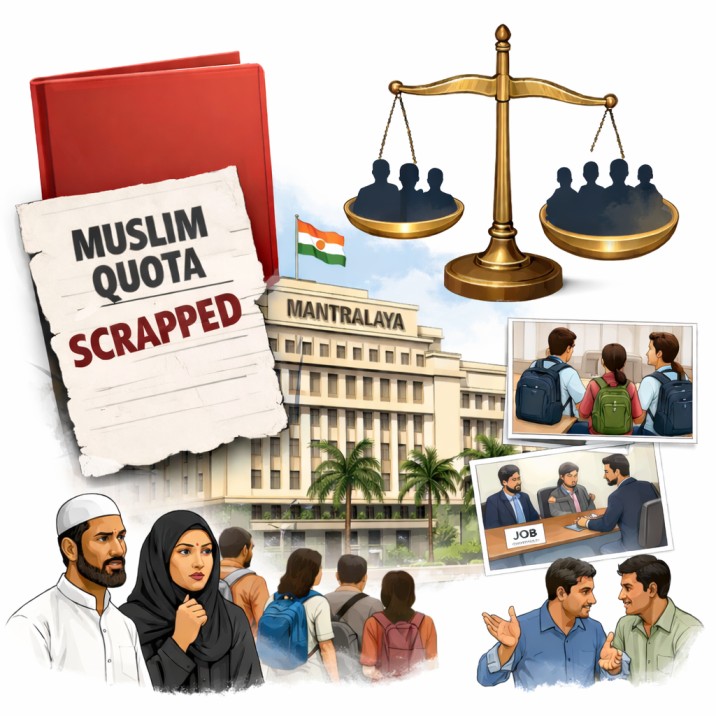
The above image is an illustrative representation, created with AI and does not depict actual individuals or events.
Mumbai, February 18, 2026 : The Maharashtra government has formally rescinded the five percent reservation earlier extended to segments of the Muslim community in public employment and educational institutions. The decision, conveyed through a resolution issued by the state’s social justice department, nullifies a series of government orders and circulars dating back to 2014.
The quota was originally introduced in July 2014 by the then Congress-NCP administration through an ordinance that classified certain Muslim groups under a newly created Special Backward Category. While the Bombay High Court had permitted the educational component of the quota to continue, it stayed the job reservations. The ordinance itself lapsed in December 2014 after it was not converted into permanent legislation, and subsequent judicial interventions by the Supreme Court further complicated its implementation.
Despite the lapse, several administrative orders relating to caste and validity certificates remained on record. The latest resolution directs authorities to discontinue the issuance of caste and non-creamy layer certificates under this category, thereby aligning official records with the current legal framework. Officials described the move as a procedural necessity to ensure clarity in admissions and recruitment processes.
The withdrawal has sparked mixed reactions across political and community circles. Supporters argue that reservations should be based strictly on social and educational backwardness rather than religious identity, calling the step a correction in line with constitutional principles. Critics, however, contend that the rollback may reduce access to opportunities for disadvantaged sections within the Muslim community who had relied on the provision.
Departments and state-run institutions have been instructed to update recruitment and admission guidelines accordingly. The government has emphasized that welfare schemes and scholarships for economically weaker sections will continue under existing rules, reaffirming its commitment to socio-economic support mechanisms while closing the chapter on religion-linked quotas.
