
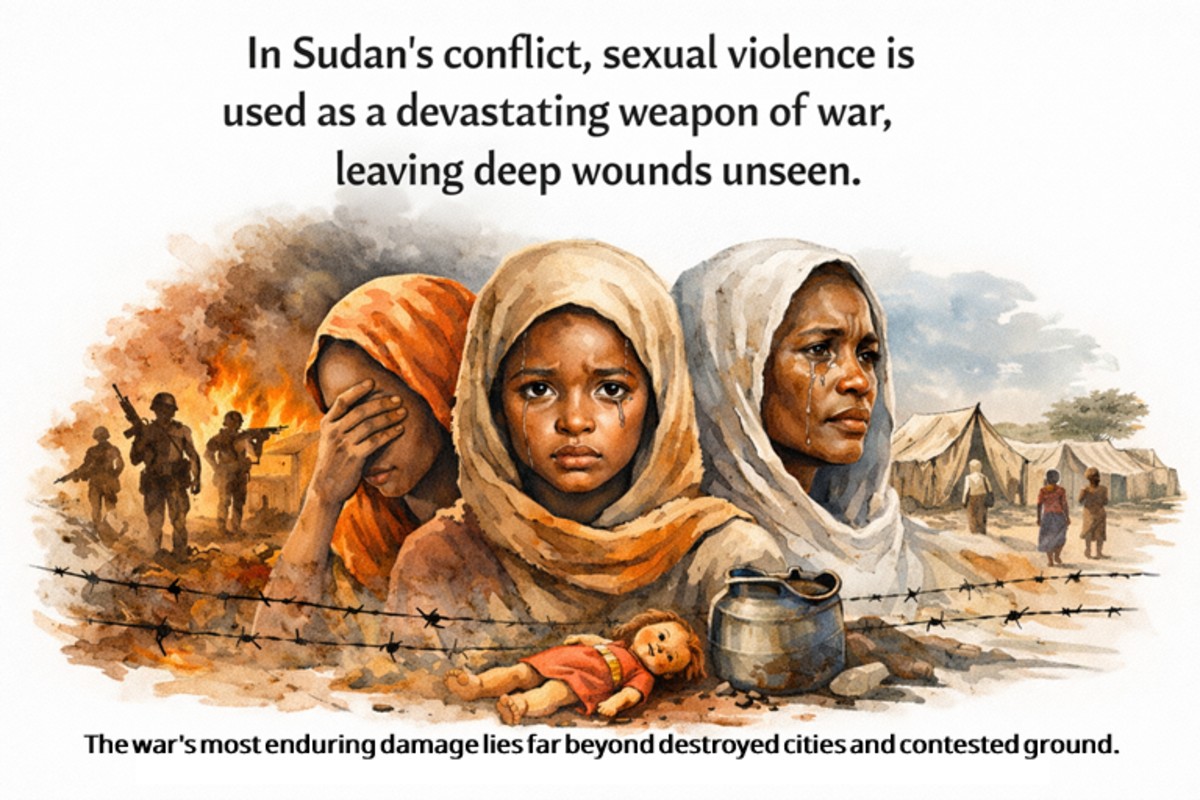
Among the many humanitarian crises unfolding in today’s fractured world, sexual violence in conflict remains one of the least discussed and least honestly confronted. It surfaces briefly in reports from war zones, slips behind military headlines, and returns only when survivors gather the courage to speak. From Sudan to other conflict-ridden regions, the pattern is disturbingly familiar: when institutions collapse and armed power goes unchecked, women’s bodies too often become extensions of the battlefield.
The anxiety extends beyond one geography, because every expanding conflict now raises familiar fears for women living where institutions are fragile and protection uncertain.
The war in Sudan has already redrawn towns, emptied villages, fractured institutions and scattered millions across uncertain borders. Yet some of its deepest damage remains unseen, carried quietly in the bodies and memories of women and girls whose suffering rarely reaches the centre of diplomatic conversation. Beyond artillery, territorial claims and military statements, another conflict has taken shape—one in which sexual violence has emerged not as incidental brutality, but as one of the darkest signatures of a war steadily eroding every boundary of human dignity.
In western Sudan, particularly across parts of Darfur, medical teams and humanitarian workers continue to receive testimonies that reveal a grim and recurring pattern. Women fleeing gunfire, families escaping besieged settlements, and girls separated during displacement have described assaults during raids, on roads leading out of conflict zones, and near temporary shelters where civilians believed they had found safety. For many survivors, violence did not end when they left home; it followed them into exile, into camps, and into the fragile spaces where survival itself had become uncertain.
Doctors working in conflict-affected areas say the number of survivors reaching treatment centres has risen sharply over the past two years. Thousands have sought medical help, though aid workers believe the real scale remains far larger than what clinics can record. Many never arrive at all. Some cannot cross routes controlled by armed groups; others remain silent because fear, shame and social stigma still weigh heavily even amid war. In communities already strained by hunger and displacement, silence often becomes another wound.
The accounts emerging from treatment centres are painfully consistent. Women have spoken of armed men entering villages during attacks, of assaults carried out before family members, and of girls attacked while collecting water, gathering firewood or searching for food. In some areas, women now avoid leaving shelters unless absolutely necessary, measuring every step against the possibility of danger. Even short distances have become negotiations with fear.
Health personnel near Tawila and surrounding regions report survivors arriving weeks after assaults, often with untreated injuries, trauma and pregnancies resulting from violence. Adolescents form a significant share of those seeking treatment, while aid workers have also documented distressing cases involving very young children. Delayed access to care often means lost chances for emergency treatment, infection prevention and psychological support. In a country where health systems have already collapsed, each delay deepens suffering.
Sudan’s conflict, which erupted openly in 2023 between the Sudanese Armed Forces and the Rapid Support Forces, has since become one of the world’s gravest humanitarian crises. Large parts of the country remain divided between competing zones of control, while civilians move repeatedly from one unsafe place to another. In many parts of Darfur, displacement camps no longer represent refuge. Families who escaped one attack often encounter another, and the promise of safety has become painfully fragile.
Recent concern has centred on areas surrounding El Fasher, where renewed fighting has intensified civilian suffering. Aid workers in nearby facilities describe sudden surges in trauma cases after fresh offensives, alongside testimonies of killings, intimidation and sexual assaults during military advances. The pattern suggests that violence against civilians deepens wherever armed pressure intensifies, with women and children often absorbing the first and hardest blows.
What is increasingly clear is that such violence cannot be dismissed as isolated misconduct in the fog of war. Humanitarian observers have repeatedly warned that gender-based violence in Sudan reflects broader patterns of domination, humiliation and forced displacement. Its purpose extends beyond immediate harm; it seeks to fracture communities, plant fear deeply enough that return becomes impossible, and leave behind psychological ruins where physical destruction already exists.
The tragedy is sharpened by the near absence of accountability. In many conflict zones, survivors have no functioning legal system to approach, no reliable authority to protect them, and little confidence that testimony will lead to justice. Clinics struggle with limited medicine, reduced staff and insecure access. Mental health support remains scarce even as trauma deepens across generations.
The wider world often encounters Sudan through casualty figures, ceasefire failures and diplomatic summaries, while the private violence endured by civilians receives less sustained attention. Yet wars are remembered not only by who controlled territory, but by what happened to ordinary people when institutions collapsed and power went unchecked. In Sudan today, women’s bodies have become unwilling terrain in a conflict that has already stripped millions of certainty, shelter and belonging.
Still, amid this darkness, survivors continue to speak when they can. Their testimonies are acts of endurance in circumstances designed to silence them. Each account carries not only grief, but also a quiet demand—that suffering be recorded, dignity acknowledged, and justice made inseparable from any serious conversation about Sudan’s future.
A ceasefire, whenever it arrives, will not by itself heal what this war has done. Reconstruction will require more than roads, hospitals and institutions. It will require confronting wounds deliberately inflicted in silence, and ensuring that the silence surrounding them does not outlive the gunfire.
