
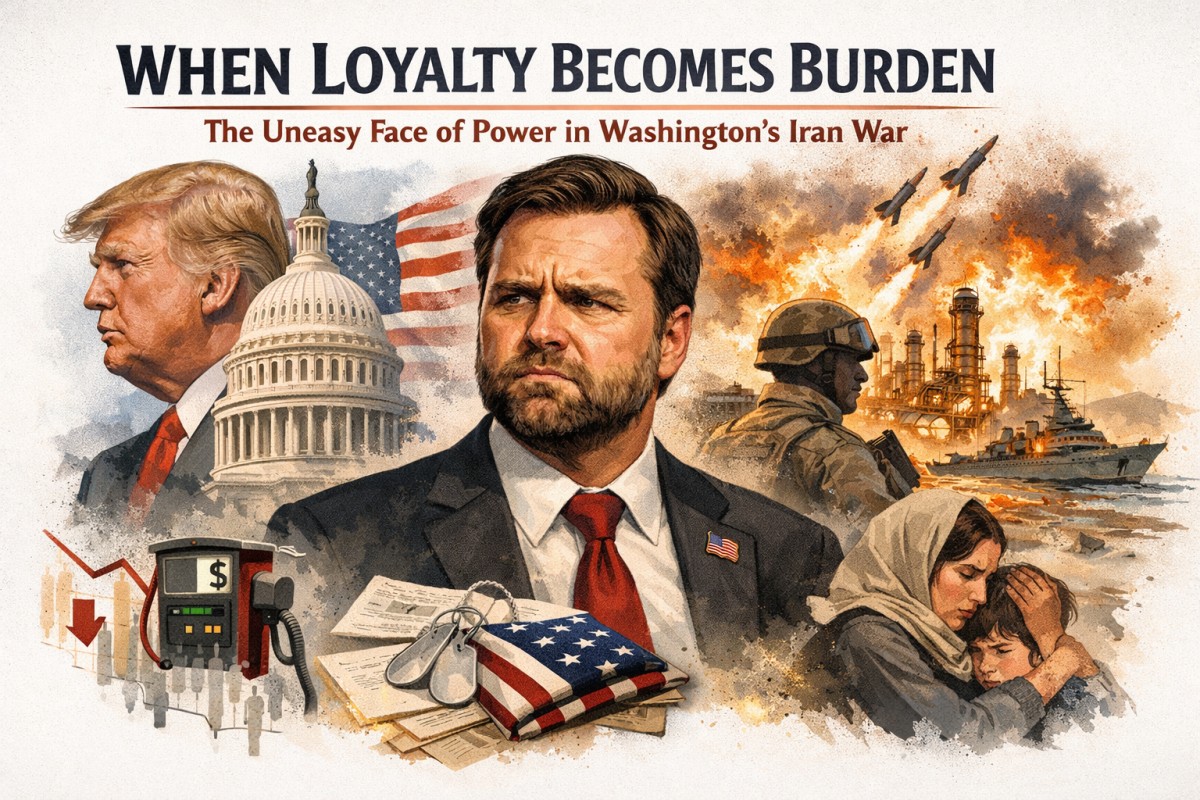
Trump’s war posture, Vance’s dilemma
There are moments in politics when silence reveals more than speech, when hesitation carries greater meaning than carefully drafted declarations. In the unfolding American confrontation with Iran, that moment appears to have arrived for JD Vance — a man who built much of his political identity on questioning foreign wars, yet now finds himself defending one from the highest office just below the presidency. The contradiction is not merely political; it is deeply human, because few burdens in public life are heavier than defending a course one once warned against.
For years, Vance’s appeal rested partly on his distance from the old language of intervention. He spoke like someone who understood that the cost of military adventures is never measured only in military briefings. Every missile launched abroad eventually lands somewhere inside domestic politics too — in fuel prices, public anxiety, fractured public trust, and the credibility of elected leadership. Yet power has always had a peculiar ability to alter political vocabulary. Today, he speaks less like a skeptic and more like an institutional guardian of Donald Trump, even as the military confrontation with Iran grows more uncertain, more expensive, and more morally difficult to explain.
What makes this shift especially striking is that the larger political movement surrounding Trump had promised something different. It had presented itself as weary of endless wars, suspicious of foreign entanglements, and impatient with the old habit of projecting strength through intervention. That promise mattered because many ordinary Americans had lived through two decades of conflict whose endings never matched their beginnings. They had heard necessity invoked too often, only to discover later that necessity had quietly become routine.
Now, those same voters are watching whether principle survives proximity to power.
Inside political systems, public discipline often hides private unease. Reports emerging from Washington suggest that caution, discomfort, and disagreement are present within internal discussions, even if official language remains firm. That is the difficult art of modern executive power: privately doubt, publicly defend. Vice presidents are often expected to master that discipline, but the cost of doing so becomes heavier when the stakes involve war.
And this burden does not exist in abstraction. The possibility of escalation with Iran has already unsettled energy markets across the Gulf. Oil routes remain vulnerable, shipping calculations are changing, and economic anxiety has begun to move quietly through international markets. Long before military maps are fully understood by the public, ordinary households begin to feel war through petrol prices, supply disruptions, and a subtle tightening of financial confidence. Even when missiles do not strike American cities, consequences still arrive in American kitchens.
There is also a particular emotional exhaustion that accompanies the possibility of another long conflict in the Middle East. Nations may speak in strategic language, but citizens hear something else beneath it — the familiar rhythm of another uncertain beginning. There is always a moment before escalation when the world collectively holds its breath, hoping rhetoric remains rhetoric. Yet history has repeatedly shown how quickly words harden into irreversible action.
For Trump, the political instinct remains recognisable: project certainty, act forcefully, and frame military movement as proof of leadership. But wars rarely obey campaign instincts. They lengthen beyond predictions, widen beyond planning, and return years later not as symbols of strength but as questions of judgment. What begins as authority can gradually become accountability.
To look at the present map of the region is to remember how often geography humbles ambition. The Middle East has never been shaped solely by military power; it has always answered force with complexity. Alliances shift, unintended fronts emerge, and what appears controlled from a briefing room often becomes uncertain on the ground.
The resignation of senior officials uneasy with the direction of policy has added another layer of fragility. When dissent emerges from inside an administration rather than outside it, citizens naturally sense that confidence is incomplete. The language from Washington increasingly sounds defensive rather than decisive, careful rather than assured.
Yet perhaps the most unsettling aspect of modern conflict is how easily war is narrated as strategy while grief remains invisible. Behind every press conference are soldiers counting uncertainty, families waiting for news, civilians wondering whether distant decisions will redraw their futures. Political leadership often forgets that maps contain homes, memories, and ordinary lives.
For Vance, this moment may define more than his current office. His future now appears tied not to what he once argued, but to what he now permits. If this confrontation remains brief, political memory may soften. If it stretches, every earlier warning against intervention will return with sharper force.
The deeper lesson reaches beyond one vice president or one administration. Across democracies, leaders often campaign in the language of restraint and govern in the language of force. Somewhere between those two languages, public trust quietly begins to erode.
And perhaps that is why this moment deserves attention far beyond Washington. Strength is not only the capacity to strike; it is also the wisdom to recognise when the cost of conflict exceeds the pride of appearing decisive. The most durable victories in history are often those where power chooses restraint before grief becomes irreversible.
Somewhere in that narrowing distance between conviction and loyalty, Vance now stands — careful, disciplined, measured, yet visibly carrying the weight of a war that once belonged to the politics he promised would not return.
