
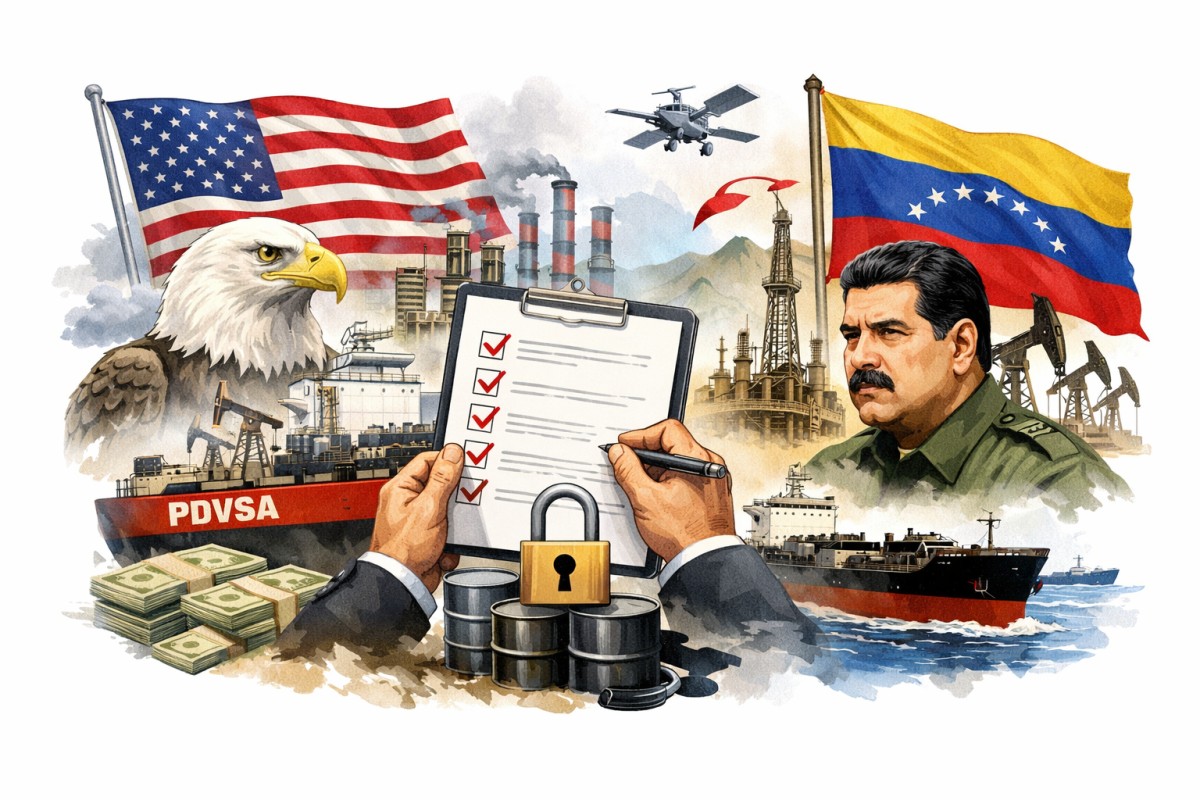
The United States has announced plans to maintain open-ended oversight of oil exports from Venezuela, extending Washington’s influence over the South American nation’s primary source of revenue as part of its broader sanctions strategy.
Senior U.S. officials said Venezuelan oil sales would continue only under U.S.-approved arrangements, with no fixed timeline for a full return to unrestricted access to global markets. The approach reflects Washington’s assessment that conditions for comprehensive sanctions relief have not yet been met.
U.S. authorities say the policy is designed to apply sustained pressure on the government of President Nicolás Maduro, while seeking to balance regional stability and broader energy market considerations.
Background on Existing Sanctions
Since 2017, the United States has imposed successive rounds of sanctions targeting Venezuela’s oil sector, the backbone of its economy. These measures have restricted the ability of state-owned oil company PDVSA to sell crude freely on international markets, requiring transactions to proceed under licenses or specific authorizations issued by U.S. authorities.
Washington has said the sanctions were intended to limit the Maduro government’s access to oil revenues used to entrench political control, while encouraging negotiations aimed at democratic reforms.
Framework for Ongoing Oversight
Under the latest approach outlined by U.S. officials, Venezuelan oil exports would continue under U.S. supervision on an open-ended basis, rather than through time-limited exemptions.
Oil sales would remain subject to U.S.-approved licensing and monitoring arrangements, with authorities retaining oversight of buyers, shipping routes, and payment mechanisms to ensure proceeds do not benefit sanctioned individuals or entities. Enforcement would rely on existing U.S. sanctions laws, under which foreign companies, banks, or insurers involved in non-compliant transactions could face penalties or secondary sanctions.
The oversight applies to both crude oil and refined petroleum products, extending beyond earlier measures that focused primarily on raw crude. Officials emphasized that the policy does not amount to a full lifting of sanctions, but rather a controlled pathway allowing limited oil flows under strict conditions.
In effect, the framework establishes several core parameters of U.S. policy: Washington intends to retain open-ended oversight of Venezuelan oil exports; sales will proceed only under U.S.-approved mechanisms; compliance will be enforced through existing sanctions authorities; and the broader objective is to balance political pressure with energy security and regional stability.
Potential Impact on Venezuela and Global Markets
Energy analysts say the approach could have several implications.
Venezuela’s oil revenues are expected to remain constrained, limiting the government’s fiscal flexibility despite continued exports. Any impact on global oil prices is likely to be modest, though Venezuelan supply remains relevant in a market sensitive to geopolitical disruptions.
Regionally, countries in the Caribbean and Latin America that rely on Venezuelan crude may continue to seek alternative suppliers or operate within U.S.-approved arrangements.
Humanitarian organizations and economists, however, warn that prolonged economic pressure risks deepening shortages of food, medicine, and basic services for ordinary Venezuelans, renewing calls for expanded humanitarian safeguards.
While Washington maintains that the measures are targeted at the Maduro government rather than the population, critics argue that open-ended restrictions risk entrenching economic hardship without guaranteeing political change.
As the framework takes effect, international energy markets and diplomatic stakeholders will closely watch whether sustained oversight encourages renewed negotiations—or further deepens Venezuela’s economic isolation.
