
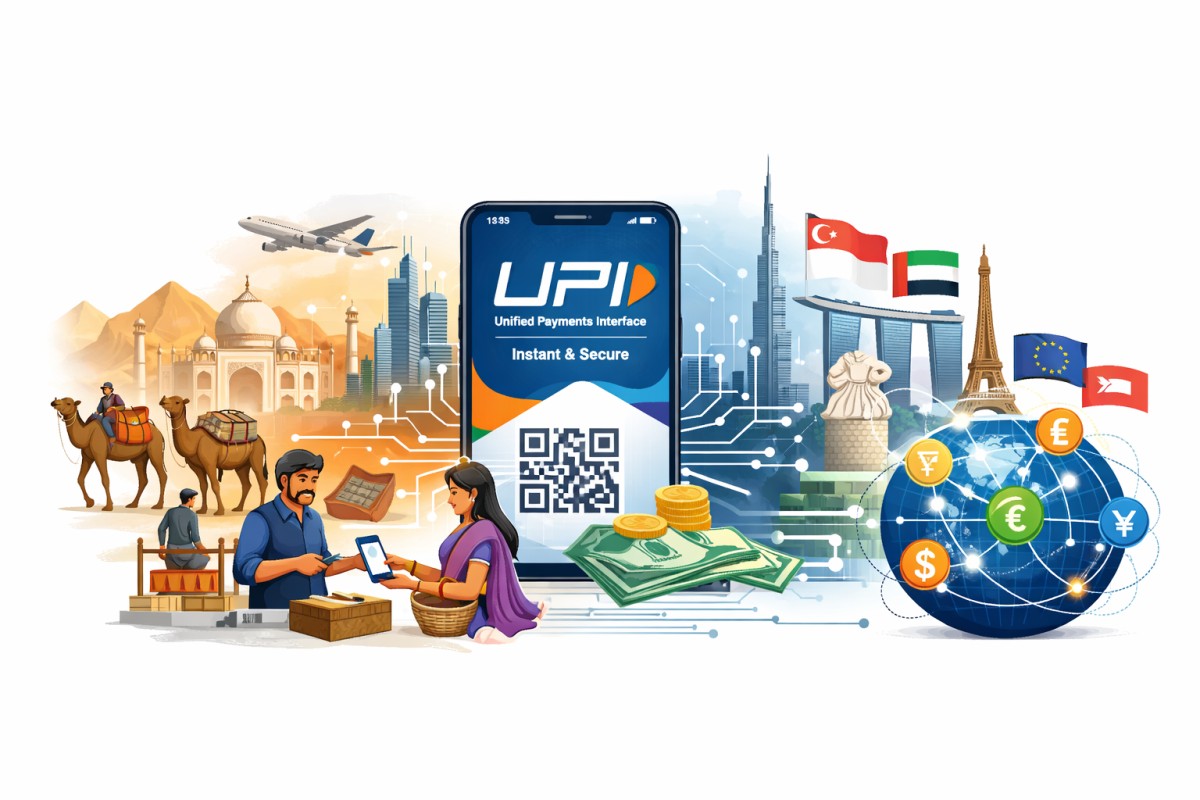
Financial paradigms rarely shift overnight, yet the subtle tremors of change are already visible. Historically, economic dominance has always mirrored infrastructure. In the 1950s, Western credit networks redefined consumerism and established a centralized financial hegemony that lasted for decades. Today, India’s Unified Payments Interface (UPI) represents a similar seismic shift—a grassroots challenge to the traditional, rigid structures of global finance. What appears routine on a mobile screen today may, in hindsight, be remembered as one of the most consequential institutional innovations of contemporary economic history.
Launched in 2016 by the National Payments Corporation of India (NPCI), UPI is not merely a tool for instant, low-cost transfers; it is a fundamental redesign of economic interaction. By prioritizing interoperability and bank-to-bank transparency, it replaces hierarchical financial systems with a fluid, participation-based network. In India, it is no longer just an alternative; it has become the default operating system for daily economic activity, where the structure of transactions favours networking over control. Its success is visible not only in metropolitan commerce but also in small rural markets where digital acceptance has leapfrogged traditional card dependency.
Much like the ancient Silk Road trade routes were carved by the practical choices of merchants, the modern digital economy is gravitating toward frictionless corridors. The integration of UPI with Singapore’s PayNow, United Arab Emirates systems, and European gateways suggests a future that evolves beyond national silos. As these interoperable digital networks expand, the absolute dominance of traditional reserve currencies and centralized monopolies may face a gradual, systemic dilution in favor of multi-currency, shared utilities. For many emerging economies, such models offer a template for digital cooperation without the heavy cost of legacy financial architecture.
UPI’s true impact lies in Financial Democratization. From street vendors in Mumbai to small international enterprises, millions participate as active nodes in a decentralized financial grid. In 2023 alone, India processed over 50 billion UPI transactions, signaling a subtle yet transformative shift in global finance. This immense volume demonstrates that modern financial power is increasingly derived from participation rather than top-down control. The ordinary transaction—tea, transport, groceries, tuition—has quietly become part of a much larger macroeconomic story.
Beyond just a transaction tool, UPI is evolving into a Global Protocol—a common language for value exchange that functions regardless of a country’s size or wealth. Unlike legacy systems that require heavy physical and institutional overhead, this digital infrastructure is lightweight and adaptable. By decoupling the payment process from the underlying currency, it allows nations to settle trades in local denominations, providing a critical buffer against external economic shocks and fluctuating exchange rates. This gives smaller economies a degree of strategic flexibility that older systems often denied them.
In an era of geopolitical tension and economic fragmentation, UPI offers a neutral and significant alternative for Digital Sovereignty. While incumbents like Visa Inc. and Mastercard have long held influence through gatekeeping, UPI grows through connection and trust without coercion. However, obstacles remain—regulatory friction, data sovereignty, and the inherent risks of digital interconnectedness. As systems become more integrated, the potential for technical or institutional disruption rises, and once trust is fractured, rebuilding it remains a complex challenge. The future therefore depends not only on technological efficiency but also on the credibility of governance behind digital systems.
UPI may not fix trade imbalances or political conflicts, but it fundamentally reshapes who controls transactions. By bypassing traditional intermediaries, it transforms financial pipelines into interconnected webs. This transformation will not be immediate; it is a slow, almost imperceptible integration. The fundamental question remains whether the world is ready for a system where relevance depends on utility and participation rather than centralized authority. The quiet reordering of global finance has already begun—one instant transaction at a time. And in that quietness lies its greatest strength: systems that become indispensable often arrive without spectacle, but leave lasting consequences.
