
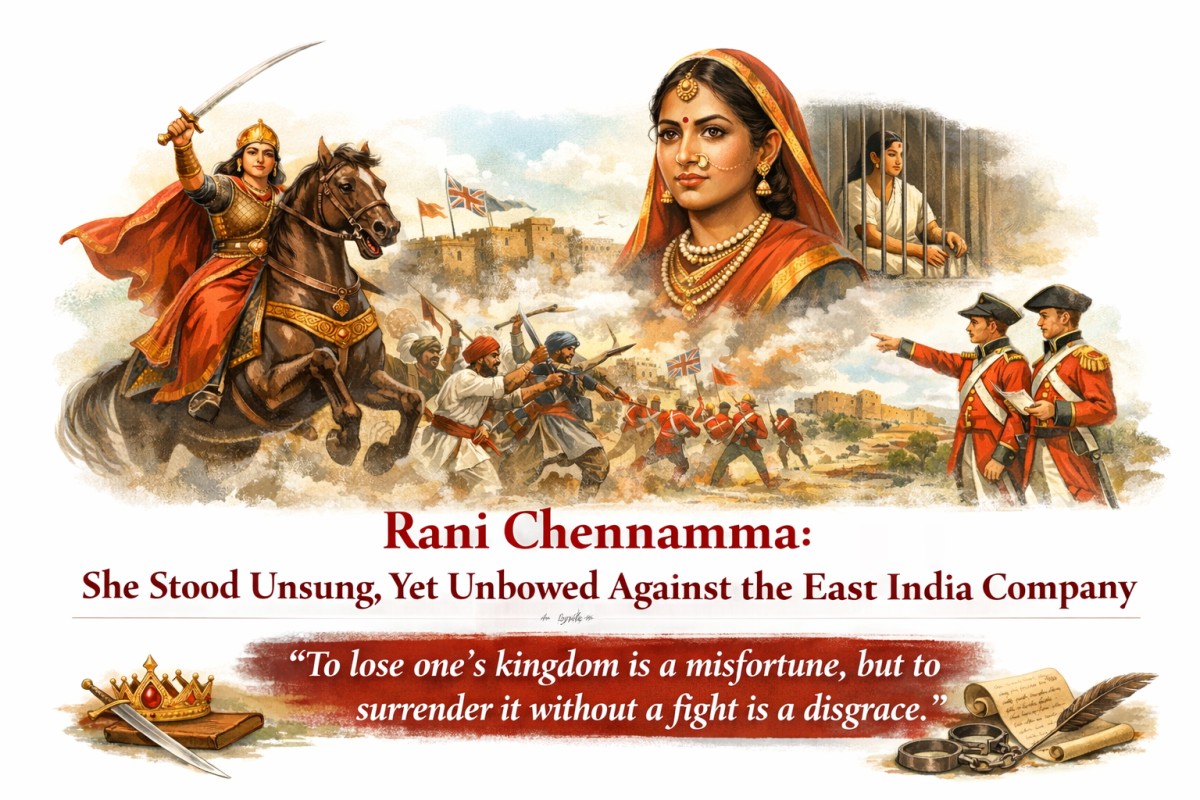
Some names in history arrive like thunder, echoing across textbooks and monuments. Others survive quietly — carried in folk songs, whispered in village stories, and remembered in the pride of a people who refuse to forget. Rani Chennamma belongs to the latter.
Long before the great uprising of Indian Rebellion of 1857 shook British rule in India, a queen in the Deccan chose resistance over submission. When the sovereignty of her land was threatened, she stood against one of the most powerful colonial forces of her age.
In that moment, history witnessed something extraordinary — the roar of Kittur.
A Childhood That Forged a Warrior
Rani Chennamma was born on 23 October 1778 in Kakati, in present-day Karnataka. At a time when royal daughters were often confined to courtly learning, she was raised with unusual discipline and purpose.
She learned horse riding, swordsmanship and archery with remarkable skill. Alongside martial training, she also studied administration and governance, developing the judgment that would later shape the destiny of her kingdom.
Those around her remembered her as fearless, thoughtful and compassionate — qualities that would one day place her in direct confrontation with empire.
Queen of Kittur
She was married to Mallasarja Desai, ruler of Kittur. As queen, she did not remain a ceremonial presence within palace walls. She took active interest in governance, listened to her people, and earned respect through both wisdom and accessibility.
For the people of Kittur, she became more than a monarch — she became a protector.
That stability did not last long.
The royal couple’s only son died young, leaving the kingdom without a direct heir. Before political uncertainty could engulf Kittur, Chennamma adopted Shivalingappa as successor to the throne.
What was meant to preserve continuity soon triggered confrontation.
When Empire Challenged Sovereignty
By the early nineteenth century, East India Company had begun tightening its control across India through calculated annexations.
When British authorities refused to recognise Shivalingappa as heir, they assumed Kittur would submit.
They saw vulnerability in a grieving widow ruling a small state.
What they failed to see was resolve.
For Chennamma, this was not merely a succession dispute; it was an attempt to erase sovereignty and impose foreign authority over her people.
Her defiance is remembered in the words often attributed to her:
“To lose one’s kingdom is a misfortune, but to surrender it without a fight is a disgrace.”
The Battle That Shook an Empire
In 1824, confrontation turned into war.
When British forces marched toward Kittur, Rani Chennamma refused surrender. Mounted on horseback and dressed for battle, she led resistance from the front.
The queen who had governed in peace now stood in war.
In the first major clash, Kittur’s forces achieved a stunning victory. British political agent St. John Thackeray was killed, and several British officers were taken captive.
The idea that a small principality led by a woman could defeat Company forces stunned colonial authority.
Yet even in victory, Chennamma chose dignity. Captured British officers were treated honourably and later released — a gesture revealing both strength and moral restraint.
Betrayal and Capture
The British soon returned with stronger reinforcements.
Kittur found itself surrounded by a far larger military force. Resistance continued fiercely, but the balance had shifted.
Accounts preserved in regional memory speak of internal betrayal: gunpowder supplies were sabotaged, weakening Kittur’s defence at a decisive moment.
After intense fighting, the fort fell.
Rani Chennamma was captured in December 1824 and imprisoned at Bailhongal Fort.
The battlefield fell silent, but her spirit did not.
A Legacy That Refused to Die
For nearly five years she remained in confinement, separated from the land she had fought to protect.
On 21 February 1829, she died within prison walls.
She did not live to witness the later uprisings that would reshape India’s destiny, yet her rebellion had already marked one of the earliest organised acts of resistance against British expansion.
More than three decades before Rani Lakshmibai emerged as a symbol of armed defiance, Chennamma had already shown that resistance had begun to stir across Indian soil.
In Karnataka, memory refused to let her fade. Folk songs, ballads and oral traditions carried her name from generation to generation.
Why Her Story Still Matters
Her life reminds us that India’s freedom struggle did not begin in one year, nor belong only to a few celebrated names.
It was shaped by many acts of courage — some recorded in official history, others preserved by collective memory.
She proved that leadership is not defined by scale, but by courage; not by power, but by refusal to yield before injustice.
Her story is not simply about a lost battle.
It is about a refusal to bow.
The Queen Who Chose Honour
Nearly two centuries have passed since Kittur roared across the Deccan.
Empires have disappeared. Borders have changed. Nations have risen.
Yet the courage of Rani Chennamma remains untouched by time.
She chose resistance when submission would have been easier. She chose honour when compromise would have been safer. She stood upright even when defeat seemed inevitable.
And in doing so, she left behind something greater than a kingdom — a legacy.
A reminder that freedom is never gifted by empires; it is claimed by those willing to defend dignity at any cost.
Unsung in many histories, yet unbowed in spirit, she remains one of the earliest voices in India’s long and unfinished conversation with freedom.
