
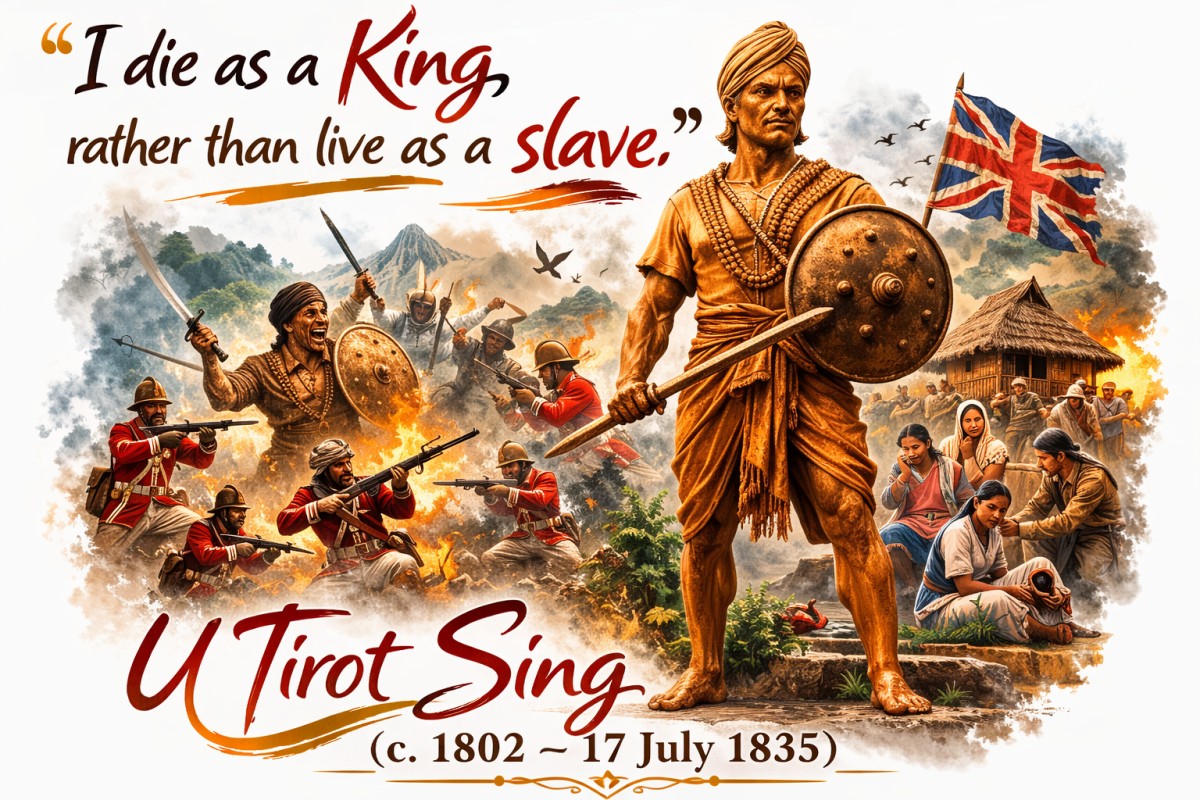
The Hills That Roared: U Tirot Sing’s War for Sovereignty
In the mist-covered hills of the Northeast, where clouds drift across ancient forests and quiet villages rest between deep valleys, a story of courage continues to echo across generations. It is the story of U Tirot Sing, the Khasi chief who chose resistance over submission when the British Empire began extending its reach into the hills of present-day Meghalaya. His struggle between 1829 and 1833 stands as one of the earliest and most determined examples of indigenous resistance against colonial expansion in India.
U Tirot Sing served as the Syiem, or traditional chief, of the Khasi state of Nongkhlaw. In those years, the Khasi hills were not merely territories on a map but living landscapes where communities shared a deep relationship with forests, rivers and mountains that sustained their way of life. Governance was rooted in traditional institutions and collective decisions, allowing local customs and community voices to guide the region.
A Road That Carried the Shadow of Empire
The turning point came when the British East India Company sought permission to build a strategic road through the Khasi hills to connect the Brahmaputra valley with Sylhet. On the surface, the proposal appeared to promise trade and connectivity. However, for the Khasi leadership, the request carried deeper implications.
U Tirot Sing and other chiefs understood that roads often brought more than traders. They opened pathways for soldiers, administrators and expanding colonial control. Initially, negotiations were attempted in the hope that peace and autonomy could coexist. But as British activities intensified and military posts appeared in the region, it became clear that the road might also become a gateway for domination.
The Decision to Resist
In 1829, after discussions among chiefs and councils, U Tirot Sing made a defining choice. Refusing to allow outside authority to dictate the future of his homeland, he led an attack on a British garrison at Nongkhlaw. That moment marked the beginning of a determined resistance that would challenge colonial forces in the Khasi hills for several years.
The conflict that followed was not fought with large armies or modern weapons. The Khasi warriors relied on courage, unity and their intimate knowledge of the rugged terrain. Forests, cliffs and narrow mountain paths became natural allies in their struggle.
Guerrilla War in the Mountains
The resistance took the form of swift and strategic attacks. Khasi fighters used guerrilla tactics, moving silently through forests and striking where the British least expected them. Every ridge and valley became part of a battlefield where determination outweighed military advantage.
Villagers across the hills quietly supported the movement. They provided shelter, food and information to the warriors who were defending their homeland. In those uncertain years, the bond between leader and people strengthened, turning the resistance into a shared struggle for dignity and survival.
Relentless Pursuit and Exile
The British administration responded with increasing force. Military expeditions were sent into the hills to crush the uprising. Villages were searched, leaders were hunted and the pressure on the resistance steadily intensified.
For nearly four years, U Tirot Sing and his followers continued their fight. But constant pursuit and the growing strength of colonial forces eventually weakened the movement. In 1833, the Khasi chief was captured after years of defiance.
The British authorities deported him far from the hills he loved to Dhaka. There, separated from his homeland and the people he had defended, U Tirot Sing spent his final years in confinement. In 1835, the brave leader died in exile.
The Legacy of an Unsung Hero
Although his life ended far from the Khasi hills, the memory of U Tirot Sing never faded among his people. In Meghalaya, he is remembered not as a defeated rebel but as a symbol of courage and self-respect. His stand against colonial authority represents the determination of indigenous communities to protect their land, identity and traditions.
India’s freedom struggle is often told through the stories of large movements and well-known leaders. Yet in distant hills and remote regions, many voices also carried the spirit of resistance. U Tirot Sing’s story reminds the nation that the fight for freedom was not confined to cities or political centers. It also rose from forests, mountains and villages where ordinary people defended their way of life with extraordinary bravery.
Today, when the clouds roll gently over the Khasi hills and the forests whisper with the wind, they seem to carry the memory of a chief who refused to surrender his land without a fight. U Tirot Sing remains a quiet but powerful reminder that even in the most remote corners of the country, the spirit of freedom once burned brightly.
