
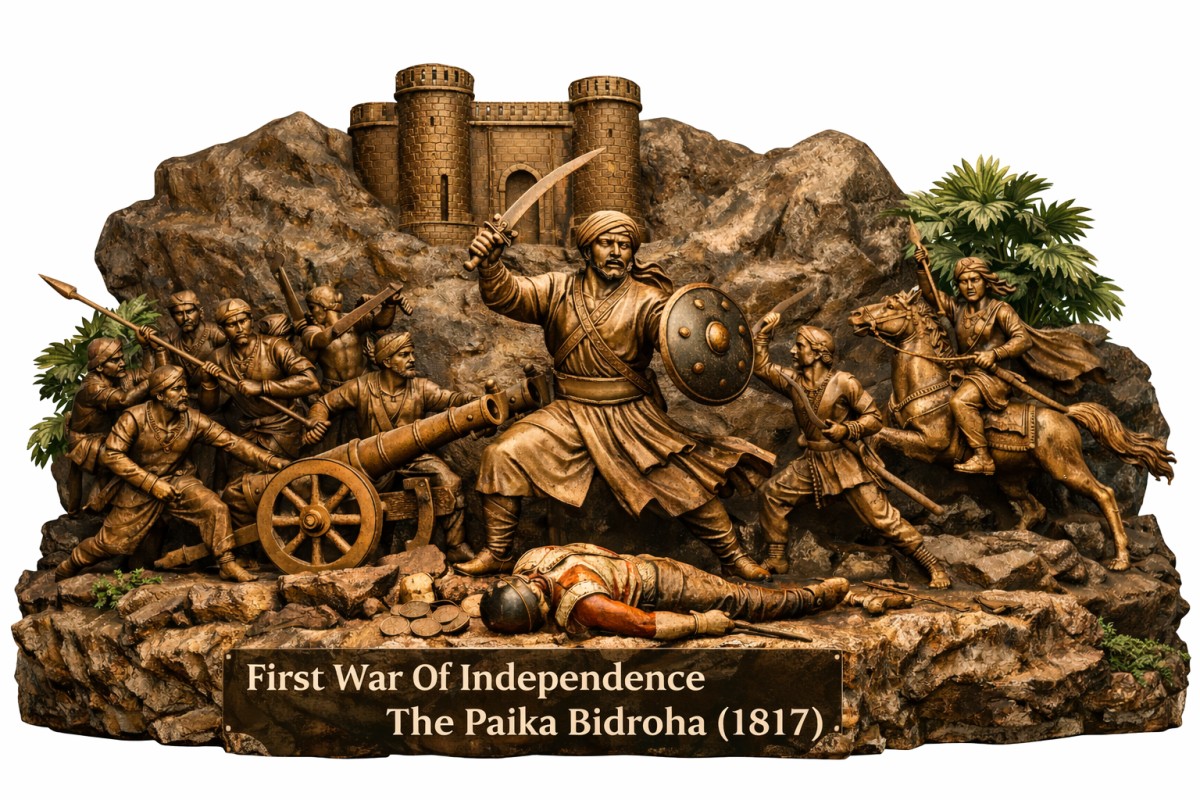
The First Roar: The Forgotten Warrior-Farmers of 1817
Odisha’s Immortal Rebellion that Shook the Empire Decades Before 1857
History is often written with the ink of victors, but the soul of a nation is etched in the blood of its martyrs. Long before the 1857 Sepoy Mutiny sent tremors through the British Empire, a fierce, primal roar erupted from the emerald jungles and ancient temples of Odisha. In 1817, the Paikas—the legendary warrior-farmers of Khurda—chose a path of fire over a life of chains.
This was not merely an administrative revolt; it was a desperate, guttural cry for dignity from a people who refused to let their identity be buried under colonial paperwork.
Who Were the Paikas?
To understand the rebellion, one must understand the Paika. They were a unique social fabric of Odisha—traditional landed militias who held the plough by day and the sword by night. Under the Kings of Khurda, they enjoyed Paikali (rent-free lands) in exchange for their military service.
They were the iron shield of the Odia kingdom, a proud class where duty was hereditary and loyalty was sacred. For them, the soil wasn’t just property; it was a gift from the heavens, earned through generations of protection.
Chains of Ink: The Death of a Way of Life
The British occupation of 1803 shattered this ancient harmony. With a cold, bureaucratic indifference, the East India Company dismantled a thousand-year-old way of life. The triggers were many, but the pain was singular:
- The Theft of the Soil: The British abolished the hereditary land rights of the Paikas, reducing proud warriors to landless peasants.
- The Salt Tax: In a cruel blow to the common man, the British monopolized salt, turning a basic human necessity into an unaffordable luxury.
- Economic Ruin: The traditional cowrie currency was abolished, replaced by a rigid silver-based system that effectively bankrupted the rural population overnight.
Bakshi Jagabandhu: The General of a Broken People
Every great movement needs a heartbeat, and for the Paikas, that was Bakshi Jagabandhu Bidyadhar Mohapatra Bhramarabar Raya. Once the revered military commander of the King of Khurda, Jagabandhu found himself stripped of his ancestral estate through British legal trickery.
He did not lead for power; he led out of a shared agony. He became the rallying voice for the humiliated. In March 1817, when a band of 400 Kondh tribals descended from the Ghumsur hills to join the Paikas, the smouldering resentment exploded into a wall of flame.
The Uprising: Fire in the Jungle
The rebellion was a master class in guerrilla warfare. Armed with traditional swords, spears, and bows, the Paikas descended upon symbols of colonial oppression. They burned police stations (Thanas), looted treasuries, and drove British officials out of Khurda.
The British were stunned. This wasn’t a disorganized riot of “savages”; it was a coordinated strike by trained fighters who knew every hidden trail and mountain pass. For a brief, glorious window, the British administration vanished, and the spirit of an independent Odisha breathed again. The rebellion surged toward Puri, Pipili, and Banapur, fuelled by the support of priests, zamindars, and commoners alike.
The Price of Defiance
The British response was as predictable as it was brutal. Overwhelming military force was deployed, and martial law descended like a shroud over the region. Villages suspected of aiding the “rebels” were razed. The Paikas, outgunned by muskets and cannons, were hunted like animals through the dense jungles.
Many leaders were captured and executed, but Bakshi Jagabandhu remained a ghost in the shadows. For years, he evaded capture, sheltered by the very people he fought for, until he finally surrendered in 1825 under a negotiated truce. He died a prisoner of state, but he died with his honour intact.
“The Paika Rebellion was not a mere local riot; it was a war for independence that predates the 1857 Sepoy Mutiny by four decades.”
The Seed of 1947: A Legacy Written in Fire
The Paika Rebellion did not drive the British into the sea, but it achieved something far more enduring: it proved that the Indian spirit could be bent, but never truly broken. These unsung heroes fought not because victory was certain, but because living on one’s kneeswas no way to live at all.
Today, the fields of Khurda are quiet, but the memory of the Paikas lingers like a heartbeat in the soil. They were the first roar in a long struggle for freedom, reminding us that the journey to 1947 began with the courage of those who dared to stand when the world told them to bow.
