
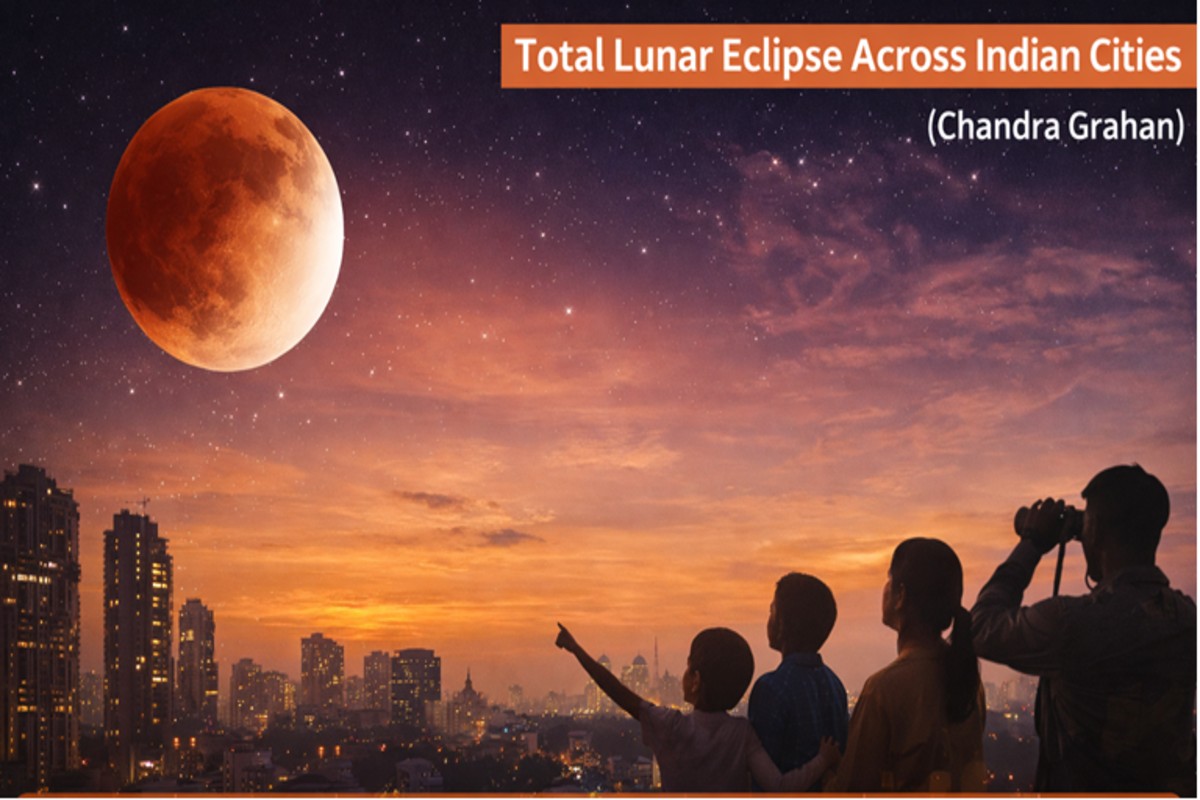
The above image is an illustrative representation, created with AI and does not depict actual individuals or events.
Eastern regions enjoy longer views, while western cities catch fleeting moments.Mumbai, March 3, 2026 : A total lunar eclipse is unfolding today, Tuesday, March 3, 2026, offering skywatchers across India a brief but striking celestial spectacle after sunset. Although the astronomical event began in the afternoon, it will only become visible in most parts of the country once the Moon rises in the evening.
According to astronomical calculations, the eclipse entered the Earth’s umbral shadow at 03:21 PM IST. The total phase began at 04:35 PM, with the maximum eclipse occurring at 05:04 PM. The total phase concluded at 05:33 PM, while the eclipse will fully end at 06:46 PM IST.
Because the Moon rises in India after the eclipse has already progressed significantly, observers will witness only the concluding stages. The duration of visibility depends on local moonrise timings, with most major cities seeing the phenomenon for roughly 20 to 60 minutes before it ends.
In Kolkata, the eclipse will be visible from 05:32 PM until 06:46 PM. Patna will witness it from 05:44 PM to 06:46 PM, while Lucknow can observe it between 06:02 PM and 06:46 PM. In the national capital, Delhi, visibility begins at 06:22 PM and continues until 06:46 PM.
Southern cities will also catch the final moments. Chennai will see the eclipse from 06:18 PM to 06:46 PM. Bengaluru’s viewing window runs from 06:28 PM to 06:46 PM, and Hyderabad from 06:26 PM to 06:46 PM. In Mumbai, the Moon rises late in the event, offering a brief viewing period from 06:42 PM until the eclipse ends at 06:46 PM.
A lunar eclipse occurs when the Earth passes directly between the Sun and the Moon, casting its shadow over the lunar surface. During totality, the Moon often takes on a reddish hue due to sunlight filtering through the Earth’s atmosphere, a phenomenon popularly referred to as a “blood moon.”
In keeping with traditional beliefs observed by many households, the Sutak Kaal began roughly nine hours before the start of the eclipse. This period commenced around 06:21 AM or 06:23 AM and will conclude at 06:46 PM with the end of the eclipse.
Astronomers note that lunar eclipses are safe to observe with the naked eye and do not require protective equipment. Weather conditions permitting, the event is expected to draw enthusiastic participation from amateur astronomers and families eager to witness one of nature’s most captivating alignments.
