
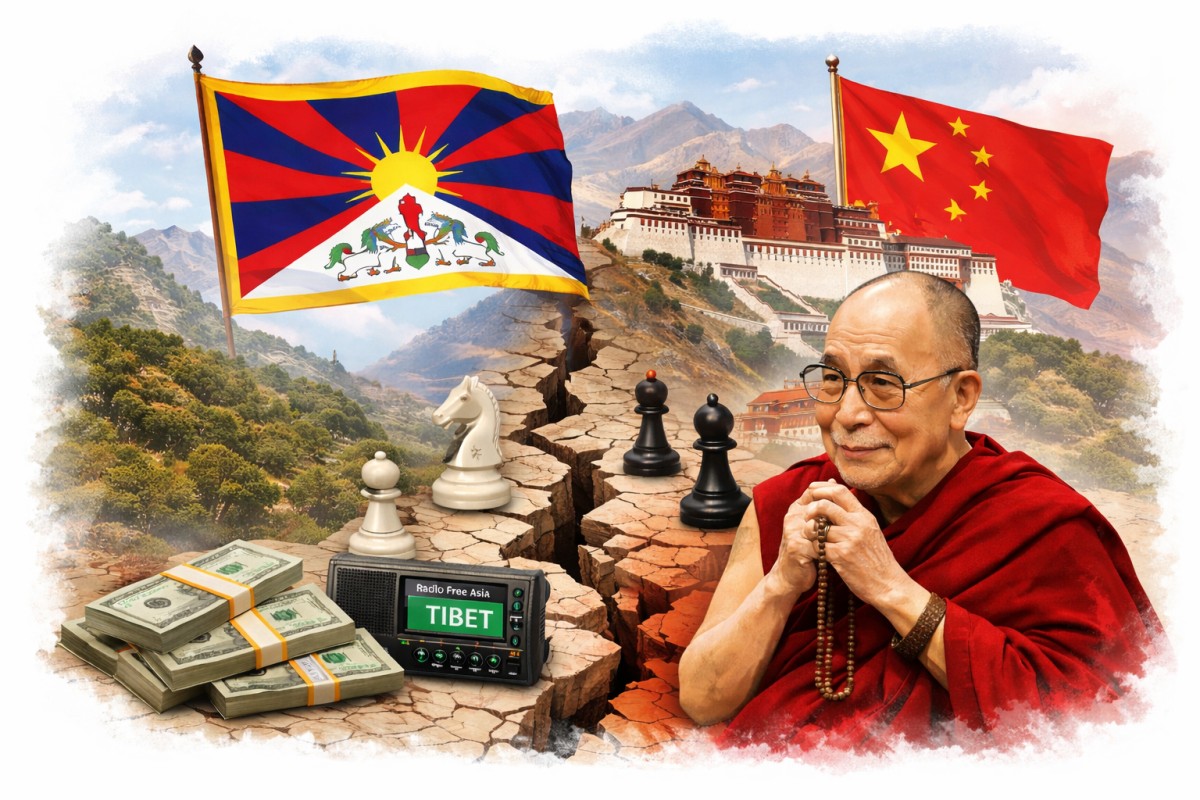
Washington, March 1, 2026 : The United States has appointed a senior official to oversee its policy on Tibet, a move that has drawn sharp criticism from China and revived debate over the role of Tibetan issues in the complex relationship between Washington and Beijing.
US Secretary of State Marco Rubio recently announced that Riley Barnes, an assistant secretary responsible for democracy, human rights and labour affairs, will serve as the new special coordinator for Tibetan issues. The position is mandated under American legislation intended to guide US engagement with Tibet and the Tibetan diaspora.
The announcement was made around the time of Losar, the Tibetan New Year, and comes roughly a year into President Donald Trump’s second term in office. Analysts say the timing reflects Washington’s continuing interest in highlighting Tibet-related matters even as the two global powers navigate a mix of cooperation, trade disputes and technological rivalry.
The appointment also arrives ahead of a period of delicate diplomatic engagement between the United States and China. Observers suggest that raising Tibet-related concerns can serve as a reminder that Washington retains political and diplomatic tools to address issues it considers linked to human rights and cultural preservation.
China reacted swiftly to the development, reiterating its long-standing position that Tibet is an inseparable part of its territory. Chinese officials said the creation of such a role by the United States amounts to interference in China’s internal affairs and insisted that Beijing does not recognise the position.
The Chinese government has also reiterated that decisions regarding the succession of the Dalai Lama must follow historical traditions and Chinese law, including approval by central authorities. The current Dalai Lama has lived in exile in India since 1959 following an uprising in Tibet that was suppressed by Chinese forces.
Debate over the Dalai Lama’s eventual succession has become an increasingly sensitive issue. The Tibetan spiritual leader has previously indicated that his successor could be identified outside China and that his office would determine the process. Beijing, however, maintains that the reincarnation of senior Tibetan Buddhist figures must occur within China and under state supervision.
Barnes has previously held several senior roles within the US State Department and has visited Dharamsala in northern India, the headquarters of the Tibetan government-in-exile, on multiple occasions, including during celebrations marking the Dalai Lama’s 90th birthday.
In remarks delivered during a State Department event marking Losar in Washington, Barnes said one of his priorities would be advancing efforts to preserve Tibetan cultural heritage and support Tibetan communities.
Despite the rhetoric, some observers remain sceptical about the practical impact of the appointment. They point to the limited diplomatic leverage available to Washington in Tibet-related matters and to broader shifts in US foreign policy under the Trump administration.
During Trump’s second term, foreign aid programmes and initiatives promoting democracy abroad have been significantly reduced, sparking debate over whether the United States is retreating from certain aspects of global advocacy.
The restructuring of foreign assistance programmes included plans to merge the US Agency for International Development into the State Department and cancel a large share of its initiatives. Funding cuts also affected US government-supported international broadcasting networks.
However, recent legislation passed by the US Congress restored substantial funding for the US Agency for Global Media, allowing Radio Free Asia to resume Mandarin, Tibetan and Uyghur language broadcasts via shortwave.
The legislation also earmarks funds to support Tibetan cultural preservation, environmental programmes and development projects inside Tibet. Additional allocations are designated for Tibetan refugee communities in India and Nepal, as well as for the Central Tibetan Administration in Dharamsala.
Further resources have been set aside for economic and capacity-building programmes aimed at displaced Tibetan communities.
Analysts say the renewed funding demonstrates that Tibet remains a point of political interest in Washington, even as the broader strategic relationship between the United States and China continues to be shaped by trade, security and technological competition.
