
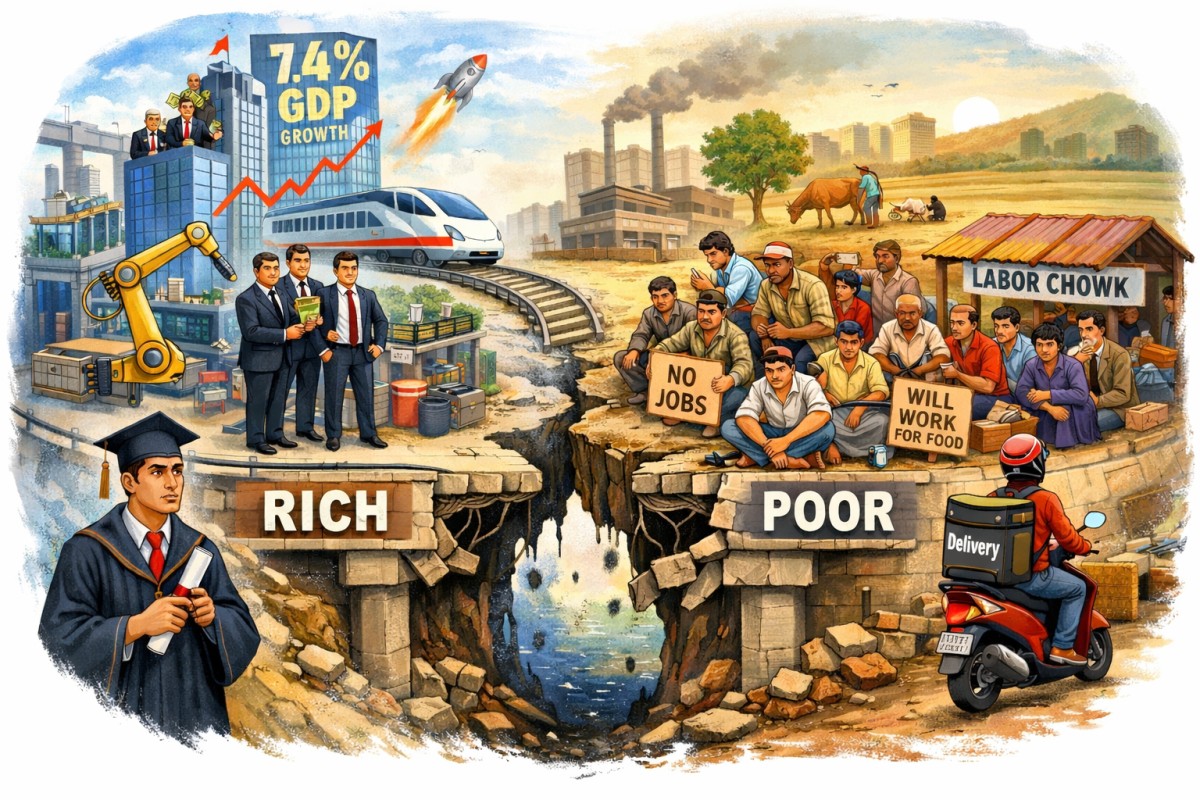
At 6 pm, Delhi’s night shelters (rain baseras) are fully occupied, a silent testament to the weary seeking shelter from the biting cold. By 10 am the next morning, any city’s labour chowks are still crowded with people without work, standing in the fragile, stubborn hope of a day’s wages. This daily rhythm of survival highlights a stark reality often masked by data: if we continue to measure success solely by the speed of the engine rather than who is actually on the train, we risk a future defined by inequality and social unrest.
When we look at the gleaming charts of modern economic progress, the headline numbers often feel like a victory lap. For a nation like India in early 2026, a GDP growth rate hovering around 8% paints a picture of a global powerhouse in full stride. We hear of billions in investments, record-breaking stock market highs, and the prestigious climb toward becoming the world’s third-largest economy. Yet, for the person standing at a crowded city intersection or a quiet village tea stall, these percentages feel abstract, almost spectral. The reason is a deepening rift that economists call the “missing link”: the decoupling of economic output from human livelihood.
The tragedy of this mismatch lies in its “jobless” nature. Historically, an expanding economy acted like a massive sponge, soaking up excess labor from fields and bringing them into factories and offices. But today, growth is increasingly capital-intensive rather than labor-intensive. Our success is being driven by high-end services, automation, and digital finance—sectors that generate immense wealth but require fewer human hands for every billion dollars added to the balance sheet. While the “Goldilocks moment” of high growth and low inflation is technically here, it feels remarkably hollow to the millions of graduates who find that their degrees are keys to doors that no longer exist.
There is a quiet, simmering risk in celebrating “growth quality” when that quality only serves the top tier of the workforce. We see a paradoxical “reverse structural shift” where, despite high GDP, a massive chunk of the youth population is being pushed back into agriculture or low-productivity “gig” work because the manufacturing sector hasn’t scaled enough to catch them. This isn’t just a statistical blip; it is a long-term threat to the social contract. When the promise of a better life through education is broken, the result is “scarring”—a phenomenon where a generation loses its prime years to underemployment, permanently lowering their lifetime earnings and, more dangerously, their sense of dignity.
The danger of ignoring this gap is that it creates a two-speed nation. On one track, we have a hyper-productive digital economy competing with the world; on the other, a vast informal workforce struggling with stagnant wages and no social safety net. Long-term stability depends on shifting the focus from how much we grow to how many people that growth can carry. Without a deliberate pivot toward labor-intensive industries and a radical overhaul of our industrial-era education system, the “missing link” will become a permanent chasm, leaving our most valuable asset—our people—behind.
