
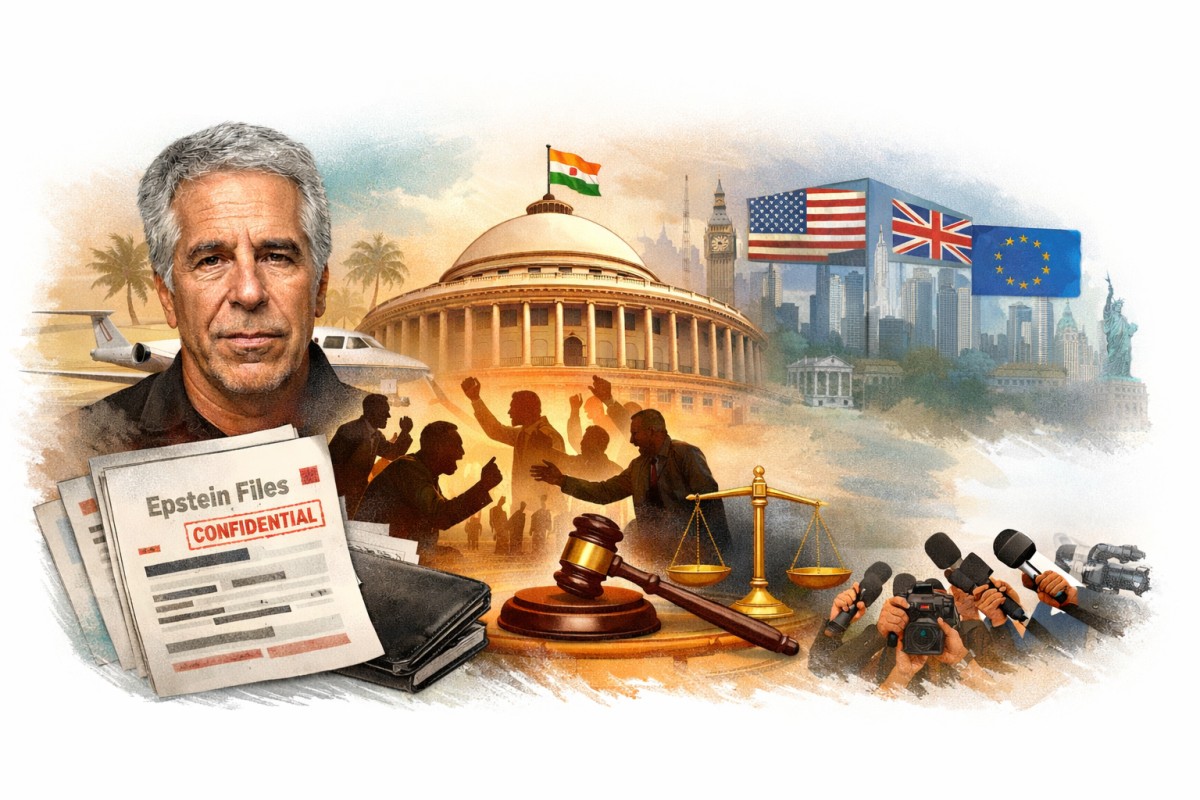
The above image is an illustrative representation, created with AI and does not depict actual individuals or events.
The recent arrest of former British prince Andrew in the United Kingdom has intensified the global reckoning over Jeffrey Epstein’s network, underscoring how deeply the scandal continues to penetrate the highest echelons of power. The shockwaves from London have found a parallel in New Delhi, where the uproar in India’s Parliament over the Epstein files is more than a procedural disruption—it is a mirror reflecting the uneasy intersection of privilege, power, and public trust. What began as a global scandal has now forced Indian democracy to confront uncomfortable questions about integrity, accountability, and the ethical standards expected of its leaders.
Epstein’s name has long been synonymous with exploitation and abuse. His arrest in 2019 and subsequent death in custody left behind a trove of records—flight logs, contact books, and calendars—that continue to reverberate across continents. These documents, now unsealed under court supervision in the United States, have implicated figures from politics, business, and diplomacy worldwide. While the mere appearance of a name in such files does not establish criminal conduct, the ethical shadow it casts is undeniable.
In India, opposition lawmakers seized upon reports that certain citizens were mentioned in these records, demanding clarity from the government. The treasury benches responded with caution, warning against trial by media and emphasizing that professional interactions at global forums often bring together diverse individuals. Yet the heated exchanges and adjournments underscored a deeper anxiety: even absent proven guilt, association with a convicted offender raises profound moral questions.
The scenes inside Parliament were not just about slogans and adjournments—they were about a nation grappling with betrayal. Citizens watching the broadcast saw leaders shouting across the aisle, but beneath the noise lay a quieter truth: the public’s growing fear that power in India, as elsewhere, may be too easily seduced by influence, even when that influence is tainted. The outrage was not only political; it was deeply personal, a cry from ordinary people who expect their representatives to embody integrity rather than compromise it.
This is where the debate transcends legality and enters the realm of public conscience. The issue is not only whether laws were broken, but whether leaders and elites exercised judgment befitting their positions of influence. To rely on figures like Epstein—even indirectly—for access or networking is to risk legitimizing a system built on exploitation. It is a reminder that power, when divorced from principle, corrodes trust at its very foundation.
Globally, the reckoning has already begun. In Europe, former leaders and ministers face scrutiny, with some under investigation for corruption linked to Epstein’s network. United Nations experts have described the activities revealed in these files as potentially meeting the threshold for crimes against humanity. Against this backdrop, India cannot afford to dismiss the matter as mere rumour or partisan noise. The credibility of its institutions depends on transparent inquiry and a willingness to confront uncomfortable truths.
The moral vacuum exposed by these files is not confined to boardrooms or diplomatic circles—it touches the lives of victims whose suffering was commodified while elites chased influence. Every name in those records is not just a line in a ledger; it is a reminder of the human cost of unchecked ambition. The silence from many quarters about this human dimension is perhaps the most chilling aspect of all. It suggests that in the pursuit of power, empathy itself has become expendable.
The parliamentary uproar is therefore not just political theatre—it is a call to re-examine the culture of elite insulation. Citizens watching the scenes of disruption expressed anger that powerful individuals often appear shielded from reputational consequences. The debate has shifted from legal guilt to ethical responsibility, from evidence in courtrooms to expectations in the public mind.
India’s democracy has always prided itself on resilience, but resilience cannot mean indifference. If leaders continue to hide behind procedural denials, they risk eroding the very trust that sustains democratic institutions. Transparency is not a concession—it is a duty. Accountability is not optional—it is the lifeblood of public service. The Epstein files, however foreign they may seem, have become a test of whether India will choose courage over convenience.
India’s leaders now face a choice. They can continue to hide behind procedural denials, or they can embrace accountability by ensuring that every name, every association, is examined with transparency. The Epstein files are not simply foreign documents; they are a test of whether Indian democracy will uphold the values of integrity it claims to represent.
