
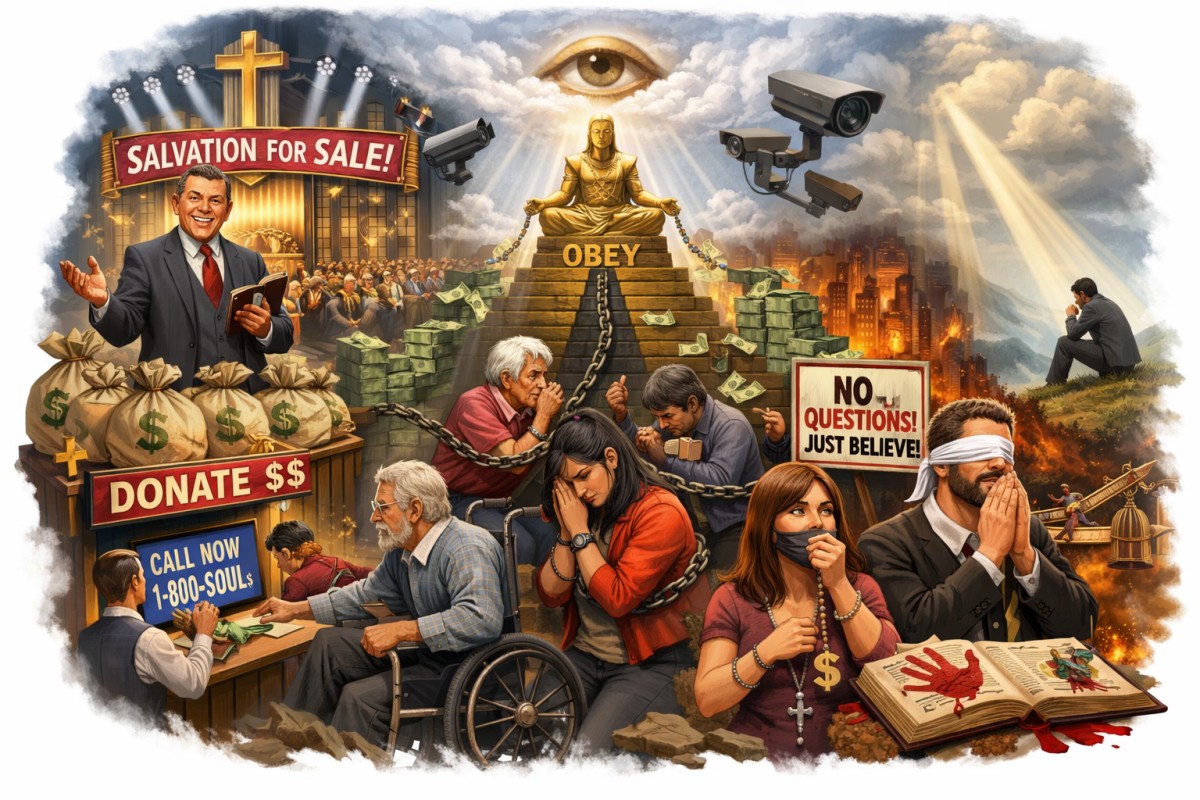
Across countless ages, the human heart has turned to faith as a sanctuary—a wellspring for the weary, a balm for the broken. Yet, in our own time, a chilling, commercial calculation has desecrated this sacred ground. Under the elaborate facades of our shrines, sects, and spiritual empires, faith is being ruthlessly repackaged as a commodity, and devotion quietly liquidated into a revenue stream.
The orchestrators of this transaction speak of the divine with practiced eloquence. Their sermons are flawlessly delivered, their rituals breathtakingly staged, and their promises of eternal relief are endlessly soothing. But listen closely, and you will hear the unspoken certainty at the core of their power: the God they invoke so loudly poses no threat to them. They have outsourced accountability, reserving it not for the preachers who profit, but for the followers who pay. The divine, in their hands, is merely a utility: convenient, malleable, and safely distant from their balance sheets.
The true cruelty of this market is its predatory focus on human vulnerability. Followers arrive, their lives fractured by crushing grief, fear, illness, and despair. They are not intrinsically foolish; they are rendered vulnerable by circumstance. And it is in this raw, exposed state that blind devotion is cultivated with surgical precision. Questions are not just discouraged—they are weaponised as ‘sin.’ Doubt is branded as betrayal. Obedience is cynically masqueraded as the highest form of faith. The promise is always a vague, future salvation, but the cost is devastatingly immediate: money, dignity, critical thought, and the very autonomy of the soul.
Let us state a hard, non-negotiable truth: no human eye has ever witnessed the Almighty in physical form. Every single image, idol, or symbol of the divine is a human invention, shaped by culture, geography, and social need. This diversity—the farmer revering the harvest, the entrepreneur venerating Lakshmi, the warrior honouring the weapon—does not weaken faith; it reveals its profoundly human construction. The menace erupts when any one interpreter claims exclusive, absolute truth, freezing fluid symbolism into rigid, profitable dogma. When representations shaped by convenience are aggressively sold as divine certainty, belief ceases to be a reverence and becomes a mechanism of control.
What grants this spiritual business model such terrifying durability is its chilling inversion of power. The broker of faith walks free, insulated by the very reverence he demands, while the flock carries the suffocating burden of belief. God is presented not as a universal force of justice, but as an exclusive asset, available only through intermediaries who gorge themselves on the access fees. The divine is not feared by those who occupy the apex of this pyramid; it is feared on their behalf by those below.
This is not an attack on genuine religion, nor on the profound capacity for belief. True faith is, and must remain, an utterly personal, unmediated encounter with one’s own conscience and compassion. It becomes a catastrophe only when it is outsourced—when thinking is surrendered and moral responsibility is delegated to a charismatic third party. History screams one truth: the greatest atrocities committed in the name of God have never been carried out by sceptics, but by those who claimed a proprietorial monopoly over Him.
A functional society must demand uncomfortable answers. When hallowed spaces morph into high-turnover enterprises, when spiritual figureheads operate above legal or moral scrutiny, and when faith demands total silence instead of sincere reflection, a fundamental corruption has occurred. God, if one truly believes in Him, cannot be owned by anyone—least of all by those who grow rich and powerful by leasing out His name.
The most bitter irony remains: the divine is said to be all-seeing, yet those who ruthlessly exploit belief operate as if utterly unseen. And the faithful, taught only to look upward in supplication, are actively discouraged from looking around at the transaction, or within at their own conscience. Until devotion acquires the courage of awareness, faith will remain tragically easy to sell, and the human spirit will be discounted as cheaply as a prayer rug.
True belief does not fear an honest question; it fears exploitation.
Disclaimer: This article reflects personal views on faith, power, and social behaviour. It does not target any religion or religious community.
