
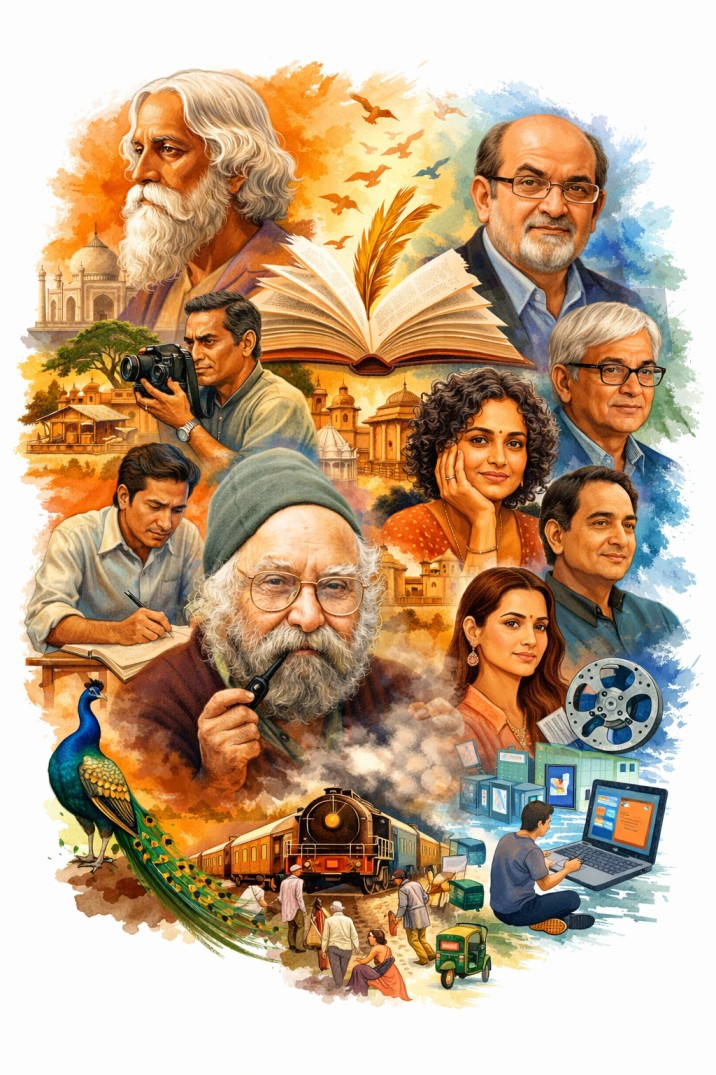
The Changing Voice of Indian English Writing
Languages are never neutral – they carry histories, burdens and power. When Rabindranath Tagore penned his timeless lines, India was not just a land but an imagination—aching to be free, struggling to discover its voice under the heavy weight of colonial rule. With Gitanjali, he did not merely write poetry; he redefined how the East could speak to the West, blending spirituality, simplicity, and lyricism into a universal language. His Nobel Prize in 1913 was not just a personal honour; it was India’s first assertion that its voice, even in English, could resonate across continents.
From Tagore’s deeply spiritual cadences to Rushdie’s dazzling postmodern exuberance, Indian English writing has mirrored our political struggles, social dilemmas, overseas anxieties, and philosophical quests. Each generation of writers has not just added to the canon—they have rewritten the very tone of what it means to be Indian in English.
Tagore’s writing was steeped in the soul of Bengal yet universal in appeal. After him came voices like R.K. Narayan, who brought Indian middle-class life into the global imagination with characters from the fictional town of Malgudi. His style was gentle, humorous, and deceptively simple—quietly asserting that the daily lives of Indians were as worthy of literature as Europe’s epics. If Tagore gave Indian English writing its lyricism, Narayan gave it its everyday humanity.
Satyajit Ray, though primarily a film director, also wrote eloquently in English—his essays and film criticism in Our Films, Their Films articulated India’s cinematic and cultural identity to an international audience. His English writings, like his cinema, balanced clarity with depth, extending the reach of Indian storytelling beyond linguistic borders.
The post-Independence era shifted the tone. Writers like Mulk Raj Anand and Raja Rao wrestled with questions of identity, caste, and freedom. Anand’s raw depictions of social injustice, especially in Untouchable, forced readers to confront the uncomfortable truths of Indian society. Raja Rao, with his philosophical depth in Kanthapura, demonstrated how the rhythms of Indian thought could be expressed through the borrowed medium of English.
In this lineage, Khushwant Singh carved a distinct space. With Train to Pakistan, he produced one of the most haunting portrayals of Partition. His writing was simple yet searing, cutting through sentimentality to reveal the brutal human cost of communal violence. Singh was also a journalist, historian, and social commentator. His voice was earthy, satirical, and fearless, bringing Indian English closer to lived reality, bridging the realism of Narayan and Anand with the experimentation that Rushdie would later unleash.
It was Salman Rushdie who detonated a revolution in voice. With Midnight’s Children in 1981, Indian English acquired boldness and irreverence previously unseen. His narrative voice bent rules, mixing myth with history, colloquial with classical, personal memory with national narrative. He made English dance to an Indian rhythm, unapologetically infused with Urdu, Hindi, and street slang. In Rushdie’s hands, Indian English became not just a language of narration, but of creation—fragmented, hybrid, playful, and deeply political.
The generation that followed—Arundhati Roy, Vikram Seth, Amitav Ghosh, Jhumpa Lahiri—took this baton and carried it in new directions. Roy’s The God of Small Things explored caste, love, and memory with poetic ferocity. Ghosh’s epics stretched across oceans and centuries, weaving global history with Indian lives. Lahiri, in her writings about the immigrant condition, gave voice to the longing for belonging. Seth, in his monumental A Suitable Boy, showed that Indian stories could command the same scope and ambition as Tolstoy or Dickens.
What unites these diverse voices is their refusal to be trapped by English. Each generation has bent the language, made it porous, and reshaped it to carry the weight of Indian realities. English, once imposed, has been indigenised, hybridised, and turned into an instrument of self-expression. Where once it was the master’s tongue, it has become a tool to interrogate power, identity, and injustice.
Today, Indian English writing is no longer confined to the high shelves of literary prizes. It thrives in new forms—graphic novels, digital storytelling, and micro-literature. Writers like Jeet Thayil push linguistic boundaries with experimental prose, while younger voices tackle themes of gender, mental health, climate change, and political dissent with urgency. The diaspora continues to enrich the narrative, with authors based abroad shaping new imaginaries of identity and belonging. Meanwhile, writers within India navigate a more precarious path, where each word bears the burden of truth, spoken against unsettled skies and ever-shifting winds.
The journey of Indian English writing is more than a story of literary evolution; it is the story of a nation finding its voice—learning to speak both to itself and to the world in a language once borrowed, but now inseparably woven into its identity.
The evolving voice of Indian English writing reveals a deeper truth: in the hands of Indian authors, English has transformed into a vast canvas, alive with the hues of India—its sorrows and joys, its diversity and contradictions, its humour and chaos—rendered in all their intensity.
Tagore’s timeless invocation—‘Where the mind is without fear and the head is held high’—still echoes in the uncompromising candour of Khushwant Singh, the defiant laughter of Rushdie, the fierce intimations of Roy, and the tender nostalgia of Lahiri. Indian English writing has travelled from submission to subversion, from imitation to innovation, from tentative cadences to original symphonies. It will continue to evolve, because India itself continues to change. And in that restless, unpredictable journey lies the true power of its voice.
