
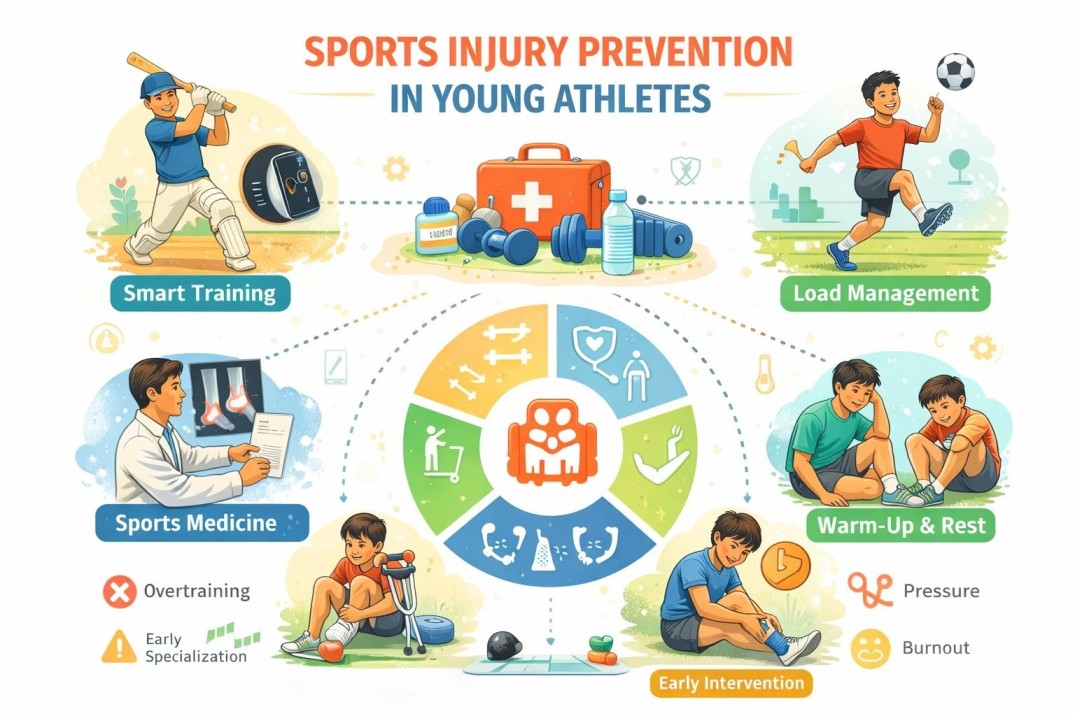
India celebrates medals, records, and sporting heroes with pride, but far from the spotlight, a quieter crisis continues to grow. At playgrounds, school fields, district academies, and local gyms, injuries go untreated, training goes unmonitored, and young athletes push their bodies without scientific guidance. The conversation around sports development in India has focused heavily on infrastructure and competition, but not enough on the human body that carries the dream. The missing link is a strong grassroots sports medicine and injury-prevention culture — and the cost of ignoring it is already visible.
At the school and community level, sports participation is often driven by enthusiasm but rarely supported by structured medical oversight. A twisted ankle is brushed aside, recurring knee pain is dismissed as weakness, and stress fractures are discovered only when performance collapses. Many families still view physiotherapy and sports rehabilitation as elite services meant only for professional athletes. In reality, early intervention and preventive care are most effective when applied early — especially among children and adolescents whose bones and muscles are still developing.
This gap becomes more worrying when we look at how training patterns have changed. Children today are specialising in a single sport at increasingly younger ages. Ten-year-olds are on year-round cricket nets, football turf sessions, badminton drills, or gymnastics routines with little seasonal variation. Early specialisation may create short-term competitive advantage, but research across sports science consistently shows it increases the risk of overuse injuries, psychological fatigue, and long-term dropout. A child’s body is not designed for repetitive, high-intensity loading without recovery cycles. Variety once protected young athletes; now repetition is wearing them down.
Injury prevention, therefore, should not be an optional workshop — it should be part of every school curriculum that promotes sports. Warm-up science, load management, rest periods, hydration, sleep, posture, and basic biomechanics can be taught in simple, age-appropriate ways. Just as students learn road safety and hygiene, they can learn joint safety and movement literacy. A structured five-minute neuromuscular warm-up routine has been shown globally to significantly reduce common sports injuries. Yet many school competitions still begin with hurried stretches and end with ice packs and guesswork.
At the same time, India is witnessing a boom in fitness technology. Mobile apps count steps, track calories, and generate workout plans within seconds. Wearables measure heart rate and sleep cycles. While these tools have made health tracking more accessible, they have also created a false sense of precision. Movement quality cannot be fully measured by a phone sensor. An app cannot correct poor running mechanics, detect early tendon overload, or adjust a training plan for a growth spurt in a teenager. Data is helpful, but unsupervised data can also mislead. Many users push harder to “close rings” or hit targets, ignoring pain signals that a trained professional would immediately recognise as warning signs.
Ironically, despite the rise of fitness apps and digital coaching, daily natural movement is declining. Screen time has replaced free play. Structured workouts have replaced spontaneous activity. People exercise for 40 minutes but sit for 10 hours. Young athletes train intensely but recover poorly. The body does not differentiate between stress from sport, exams, travel, or lack of sleep — it simply accumulates load. When recovery is missing, burnout follows.
Athlete burnout is no longer limited to professionals. It is appearing in teenagers who lose motivation, develop chronic soreness, or walk away from sports they once loved. Behind many such exits is not lack of talent, but unmanaged pressure and untreated injury. When performance becomes identity at too young an age, sport stops being play and becomes burden. A healthy sports culture must protect joy as fiercely as it pursues victory.
What India needs is not only more stadiums and leagues, but a layered support system: trained sports physiotherapists linked to schools and district centres, injury screening camps, coach education in load management, and curriculum-level awareness of preventive exercise. Community health programs can integrate movement screening just as they conduct dental or vision checks. Insurance products can include preventive sports assessments. Coaching certifications can mandate basic sports medicine literacy.
Sport builds confidence, discipline, and social strength — but only when bodies are protected along the way. Every medal story we celebrate publicly rests on thousands of invisible training hours. Those hours deserve scientific care, not trial and error. If we want a sporting nation, we must first become a movement-literate nation. Prevention is not a luxury layer added after success; it is the foundation that makes success sustainable.
