
Understanding Iran Through an Indian Lens
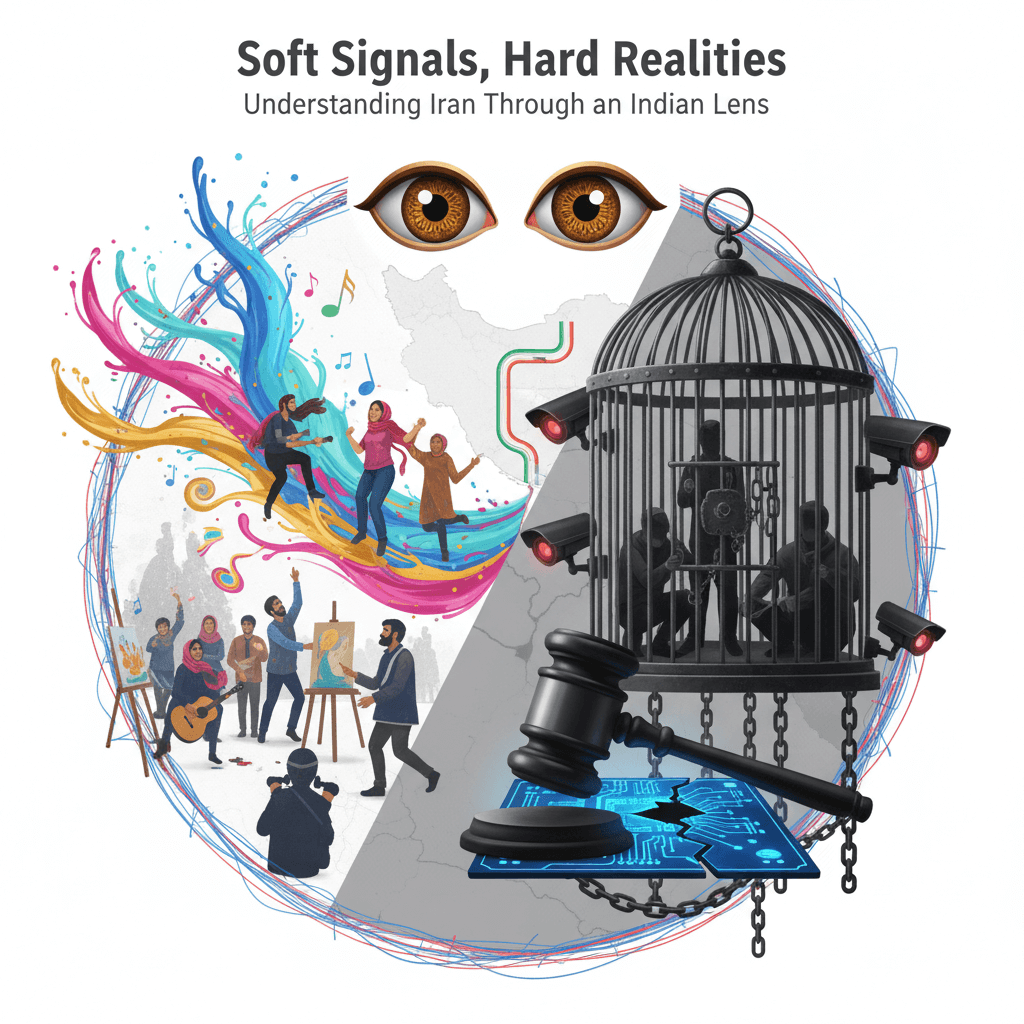
Iran today stands at a paradoxical crossroads, where shifting social behaviour coexists uneasily with a tightening political order. Across the boulevards of Tehran and the provincial heartlands, one can sense a quiet cultural drift—women moving freely without the mandatory hijab, young people forming mixed-gender circles, and a rise in impromptu artistic events. These expressions reveal a population yearning for normalcy, dignity, and the emotional release that comes from reclaiming personal space.
But this cultural breeze cannot mask the storm building within Iran’s political core. Even as the state tolerates limited social flexibility, it simultaneously hardens its authoritarian scaffolding. The authorities have intensified surveillance, detained journalists and activists under ambiguous legal provisions, and widened the scope of capital punishment in the name of preserving national security. What looks like liberalization from afar is in reality a controlled illusion, designed to diffuse pressure while reinforcing the state’s monopoly on power.
This internal contradiction is not a domestic matter alone—it forms a strategic signal to Iran’s partners, especially India.
A Relationship Built on History—Now Facing Uncertainty
India’s engagement with Iran has traditionally rested on three pillars: civilizational continuity, energy interdependence, and regional connectivity, with Chabahar port symbolizing shared strategic ambitions. Yet the stability that once underpinned this relationship is eroding.
Iran’s economic collapse, persistent regional confrontations, and rising political volatility are gradually spilling into the bilateral space. Tehran’s recent suspension of visa-free entry for Indian citizens, reportedly triggered by concerns over illegal trafficking and ransom incidents, reflects the increasing unpredictability of its internal environment. Though diplomatic reassurances continue, India must recognize that the operational risk profile in Iran is no longer what it was a decade ago.
What exacerbates the concern is the expanding coercive reach of Iran’s judiciary. The rapid surge in executions, the prosecution of individuals for online expression, and the widening use of espionage-related charges create a challenging landscape for Indian students, workers, pilgrims, and businesses. The line between internal repression and foreign engagement is becoming thinner, and New Delhi must not underestimate the implications.
Regional Tensions and Global Headwinds
Iran’s fragile position in the global order adds another dimension to the risk. Its contentious nuclear trajectory, fractured relationship with Western powers, and deepening hostility with Israel make the region highly combustible. Any escalation can disrupt India’s energy supply chains, threaten the safety of its diaspora across West Asia, and complicate its wider geopolitical engagement.
India’s foreign policy has long relied on balancing historic bonds with Iran against strategic partnerships with the United States, Europe, and Israel. As Iran drifts into deeper confrontation with the West, India’s diplomatic calculus becomes increasingly delicate.
The Human Angle India Cannot Ignore
Behind the geopolitical complexity lies a human story that demands attention. Young Iranians, whose courage fuels the cultural shift, face dire consequences for questioning the state’s authority. Ethnic and religious minorities encounter a harsher fate, often prosecuted under expansive national-security narratives. This climate of fear shapes the broader context within which India must safeguard its citizens and conduct diplomacy.
A Roadmap for India: Principled, Pragmatic, Prepared
India cannot afford dramatic swings. Its response must combine strategic caution with moral clarity:
Prioritize the safety of Indian nationals engaging with Iran’s educational, religious, or commercial sectors.
Maintain dialogue without appearing to legitimize coercive political behaviour.
Stand empathetically with the Iranian people’s aspirations for dignity, freedom, and stable livelihoods.
Secure supply chains and diversify energy pathways to cushion potential geopolitical shocks.
Iran’s future is uncertain—an uneasy blend of defiance, decay, and desire for change. But India’s approach must remain calm, calibrated, and guided by its democratic ethos. As Tehran oscillates between veils of openness and vaults of repression, New Delhi’s imperative is clear: engage, but with eyes wide open.
