
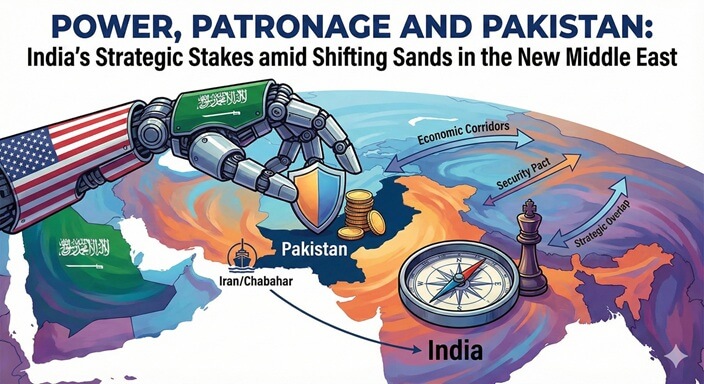
India’s Strategic Stakes amid Shifting Sands in the New Middle East
The Saudi Crown Prince Mohammed bin Salman’s recent visit to the White House reactivates the old US–Saudi partnership—and, with unmistakable consequences for India, restores Pakistan’s relevance in their strategic design. This shift is not speculative; it follows a well-established historical pattern. Whenever Washington and Riyadh move in tandem, Pakistan tends to gain through security assurances, financial breathing space, and enhanced diplomatic visibility. India must therefore approach this moment with clarity and calibrated realism.
The Middle East today is shaped less by ideology and more by hard interests: regional security, energy stability, financial diplomacy, and the struggle for geopolitical dominance. For Saudi Arabia, deeper engagement with Washington offers defence guarantees, technology access, and political backing for its domestic and regional ambitions. For the United States, Saudi Arabia remains a key partner in energy security, maritime routes, counterterror frameworks, and in balancing unfriendly regional actors.
Within this arrangement, Pakistan occupies a familiar and pragmatic role. Saudi Arabia has long extended financial lifelines to Islamabad—through central bank deposits, deferred-payment oil facilities, and the revival of military cooperation. Washington, meanwhile, continues to view Pakistan as a useful interlocutor in Afghanistan and, when required, a counterweight in its Iran calculus. This tilt has manifested clearly: from extending diplomatic backing to Pakistan during Operation Sindhoor, to keeping tariffs on Pakistani exports conspicuously low while levying steep duties on comparable Indian goods.
For India, this renewed tilt introduces both strategic challenges and policy adjustments. A financially stabilised Pakistan, supported by Gulf capital and enjoying diplomatic space in Western channels, may adopt a firmer posture on Kashmir narratives, defence modernisation, and regional diplomacy. Gulf re-engagement with Islamabad could also strengthen Pakistan’s voice within the Organisation of Islamic Cooperation (OIC), complicating India’s efforts to counter politically driven resolutions.
Before the Saudi–Pakistan military pact of 17 September 2025, energy cooperation between India and Riyadh was steadily expanding. Gulf sovereign wealth funds were increasingly investing in Indian infrastructure, logistics, digital platforms, and renewable energy projects. Though, on 12–13 November 2025, India and Saudi Arabia reaffirmed their commitment to conclude a proposed Bilateral Investment Treaty (BIT) at the earliest, aiming to unlock robust two-way capital flows and accelerate long-term strategic investments across priority sectors. Yet this military pact introduces a layer of complexity to Riyadh’s signalling, narrowing India’s manoeuvring space on fronts such as Iran, the Chabahar Port, and regional connectivity. If pressure on Tehran intensifies, India’s access to Central Asian trade routes could slow—a development Pakistan would welcome. Islamabad may also attempt to reposition itself as a frontline state in Western security discourse if regional tensions escalate.
India’s leverage in the Gulf should not be taken for granted. Gulf leaders have long viewed India as a dependable economic partner, with demographic weight, expanding markets, technological capability, and political stability. But Saudi Arabia’s dual-track approach—extending security and financial space to Pakistan while maintaining economic partnership with India—may gradually erode New Delhi’s room for manoeuvre. If Gulf capitals recalibrate priorities under external pressure from Washington or Beijing, India could face constraints in areas vital to its long-term interests, including food security, digitalisation, infrastructure, and energy demand. The caution lies in assuming that economic logic alone will safeguard India’s position; Riyadh’s signalling now carries layers of complexity, and India must prepare for scenarios where its economic partnership is overshadowed by shifting alignments. Vigilance, diversification, and proactive diplomacy are essential.
The Middle East’s new phase is ultimately pragmatic, rewarding states that deliver economic scale, policy predictability, and stable partnerships. India may fit this mould, but it must remain wary: Saudi Arabia and the United States will continue to maintain strategic ties with Pakistan, a reality that is structural. In this shifting landscape, loyalties are fluid while interests remain immovable. India’s challenge is not to compete for favour but to guard against complacency. Multiplying relevance through defence cooperation with Gulf States, expanding economic corridors, and adopting a calibrated approach toward Iran are necessary steps, yet none guarantee insulation from shifting alignments. In West Asia, relevance is contested and conditional, and the true measure of power lies not in alignment but in the ability to endure uncertainty without losing ground.

I always read your article .I feel it’s thought provoking and your articles shows vast knowledge on so many subjects.The language,content and your expressions adds up to my knowledge.
Please keep writing and expressing your viewpoints.
Best regards