
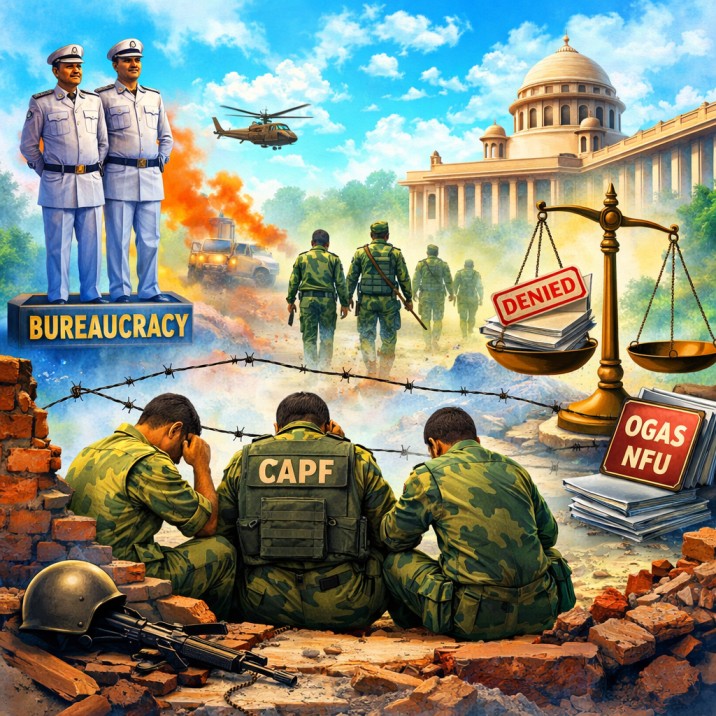
In a nation that prides itself on its security forces, many serving and retired personnel believe that a longstanding structural imbalance continues to affect India’s Central Armed Police Forces (CAPFs), the very guardians of its borders and internal peace. Often hailed as heroes in public rhetoric, these forces, comprising over a million dedicated personnel, are frequently viewed within the fraternity as receiving less parity than certain other services. Their struggle is not merely for better pay or perks, but for dignity, parity, and fuller institutional recognition within a system that many officers feel has yet to adequately address their longstanding concerns.
In today’s India, many officers ask whether meaningful institutional reform can emerge when decisions affecting service structures are shaped within tightly held administrative frameworks. Critics often describe parts of the higher bureaucracy as naturally inclined to preserve existing service hierarchies, particularly in matters of pay, promotions, and cadre control. For many within the paramilitary fraternity, this makes the path to parity feel unusually long and difficult.
There was a time when external adversaries such as the Inter-Services Intelligence were routinely invoked in explaining security threats facing the country. Without suggesting internal sabotage, many officers believe that successive structural interventions over recent decades have significantly altered the institutional character of these forces. In repeated efforts to reform or modernize the system, lateral-entry arrangements and administrative restructuring have, according to critics, affected long-established internal balances and operational identity.
The Executive’s Burden: Cream Left with Buttermilk
Imagine an armed force where supporting cadres receive relatively faster career progression, while the executive cadre, responsible for core operational tasks, experiences comparatively slower advancement. Many officers describe this as one of the more difficult service imbalances within India’s paramilitary forces.
Consider the medical cadre within the CAPFs. They enjoy time-bound promotions up to the rank of Commandant, after which they become part of a joint cadre, with officers transferable between forces, ensuring a structured career path.
Previously, upon receiving time-scale promotions, medical officers obtained the financial benefits of higher rank but wore the corresponding badges only when executive cadre counterparts reached similar rank progression. That practice was later discontinued, and medical officers now assume rank insignia immediately upon entering the next scale. Many executive cadre officers argue that this has made traditional seniority relationships institutionally difficult to reconcile.
Similarly, the ministerial staff, who once joined as Assistant Sub-Inspectors (ASI) and could rise to the post of Administrative Officer (AO), a gazetted decombatised position, now join as Head Constables (HC) and can ascend up to the rank of Deputy Commandant, securing multiple promotional avenues. While there is nothing to take away from the valuable contributions of these supporting cadres, their relatively faster progression is often cited by executive cadre officers as evidence of widening disparity in career advancement.
In an armed force, many serving and retired officers describe this as a significant anomaly: an executive officer with years of seniority in service may find themselves junior to a medical cadre officer who joined later.
Many officers argue that such structural imbalance affects morale and places strain on the hierarchy and ethos of an armed force, where combat leadership and operational experience traditionally hold central importance.
The Denied Rights: OGAS, NFU, and Stagnation
The core of many paramilitary officers’ grievances lies in the continued debate over service benefits available to other central Group A services, particularly services such as the Indian Administrative Service and Indian Police Service. These concerns generally focus on three major areas:
Organised Group A Services (OGAS) Status:
For years, despite having Group A officers, CAPFs sought formal recognition within the organised service framework. Such recognition is widely viewed as important because it influences pay progression, promotional avenues, and eligibility for Non-Functional Upgradation (NFU). Judicial proceedings before the Supreme Court of India have kept this issue alive for years, making it one of the most prolonged service-related legal debates affecting CAPFs.
Non-Functional Upgradation (NFU):
Introduced in 2006 to address stagnation across organised services, NFU allows officers of a batch to receive corresponding financial upgradation when one officer reaches a higher level. CAPF officers remained outside this framework for long periods, creating what many officers describe as a significant service disparity where senior uniformed officers often compared unfavourably with civilian counterparts in financial progression. Judicial observations in related litigation have also questioned some of the administrative reasoning offered for such exclusion.
Promotion Stagnation:
While an IPS officer may reach the level of Superintendent of Police relatively early in service, many CAPF officers take far longer to reach Commandant rank. Officers often attribute this delay to existing deputation structures, limited promotional vacancies, and force expansion patterns that have resulted in long waiting periods, including nearly fifteen years for first promotion in many cases. Many within the cadre describe this as creating a persistent promotional ceiling for internal officers.
The Judiciary: Last Resort, The Bureaucracy as a Roadblock
The struggle for service parity for CAPF officers has largely unfolded through litigation, with the judiciary often becoming the final avenue for institutional relief. Several judgments of the Supreme Court of India have provided important recognition to long-standing service concerns raised by CAPF officers. In recent years, judicial orders concerning NFU, OGAS, and cadre-related parity have significantly shaped this debate.
A major development came when judicial proceedings affirmed important service claims relating to CAPF Group A officers, including recognition linked to organised service principles. Subsequent legal proceedings, including review stages, further reinforced the importance of resolving these issues within a clear administrative framework.
Despite judicial clarity on several aspects, implementation has remained gradual, and many officers continue to express concern over delays in translating legal outcomes into administrative action. Discussions have also emerged in policy circles regarding possible future administrative or legislative responses, although no definitive institutional position has yet taken shape.
Many officers argue that repeated litigation has extended uncertainty around benefits that they believe should now move toward administrative closure. The contrast between public recognition of CAPF contributions and the pace of service reform continues to shape debate within serving and retired ranks.
The practical challenge, many observers note, lies in the layered decision-making structure of government, where service-related matters move through multiple administrative channels, including those influenced by services such as the Indian Administrative Service and Indian Police Service. As a result, even after judicial orders, implementation often takes time and may involve further legal examination, including Special Leave Petitions and related proceedings.
The Cost of Neglect: A Demoralized Force
The struggle for justice for CAPF officers has largely played out in the courts, with the judiciary often acting as the last resort amid prolonged administrative disagreement. Several judgments of the Supreme Court of India have provided significant relief to CAPF officers on long-pending service issues. In 2019, the Court upheld the grant of Non-Functional Financial Upgradation (NFFU) by treating CAPF officers within the organised service framework for that limited purpose. More recently, in May 2025, the Court delivered a major judgment recognising CAPF Group A officers within the organised service framework for all consequential purposes from 1986 onwards. A further important stage came in October 2025, when the Supreme Court of India dismissed the review petition filed by the Central Government, thereby reinforcing the earlier judgment in favour of cadre officers
The Cost of Neglect: A Demoralized Force
The prolonged delay in resolving service-related disparities has significant institutional consequences. Many officers argue that uneven promotional opportunities and delayed benefits contribute to frustration and a growing sense of being undervalued among personnel who serve in demanding and high-risk conditions. Judicial observations have also acknowledged that prolonged stagnation can affect morale within the forces.
A force facing uncertainty in career progression and service parity may experience difficulty in sustaining long-term morale and internal confidence. Many officers believe that limited promotional avenues and deputation-related structures have also affected internal leadership progression and altered established service expectations within the forces. Such concerns are increasingly discussed not merely as service matters, but as questions linked to institutional strength and long-term operational confidence.
For many within the CAPFs, the continuing demand is not simply for additional benefits, but for recognition of service conditions broadly comparable to other central services. Their continuing legal and administrative struggle reflects a wider debate about parity, institutional identity, and the place of frontline uniformed services within India’s governance structure. Even after important judicial developments, many officers believe that durable resolution will require sustained administrative attention and a more balanced policy approach.
A fresh dimension has now emerged in this debate with the introduction of the Central Armed Police Forces (General Administration) Bill, 2026 in Parliament on 25 March 2026. The proposed legislation has drawn attention because several of its provisions are being widely examined in the context of recent judicial directions concerning cadre structure, organised service status, and deputation in the CAPFs. While the Government has presented the Bill as an administrative framework for unified service governance, many serving and retired officers view it as a development that could significantly influence how recent judgments of the Supreme Court of India are implemented in practice.
Disclaimer: This article represents the personal views and proposals of the author. Truth Chronicle publishes diverse perspectives in the interest of public discussion and does not endorse or assume responsibility for the opinions expressed herein.

The article offers a thoughtful and well-articulated perspective on the long-standing structural concerns within India’s Central Armed Police Forces (CAPFs). It highlights issues such as promotion stagnation, disparities in career progression between executive and supporting cadres, and the prolonged struggle for benefits like Organised Group A Service status and Non-Functional Upgradation. By linking these concerns with recent judicial developments and the proposed CAPF (General Administration) Bill, 2026, the piece places the debate in a timely policy context.
The article raises important questions about institutional parity, morale, and recognition of the forces that shoulder a major share of the country’s internal security responsibilities. I must congratulate author for highlighting the issue which is becoming concern for internal security if not solved amicably as demoralised & demotivated force becomes a burden than an asset for a state.
Excellent and relevant article with covering all aspects.
Big salute to you for raising the voice of CAPFs and describing the matter with detailed facts .
CAPFs just want their lawful rights , Govt must implement order of Honb’le Supreme court in letter and spirit.
Save CAPFs, Save Nation.
Govt left the CAPF like an orphan
Very sad
Nicely elaborated each and every aspect.