
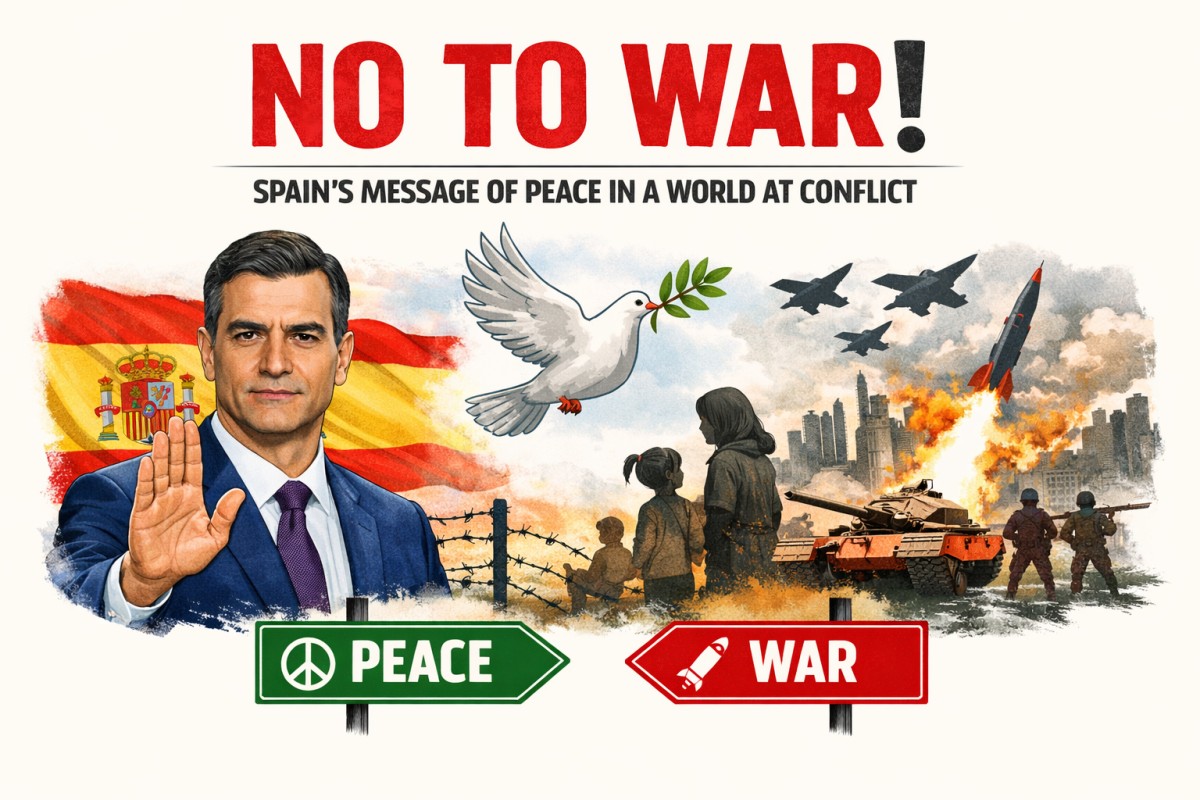
In an era where geopolitical chess pieces move with cold, calculated precision and the language of diplomacy often descends into hollow rhetoric, Spain stands as a powerful beacon of moral fortitude.
Led by Prime Minister Pedro Sánchez, the Spanish government has articulated a stance on global conflicts that is as simple as it is profound:
“No to war.”
This position, far from being a naive utopian dream, is a principled commitment to international law and the preservation of human dignity, even as the drums of war beat louder around the globe.
Spain’s stance is not merely symbolic; it has been translated into concrete actions of historic defiance. By refusing to allow joint military bases like Rota and Morón de la Frontera to be used for offensive operations against Iran, Madrid has sent a shockwave through the international community. This wasn’t a decision made in comfort; it was made in the face of direct threats of trade embargoes and economic retaliation. Prime Minister Sánchez’s response to such pressure was a master class in sovereign dignity:
“Being an ally of the United States does not mean saying yes to everything.”
He has effectively broken the “spiral of silence” that often paralyzes European capitals, proving that moral strength is a currency more valuable than transactional loyalty.
This “Madrid Doctrine” challenges the very architecture of modern conflict, where “national interest” is frequently used as a euphemism for the abandonment of ethics. Spain is essentially arguing that there is no national interest greater than the prevention of mass slaughter. The motivations behind Spain’s position are deeply rooted in its collective memory. The scars of the 2003 Iraq War—a conflict built on the lie of “weapons of mass destruction” that resulted in mass civilian deaths and the tragic Madrid train bombings—remain a vivid warning. Spain has learned the hardest way that “blind and servile obedience” is not leadership. Today, Madrid argues with heart-breaking clarity that a government’s overriding duty is to build hospitals and schools, not to profit from global instability or “line the pockets of the usual few” while the world starts building missiles. By choosing to invest in life rather than the machinery of death, Spain is issuing a silent indictment of the global military-industrial complex that feeds on perpetual unrest.
It is crucial to recognize that Spain’s stance is not absolute pacifism, but rather a “universal application of international law.” Spain continues to support Ukraine’s defense against Russian aggression and remains a committed NATO member. However, it refuses to apply a double standard. Whether in Ukraine, Gaza, or Iran, Madrid insists that one violation of law cannot justify another. When Sánchez speaks of “innocent boys and girls being killed with hunger” in Gaza, he is reminding a cold world that humanity must always come before gas supplies, tariffs, or strategic influence. He is forcing the world to look into the eyes of the victims rather than the spreadsheets of the arms dealers.
In a world that often seems devoid of a moral compass, Spain’s policy—to support peace, defend international law, and avoid offensive war—offers a stark contrast to the transactional nature of modern politics. While many nations are preoccupied with manoeuvring for influence in Washington, Moscow, or Tehran, Spain is worrying about the children. The Spanish approach suggests that a nation’s greatness should be measured by the conflicts it prevents, not the battles it wins.
As the world acknowledges such moral clarity, it inevitably raises questions about the responses of other nations, including India. A country that proudly carries the civilizational legacy of Ahimsa and peaceful coexistence has often chosen measured diplomatic caution in moments of international crisis. While strategic balance and national interest remain central to foreign policy, there are times when prolonged restraint risks being read not as prudence, but as reluctance to speak with moral conviction. In situations where civilian suffering dominates global concern, many expect a voice that rises above calculations of alignment, procurement, and geopolitical comfort. True global leadership demands not only strategic wisdom, but also the courage to express humanitarian clarity when innocent lives are at stake.
Spain has reminded us that it is naive to believe that democracies can “spring from ruins” or that violence is a lasting solution. They have shown that a medium-sized power can stand tall against the world’s giants if it stands on the foundation of truth. Spain’s “No to War” is not just a slogan; it is a desperate, beautiful plea for the world to remember its own humanity before there is nothing left to save.
