
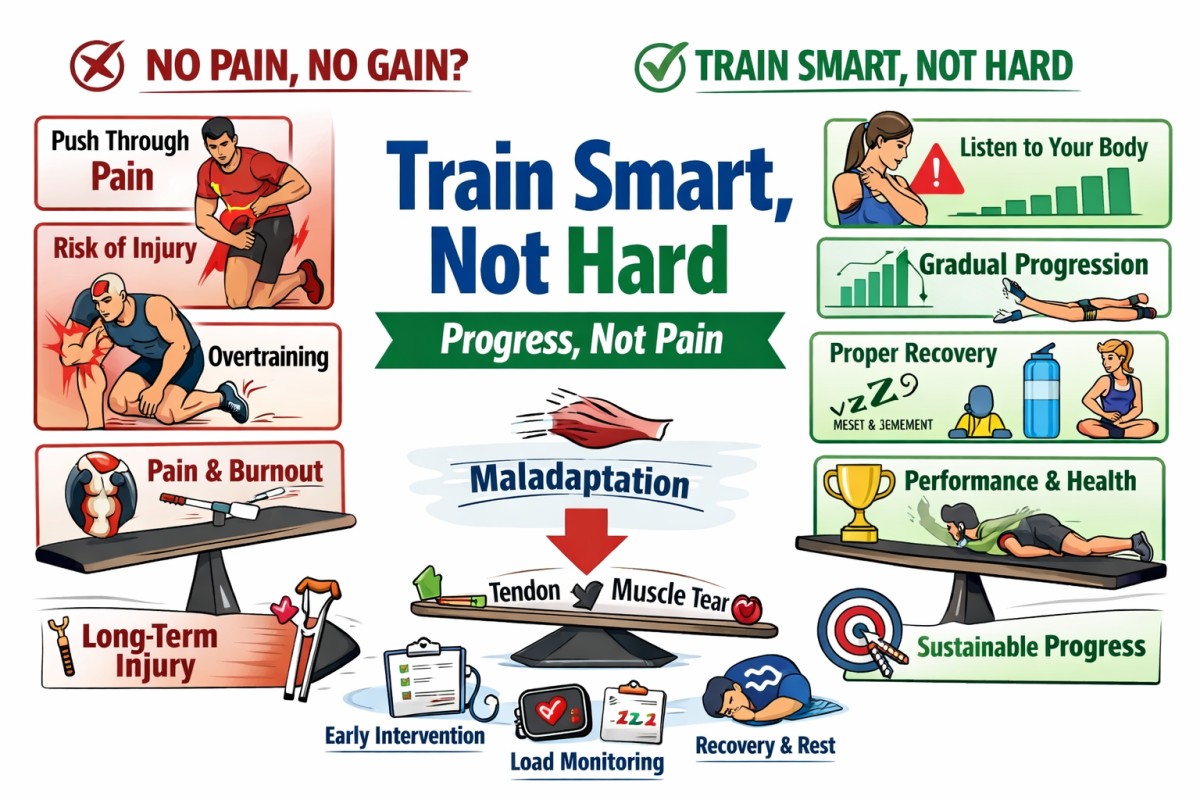
The long-standing gym slogan “No Pain No Gain” is increasingly being challenged by sports medicine experts, who warn that the phrase encourages unsafe training behaviour and preventable injuries across both professional and recreational sport. Once treated as a motivational badge of honour, pain is now widely recognized by physiotherapists and performance specialists as a signal that requires interpretation — not blind endurance.
Across training centers, school sports programs, and amateur fitness communities, clinicians report a steady rise in overuse injuries linked to aggressive, pain-driven training habits. Tendon irritation, stress reactions, muscle tears, and joint overload are frequently traced back to athletes pushing through warning symptoms rather than adjusting workload.
Sports physiotherapists emphasize a key distinction that is often misunderstood: discomfort and pain are not the same. Training discomfort — such as muscle fatigue, breathlessness, or temporary soreness — is a normal adaptation response. Pain that alters movement, sharpens with repetition, or persists after recovery windows is different. It suggests tissue stress exceeding tolerance.
Medical professionals note that the body adapts to load only when stress is applied within recoverable limits. When load consistently exceeds recovery capacity, performance declines instead of improving. This pattern, known as maladaptation, is now considered one of the main drivers of chronic sports injuries.
In recent years, rehabilitation data has also shown that athletes who ignore early pain signals tend to require longer recovery periods later. What begins as minor tendon soreness can progress into tendinopathy. A manageable muscle strain can become a significant tear if repeatedly stressed. The short-term “gain” often turns into long-term training loss.
Coaches and conditioning experts are also revising their language. Many now promote “progressive overload with feedback” instead of pain-based motivation. Monitoring tools — including workload tracking, movement quality assessment, and recovery markers — are increasingly used to guide training intensity. The goal is measurable progress, not suffering.
Another concern is the psychological effect of pain-glorifying culture on young athletes. Youth players, eager to prove commitment, may hide symptoms to avoid appearing weak or losing selection opportunities. Sports health professionals warn that this mindset increases injury risk during critical growth and development years, when tissues are more vulnerable to load spikes.
Elite sport has already moved away from pain-driven ideology. High-performance programs now focus on efficiency, biomechanics, and recovery science. Training success is measured by output consistency and injury-free availability — not by how much pain an athlete can tolerate.
Research in exercise science supports this shift. Studies on strength and endurance adaptation show that structured progression, adequate sleep, and recovery intervals produce better performance outcomes than repeated maximal-effort sessions performed through pain. In fact, excessive pain during training often correlates with reduced neuromuscular control, which further increases injury probability.
Clinicians recommend a simple guideline: pain that changes technique, reduces force, or lingers beyond 48 hours deserves evaluation and load modification. Early intervention — not stubborn persistence — is now considered the smarter athletic response.
The slogan that once fueled locker-room motivation is steadily being replaced by a more evidence-based message: train hard, but train intelligently. Sustainable performance is built on adaptation, not punishment.
