
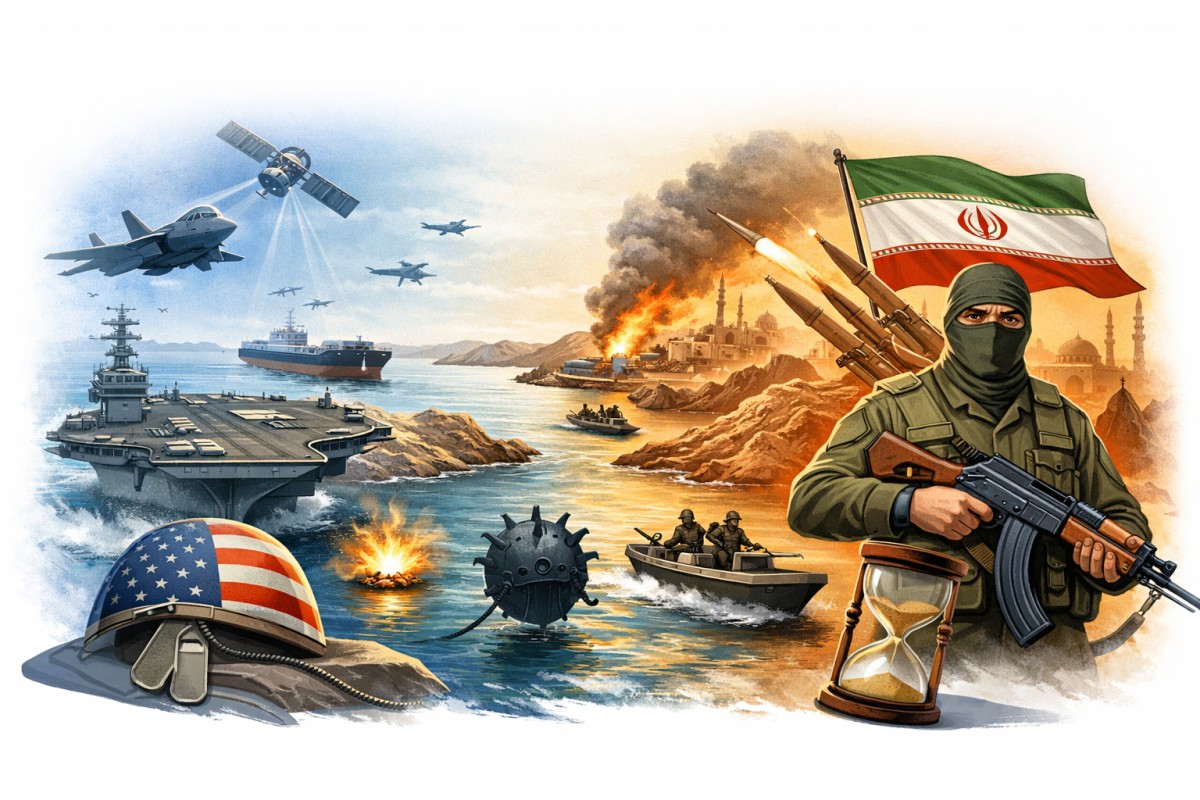
Military power often looks invincible from a distance. Satellites, stealth aircraft, precision missiles, aircraft carriers, and command rooms glowing with digital maps create the illusion of total control. Yet history has always been less obedient than military theory.
Wars are rarely won by machines alone. Geography, patience, political fatigue, economic vulnerability, and human unpredictability often enter the battlefield quietly, only to become decisive later. That reality is once again visible in the tense and dangerous equation surrounding Iran.
The United States possesses the most technologically advanced military system in the world. Its strike capability remains unmatched; its ability to project force across continents is the product of decades of strategic investment, industrial capacity, and military doctrine. Yet superiority in firepower does not automatically produce political victory. In Iran, America confronts a difficulty that no military budget can easily erase: a battlefield shaped by narrow sea lanes, asymmetric tactics, domestic political caution, and strategic limits that technology alone cannot overcome.
The narrow waters of Strait of Hormuz explain much of this tension. Barely a few dozen miles wide at its narrowest point, this passage carries roughly one-fifth of globally traded oil, making it one of the most sensitive arteries of the world economy. Even limited disruption here sends immediate tremors through shipping insurance, fuel prices, freight costs, and financial markets. Geography, in this case, becomes more powerful than rhetoric.
Iran understands this reality deeply.
Unlike conventional military powers that seek dominance through open confrontation, Tehran has spent years refining a strategy built not around conquest, but around calibrated disruption: drones, sea mines, coastal missile batteries, proxy networks, and pressure designed to create uncertainty rather than outright battlefield victory. Iran does not need to defeat America militarily; it needs only to make every military success politically expensive.
This is where American strength becomes strangely fragile.
A missile launched from a destroyer may cost millions of dollars. A drone sent in response may cost a fraction of that. Intercepting repeated low-cost threats with expensive systems creates what military analysts increasingly call the arithmetic of exhaustion — a battlefield where the stronger power slowly pays more to preserve order than the weaker side pays to disturb it.
The imbalance is not merely tactical; it is psychological.
Iran’s strategy reflects an understanding that modern superpowers often struggle not against enemy firepower, but against prolonged uncertainty. America can destroy targets, but it cannot easily eliminate the economic consequences of remaining engaged in an open-ended regional confrontation.
This exposes a deeper weakness — one not found in weapons systems, but in political endurance.
For decades, American military doctrine has assumed that overwhelming force can break strategic resistance. Yet recent history tells a more sobering story. Iraq and Afghanistan remain enduring reminders that removing targets is easier than constructing political outcomes. Regimes can survive bombardment; narratives of resistance often become stronger under pressure.
Iran presents an even more layered challenge because it combines nationalism, ideology, strategic depth, and regional influence. Pressure weakens infrastructure, but often strengthens internal narratives of survival.
Beyond weapons lies leadership.
Modern war unfolds under immediate public scrutiny. Every strike now travels instantly through screens: damaged infrastructure, frightened children, burning ports, interrupted medicine supplies, displaced families, anxious markets. Strategic calculations made in command rooms eventually collide with human images no government can fully control.
The world hears terms like deterrence, maritime security, strategic response, and calibrated escalation. But ordinary people experience war differently: fuel shortages, delayed medicines, rising food prices, interrupted work, fear at night, uncertainty by morning.
A superpower may dominate skies and seas, yet still struggle to dominate consequences.
America’s deeper challenge in Iran is not simply geography or asymmetric warfare. It is that Washington increasingly seeks the results of decisive victory without accepting the political cost of prolonged commitment. Air power appears safer than occupation. Sanctions appear cleaner than invasion. Precision strikes appear manageable compared to ground war.
But this middle path often produces neither resolution nor peace.
It creates suspended conflict — enough force to inflame, not enough clarity to conclude.
This is why casualty aversion, while morally understandable, has strategic consequences. American leadership knows that public tolerance for body bags, prolonged deployments, and uncertain outcomes has sharply narrowed. Its adversaries know this too. They understand that if conflict can be stretched economically, psychologically, and politically, even a stronger military begins to feel constrained.
And perhaps that is the most uncomfortable truth modern powers resist:
Military hardware cannot compensate for political hesitation, strategic inconsistency, or leadership that mistakes pressure for vision.
No aircraft carrier can permanently silence geography.
No missile can instantly produce political wisdom.
No drone can replace deep understanding of history, culture, and regional psychology.
Even leadership errors become magnified in such environments. Friendly-fire incidents, operational miscalculations, and unintended civilian suffering are not merely battlefield events; they become symbols of strategic overconfidence. Behind every military statistic stand families, soldiers, hospital wards, mourning households, and silent civilian costs rarely visible in official language.
That is why some of Washington’s hardest limitations are not military at all — they are political, moral, and institutional.
American leadership must balance every action against oil prices, allied hesitation, domestic elections, stock market reactions, diplomatic credibility, and public fatigue. A prolonged Gulf crisis never remains regional; it enters households across continents through inflation, energy anxiety, and market instability.
And still, Iran’s greatest strength may simply be patience.
It understands that geography cannot be relocated, that maritime chokepoints do not disappear, and that time often pressures democracies more than authoritarian systems.
The real strength of great nations may not lie only in how forcefully they can strike, but in how honestly they understand where force stops working. Because when power reaches a narrow sea and meets a patient adversary, even giants discover that some weaknesses cannot be bombed away.
